
Key takeaways:
- Geopolitical realignment – which we have identified as a key macro driver for the past few years – continues to have broad implications globally and is one of the most prominent themes on investors’ minds.
- Artificial intelligence (AI) is also a central theme, with focus now shifting from hyperscalers to how other companies and sectors will be impacted by – and benefit from – the continued growth of AI.
- These macro trends play into our experience as active managers and provide opportunities for us to deliver innovative solutions for our clients.
IMPORTANT INFORMATION
Actively managed portfolios may fail to produce the intended results. No investment strategy can ensure a profit or eliminate the risk of loss.
Artificial intelligence (“AI”) focused companies, including those that develop or utilize AI technologies, may face rapid product obsolescence, intense competition, and increased regulatory scrutiny. These companies often rely heavily on intellectual property, invest significantly in research and development, and depend on maintaining and growing consumer demand. Their securities may be more volatile than those of companies offering more established technologies and may be affected by risks tied to the use of AI in business operations, including legal liability or reputational harm.
Derivatives can be more volatile and sensitive to economic or market changes than other investments, which could result in losses exceeding the original investment and magnified by leverage.
Equity‑linked notes (ELNs) are structured obligations whose value is derived from an equity or equity index. ELNs may be difficult to value or sell, may lack active secondary markets, and may not fully participate in equity market gains. Because ELNs are unsecured obligations of issuing banks or broker‑dealers, investors are exposed to issuer credit risk and may experience losses if the issuer becomes unable or unwilling to meet its obligations. Many ELNs contain call features that can terminate future coupon payments and require reinvestment at less favorable terms.
Equity securities are subject to risks including market risk. Returns will fluctuate in response to issuer, political and economic developments.
Fixed income securities are subject to interest rate, inflation, credit and default risk. The bond market is volatile. As interest rates rise, bond prices usually fall, and vice versa. The return of principal is not guaranteed, and prices may decline if an issuer fails to make timely payments or its credit strength weakens.
High-yield or “junk” bonds involve a greater risk of default and price volatility and can experience sudden and sharp price swings.
Securitized products, such as mortgage- and asset-backed securities, are more sensitive to interest rate changes, have extension and prepayment risk, and are subject to more credit, valuation and liquidity risk than other fixed-income securities.
Definitions
Cost of goods sold refers to the direct costs associated with producing the goods a company sells, excluding indirect expenses such as distribution and sales costs.
Credit Spread is the difference in yield between securities with similar maturity but different credit quality. Widening spreads generally indicate deteriorating creditworthiness of corporate borrowers, and narrowing indicate improving.
Derivatives are financial instruments for which the price is derived from one or more underlying assets such as shares, bonds, commodities or currencies. It is a contract between two or more parties which allows investors to take advantage of price movements in the asset(s). Futures, options and swaps are all example of derivatives.
Dispersion: The extent to which a distribution of data points is stretched or squeezed. If the data points cluster around certain values, then dispersion is low, whereas if they are more spread out, then dispersion is high. For example, dispersion in stocks measures the range of returns for a group of stocks. Higher dispersion opens up opportunities for stock pickers to outperform by selecting the winners and avoiding the losers, given that stock returns are spread more widely on either side of the benchmark.
S&P 500® Index reflects U.S. large-cap equity performance and represents broad U.S. equity market performance.
Selling, General, and Administrative (SG&A) expenses are a company’s indirect operating costs, such as rent, marketing, and executive salaries, that are not directly tied to producing goods or services.
Tokenization: The process of converting ownership of real-world assets into digital tokens that can be traded on a blockchain.
Volatility measures risk using the dispersion of returns for a given investment.
View transcript
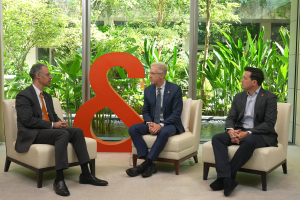
Ali Dibadj: Hey everybody, it’s Ali Dibadj. We’re here at the Milken Conference in Los Angeles. I’m really pleased to have with me Seth Meyer, our Global Head of Client Portfolio Management. Seth, great to have you.
Seth Meyer: Thanks for having me.
Dibadj: So, we’ve been really busy over the past couple of days together. You’ve been going to a lot of sessions. What are some of the main takeaways that you’re hearing from the conference?
Meyer: I think it’s probably not that surprising, right, when you think about what are investors thinking about, what’s on their minds. You’ve been talking about this for a couple of years: the geopolitical realignment, what that means globally. The onshore, near shore, whatever you want to describe, shore theme, that is obviously prevalent in shortening supply chains and/or moving everything locally, what that’s doing for inflation, how that’s impacting inflation. And even more importantly, as you think about the dislocations we’re having worldwide, how that’s impacting oil prices with the unfortunate war that’s happening in Iran and what that means, whether or not that’s going to be sustainable or not as we look forward.
Secondarily, you can’t go to a conference breakout session without hearing about AI. Everything is about AI. The interesting part about the conversations now are not so much about the building out of the infrastructure, although that’s obviously a conversation, and what it means from a data center perspective, but how that’s going to start impacting other businesses. So, clearly, we have the picks and shovels, if you will, with the hyperscalers and the buildout that we’re seeing there. But what’s probably been most promising, at least from the conversations I’ve been having, is what this is meaning for other companies.
So, what that should mean from an active manager perspective is more opportunity for us to be picking winners. It won’t be about buying an S&P 500® Index in order to win over the next few years. At least it sounds that way. It’s going to be identifying those sectors and industries that are really going to benefit from both those themes that we were just describing, the geopolitical realignment, and how that continues to play out. And then even more importantly, or maybe not, would be how AI starts impacting these companies.
Dibadj: So, if you take a step back and you think about geopolitical changes [that] are going on, AI and the way people talk about AI – which by the way, I think people talk too much from our perspective of what we’re doing at Janus Henderson on a cost side as opposed to a growth side; we’re much more on the growth side of things. But if you pull all that stuff together, where do you think the opportunities are to invest?
Meyer: Yeah, I still think as you start identifying sort of the AI themes, and you’re right, Ali, I think the investors’ minds tend to go to the cost of goods sold line, the SG&A [Selling, General, and Administrative] line, and how AI is going to impact that. I think it’s more important to start thinking about revenue benefits from AI, identifying the right client at the right time, the right product with the right solution. AI, I think, is really going to transform not only perhaps the asset management industry, but many multiple industries. You’re starting to see, obviously, we’re seeing the buildout impact areas like power and utilities and materials and the unfortunate, the war in Iran, as I mentioned earlier, impacting energy prices. So, all of this is starting to create this opportunity where it won’t be about the largest [companies]; it will be about identifying the other 493 out of that S&P 500 that are going to outperform. I think that’s one obvious theme.
The second one that we’re starting to see is M&A. So, you’re starting to see, this year should be a record year if things hold and volatility markets kind of dampen back down. But that M&A theme is really starting to resonate in specific areas of the market. And I don’t expect that to really, when you think about it, slow down from that perspective.
On the fixed income side, we’re starting to see some interesting opportunities with securitized assets. We’ve really been a believer of kind of the corporate bond spread tightening, translating in what we should see in the securitized market as well. That theme has continued, and we continue to see some opportunities in securitized assets.
Finally, in fixed, I think what you’re going to have to start being is a little bit more nimble. Think about April of last year when spreads widened as aggressively as they did in the high yield market. It felt like it was a 12-day move that you can actually take advantage of it, or maybe a 14-day trade. That’s really where you need a multi-sector manager to take advantage of those market dislocations. You can’t really go back to your investment committee, have a vote, agree on allocating to the high-yield capital market, and have the trade be gone in 12 or 14 days. So, I think those type of responses are more common, or we expect them to be more common, which should lend itself for a multi-sector type broad strategy on the fixed income side.
Dibadj: So, whether it be on the equity side, public or private, or on the fixed income side, public or private for us as well, one of the themes that we keep hearing as well here is one of dispersion, increased dispersion, which really allows us and the 350 people across the firm that actually spend their whole days trying to find positive places to invest and negative places to avoid or short, there’s a real opportunity for us to deliver for our clients. Now, one of the things that we’ve done, and you’ve been driving a lot of this at Janus Henderson with the rest of your team, is around innovation. What do you think innovation from a product perspective is going to look like over the next little while for our clients, or the real opportunities that we can deliver for our clients?
Meyer: Yeah, it’s a great question, because I think what clients are asking from us is way different than it was 10 years ago. Really seeking solutions, really seeking answers to their problems, not just another product to sort of fill a void. It’s about how you can help me deal with an inflationary issue, how you can help me deal with broadening of markets and how AI is going to impact different sectors.
There are some innovative ways that we can think about delivering solutions and products to clients. Simple ways are some of the things like equity-linked notes, income opportunities that really weren’t available to clients, or the way they were thinking about them, maybe a couple years ago. Derivative income. So, super simple ways to generate a little bit more income for clients but still give them some equity exposure. Model delivery: how we do that, what’s different about it, and how clients are seeking really different solutions when it comes to that. Tokenization: another way that I think clients are really kind of dialing in to what we’re doing here at Janus Henderson, what it means for them. And then finally, just broadly, the ETF franchise. It’s just a vehicle and a wrapper that isn’t necessarily new, but clients are demanding more from that.
So, it’s been a really exciting time in the asset management industry. I think that would have been probably an oxymoron to say 10 years ago with development and product innovation. But right now, I think clients are just demanding a little bit more, so you have to be creative in your solution.
Dibadj: It’s one of the things that we’re clearly seeing from Milken. Some of the themes around geopolitical change or change with AI or other things really allow active asset managers like Janus Henderson to deliver for our clients. And many of them are here at Milken. It was great to see them.
We’re happy to follow up with folks as well. And as I mentioned earlier, 350 people at Janus Henderson spend all days, and all nights, frankly, sometimes, delivering for you, our clients. And we try to do that to deliver another word that comes up at Milken a lot: resilience. Resilience in this very volatile day and age. So, thanks very much for listening. If you have any questions, please follow up.
Related insights
All opinions and estimates in this information are subject to change without notice and are the views of the author at the time of publication. Janus Henderson is not under any obligation to update this information to the extent that it is or becomes out of date or incorrect. The information herein shall not in any way constitute advice or an invitation to invest. It is solely for information purposes and subject to change without notice. This information does not purport to be a comprehensive statement or description of any markets or securities referred to within. Any references to individual securities do not constitute a securities recommendation. Past performance is not indicative of future performance. The value of an investment and the income from it can fall as well as rise and you may not get back the amount originally invested.
Whilst Janus Henderson believe that the information is correct at the date of publication, no warranty or representation is given to this effect and no responsibility can be accepted by Janus Henderson to any end users for any action taken on the basis of this information.