
Key takeaways:
- AI demand is running well ahead of supply, a mismatch we believe will persist for the foreseeable future.
- Frontier large language models (LLMs) continue advancing while agentic AI is rapidly broadening use cases across industries, reinforcing our view that this technology cycle has considerably more runway.
- We maintain focus on AI infrastructure companies operating in critical bottlenecks – compute, cooling, power management, and memory – where we see strong earnings visibility and potential for continued positive revisions.
The persistence of AI as an investment theme has been on full display so far this year. The PHLX Semiconductor Sector Index (SOX) is up 46.9% year to date versus the broader S&P 500® Index’s 4.8% gain, and 17 of the 20 top-performing stocks in the S&P 500 this year are tied to the AI buildout.1
The performance of companies within the AI supply chain reflects the early, still-accelerating adoption of these technologies – and we believe the cycle has considerably more runway.
The supply side of AI cannot keep up
Part of the volatility in AI-related markets over the past few years stemmed from concerns about the magnitude of new supply coming online: new chips, new data centers, new cloud infrastructure. The market’s attention was focused on supply additions and the potential for a capacity glut.
But our conversations with companies across the AI ecosystem point to a more important reality: Supply at nearly every layer of the stack, from memory to compute to power, still cannot keep pace with demand. The constraints in many cases appear structural, not cyclical, and are only increasing.
Unlike typical market bubbles, which tend to form during periods of oversupply, the current AI landscape is defined by a persistent deficit. Alphabet’s leadership recently noted the company exited the year with more demand than available capacity, a sentiment echoed consistently by management teams across the industry.
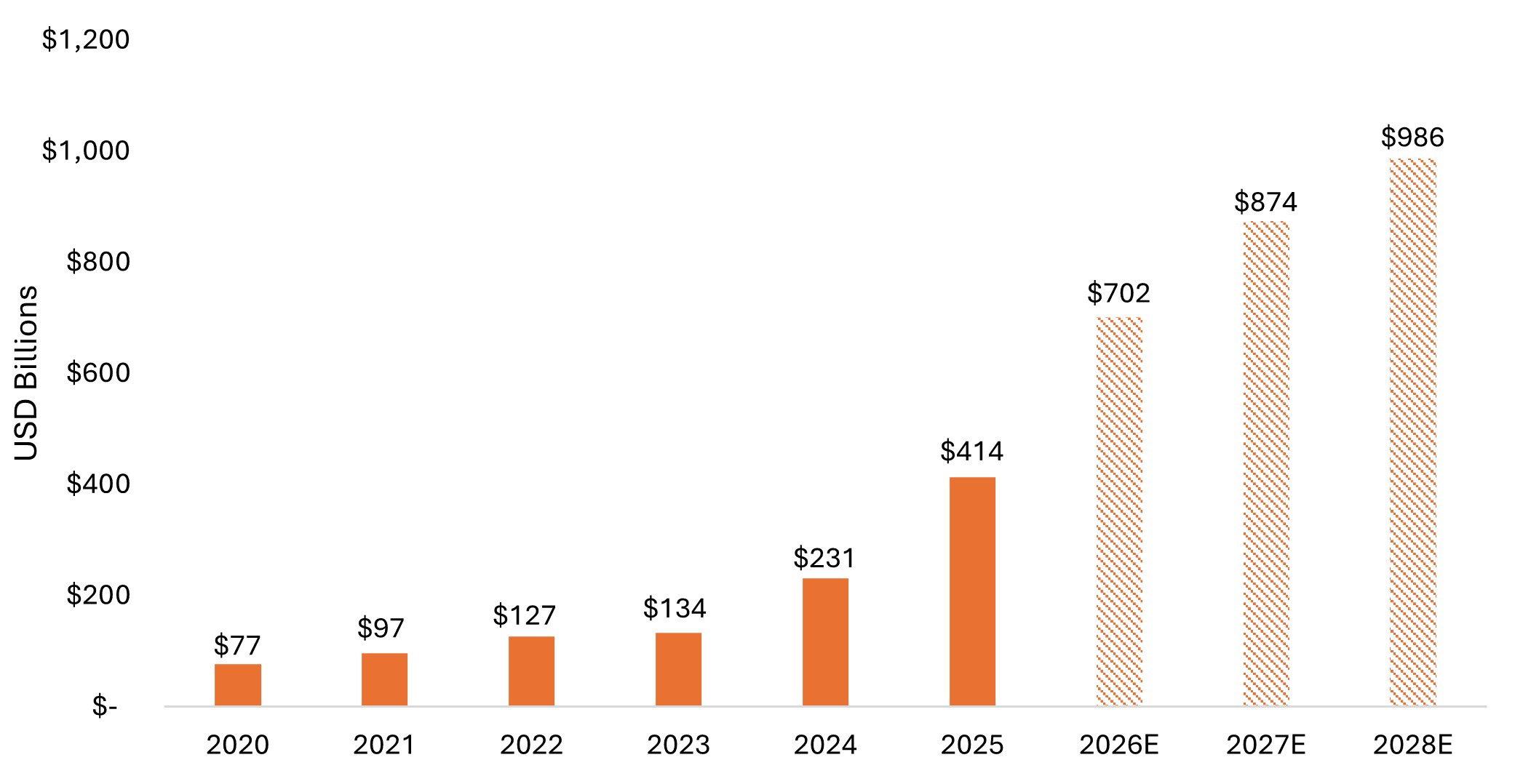
Hyperscalers are responding with record investment. Google, Microsoft, and Amazon are each materially increasing their 2026 capital expenditure plans to support AI infrastructure, with total hyperscaler spending on track to exceed $650 billion in 2026.
Exhibit 1: CapEx from the major AI hyperscalers: AWS, Alphabet, Meta, Microsoft, Oracle
Source: Bloomberg as at 23 April 2026. Data for 2026, 2027, and 2028 reflect estimates. References made to individual securities do not constitute a recommendation to buy, sell or hold any security, investment strategy or market sector, and should not be assumed to be profitable. Janus Henderson Investors, its affiliated advisor, or its employees, may have a position in the securities mentioned.
Model capabilities keep raising the ceiling
AI model performance also continues to improve. Scaling laws remain intact as frontier models from Google, OpenAI, and Anthropic continue to leapfrog each other. The models available today are far more useful and reliable than they were even a year ago, with testing showing fewer factual errors and expanding reasoning abilities.
Exhibit 2: Length of tasks AI agents can autonomously complete at 80% success, by model
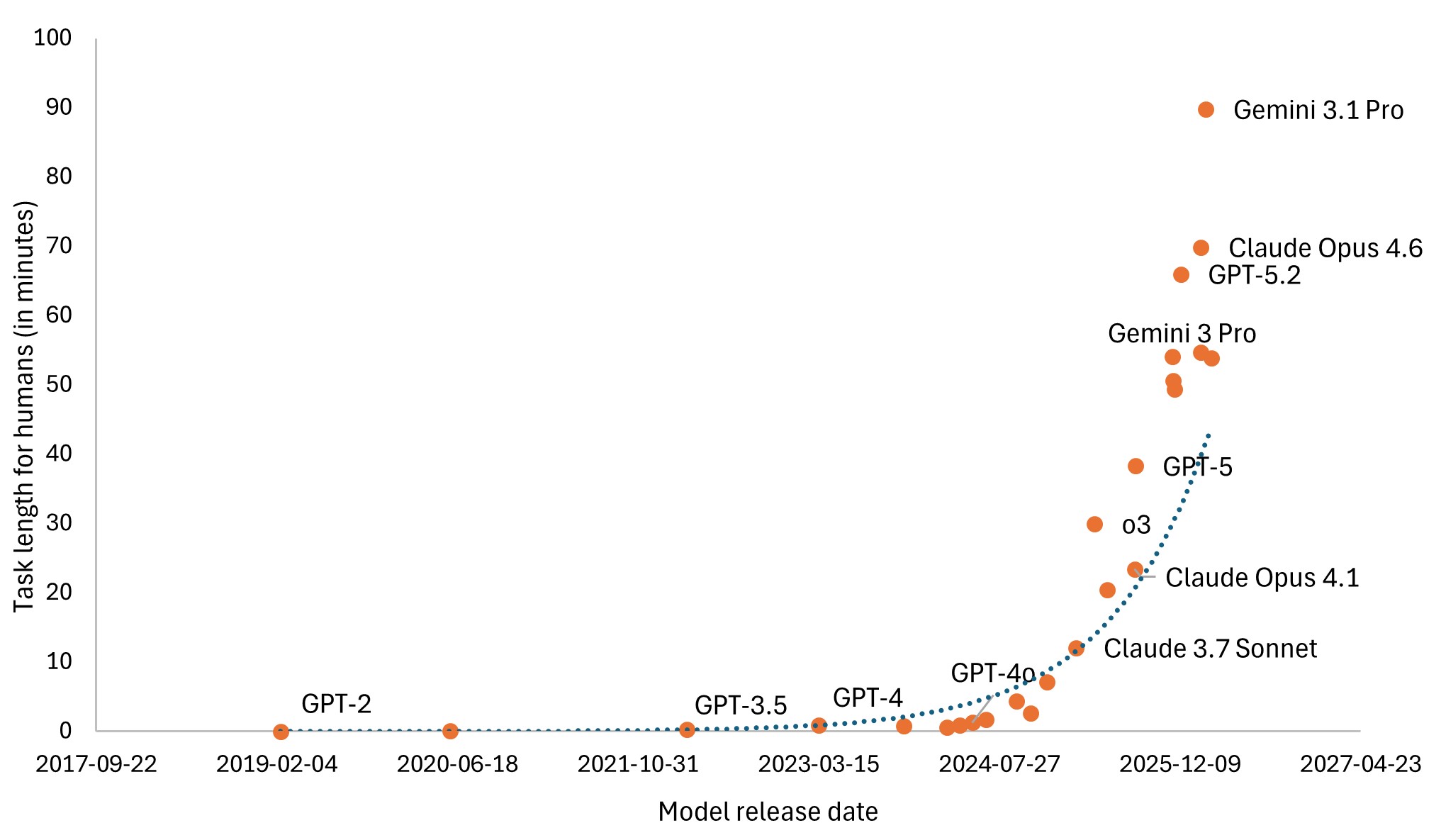
Source: METR. “Measuring AI Ability to complete long tasks”. The length of task (measured by how long they take skilled human professionals) that generalist frontier model agents can complete autonomously with 80% reliability.
We have moved far beyond simple chatbots. Amazon CEO Andy Jassy recently illustrated what agentic AI makes possible:
Normally, this sort of activity might take a team of 40 people about a year to carefully build. Instead, the Bedrock team spun up a separable group of six very skilled engineers who were excited about starting over and building on our agentic coding service (Kiro) and delivered this new engine (which we call “Mantle”) in 76 days.
– Andy Jassy, CEO Amazon (April 9, 2026)
The use cases continue to broaden and deepen. AI is transforming coding, workflows, and customer service at scale. Any rules-based task is a current or potential candidate for automation. Enterprise adoption is accelerating, and as AI capabilities mature, demand from consumer and personal intelligence applications is likely to generate another major wave. OpenAI’s recent decision to take its video-generation tool Sora offline to free up compute resources for coding applications is a telling indicator of demand intensity.
Exhibit 3: Businesses using AI in any business function, % of all firms reporting use of AI applications
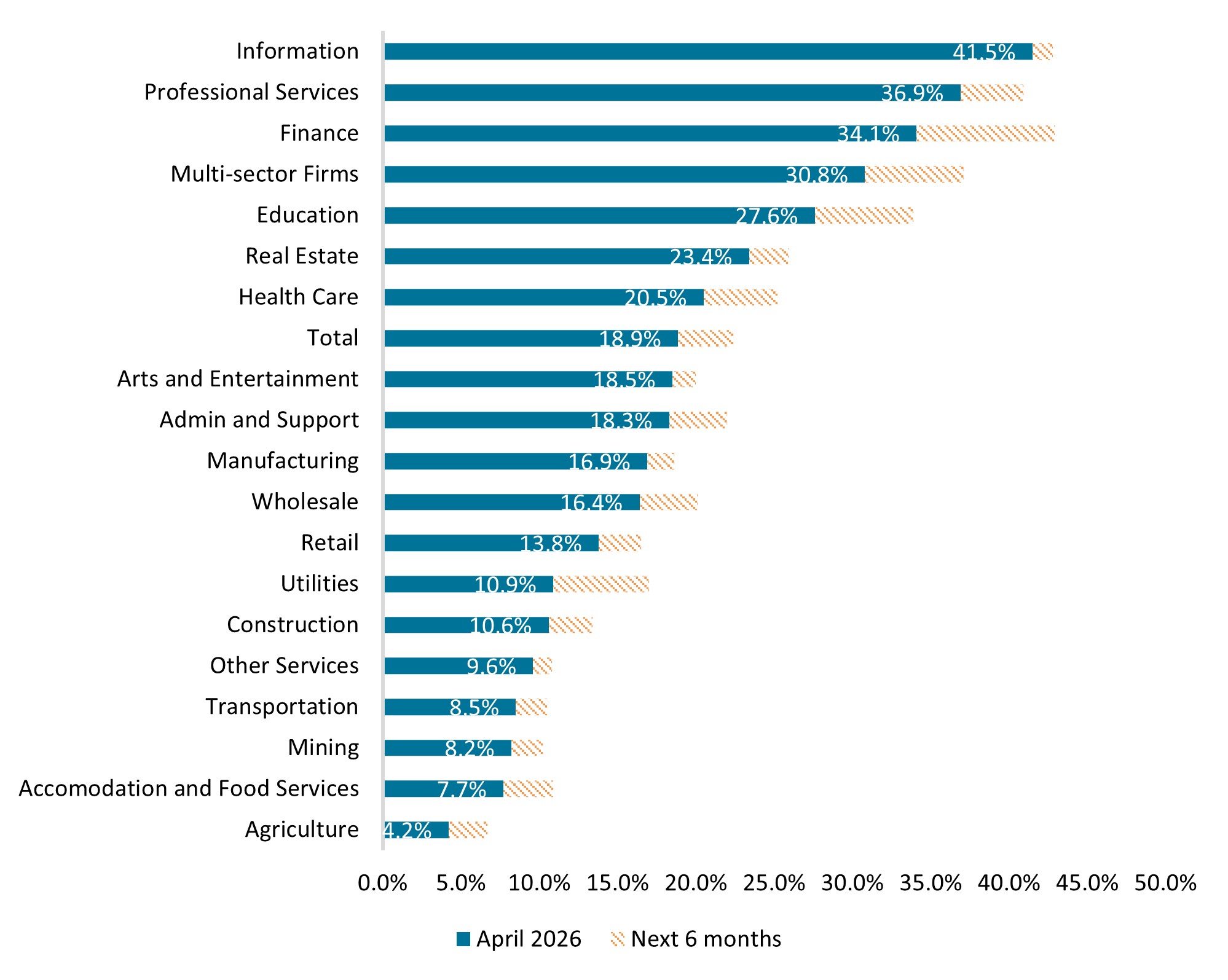
Source: Census Business Trends and Outlook Survey. Survey collection March 23 to April 5, 2026 referencing period March 9 to March 22, 2026.
Bottlenecks as an investment opportunity
To capture growth in AI, investors may look beyond mega-cap household names toward companies operating where supply is most constrained.
Bottlenecks span multiple layers of the infrastructure stack simultaneously. GPU rental prices are rising, not falling, even for prior-generation chips; this runs counter to what typically happens when newer generations arrive. Semiconductor capital equipment manufacturers have reported orders well beyond estimates.
Memory has joined electrical power as a primary constraint for data center construction this year. One leading producer had sold out its entire 2026 production by October 2025 while another is seeing surging demand extending well into 2027.
Power generation is an additional pressure point, with data center energy needs expected to grow steeply through 2030. Optical connectivity and advanced cooling systems face further strain. Lead times for new capacity are long, and these constraints typically do not resolve quickly.
We are focused on businesses operating directly at the bottlenecks where capital investment shows no sign of slowing, particularly those with sustainable earnings growth visibility. That includes companies supplying semiconductors, cooling systems, energy-efficient power management, and rack systems to AI data centers.
Staying the course
Trends like AI often persist longer than markets expect. The deployment and adoption of new technologies take time to be fully appreciated by investors, and growth is not always linear. We believe the inevitable volatility along the way is a natural part of any major technological shift.
Areas of opportunity may change along the way, but for the foreseeable future, demand for AI compute appears set to exceed supply. Companies positioned at the intersection of this supply/demand imbalance have the potential to compound growth across economic cycles, outpacing short-term expectations – a phenomenon we believe is occurring today.
1 Source: Bloomberg, as of 27 April 2026.
Volatility measures risk using the dispersion of returns for a given investment.
S&P 500® Index reflects U.S. large-cap equity performance and represents broad U.S. equity market performance.
The PHLX Semiconductor Sector Index (SOX) is a specialized, modified market capitalization-weighted index that tracks the performance of 30 U.S.-listed companies primarily engaged in the design, distribution, manufacture, and sale of semiconductors.
IMPORTANT INFORMATION
Artificial intelligence (“AI”) focused companies, including those that develop or utilize AI technologies, may face rapid product obsolescence, intense competition, and increased regulatory scrutiny. These companies often rely heavily on intellectual property, invest significantly in research and development, and depend on maintaining and growing consumer demand. Their securities may be more volatile than those of companies offering more established technologies and may be affected by risks tied to the use of AI in business operations, including legal liability or reputational harm.
These are the views of the author at the time of publication and may differ from the views of other individuals/teams at Janus Henderson Investors. References made to individual securities do not constitute a recommendation to buy, sell or hold any security, investment strategy or market sector, and should not be assumed to be profitable. Janus Henderson Investors, its affiliated advisor, or its employees, may have a position in the securities mentioned.
Past performance does not predict future returns. The value of an investment and the income from it can fall as well as rise and you may not get back the amount originally invested.
The information in this article does not qualify as an investment recommendation.
There is no guarantee that past trends will continue, or forecasts will be realised.
Marketing Communication.
Important information
Please read the following important information regarding funds related to this article.
- Shares can lose value rapidly, and typically involve higher risks than bonds or money market instruments. The value of your investment may fall as a result.
- Shares of small and mid-size companies can be more volatile than shares of larger companies, and at times it may be difficult to value or to sell shares at desired times and prices, increasing the risk of losses.
- High exposure to a particular country or geographical region carries a higher level of risk than a more broadly diversified portfolio.
- Derivatives may be used with the aim of reducing risk or managing the portfolio more efficiently. However, this introduces other risks, in particular, that a derivative counterparty may not meet its contractual obligations.
- If the Fund holds assets in currencies other than the base currency of the Fund, or you invest in a share/unit class of a different currency to the Fund (unless hedged, i.e. seeks to mitigate exchange rate movements between the share/unit class currency and the base currency of the Fund), the value of your investment may be impacted by changes in exchange rates.
- When the Fund, or a share/unit class, seeks to mitigate exchange rate movements of a currency relative to the base currency (hedge), the hedging strategy itself may positively or negatively impact the value of the Fund due to differences in short-term interest rates between the currencies.
- Securities could become hard to value or to sell at a desired time and price, especially in extreme market conditions when asset prices may be falling, increasing the risk of investment losses.
- The performance of the Fund is not expected to precisely match the performance of the index at all times and the deduction of fees and expenses means the Fund might deliver a lower total return than the index.
- Losses could be incurred if a counterparty became unwilling or unable to meet its obligations, or as a result of failure or delay in operational processes or the failure of a third party provider.