
Key takeaways:
- Higher yields do not automatically make longer-duration bonds attractive, as persistent inflation, resilient growth, and heavy debt issuance could maintain upward pressure on yields in the near term.
- Adding duration requires a change in conditions – not just a target Treasury yield. We would look for multiple market signals to turn before taking on more interest rate exposure.
- We continue to favor a lower-duration stance for now, emphasizing carry and limiting drawdown risk, while retaining the flexibility to add duration for potential returns and portfolio defense when conditions shift.
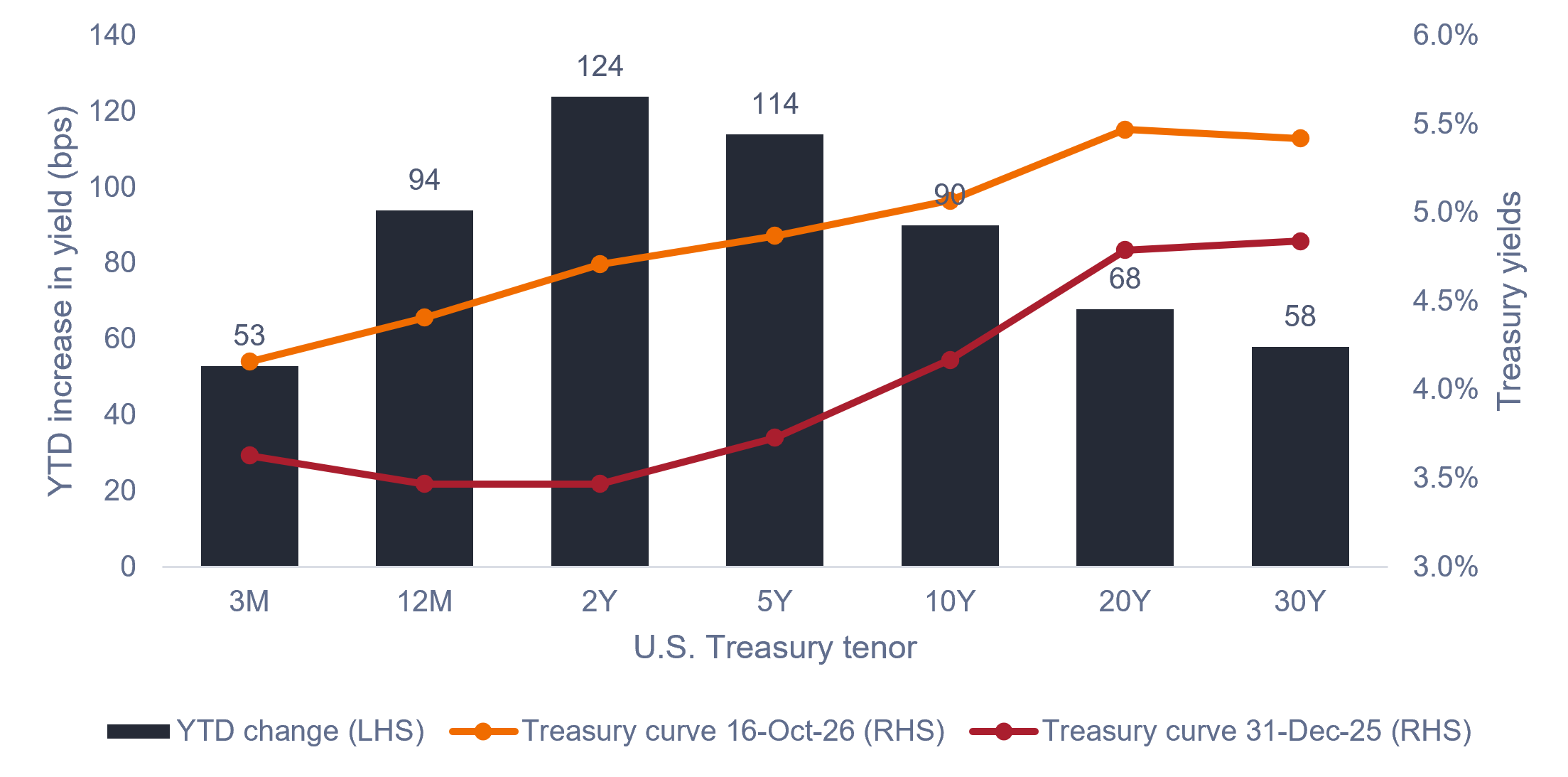
The word “whipsaw” probably best describes how government bond yields have behaved so far in 2026. We started off the year with expectations for three-to-four rate cuts and watched as the 10-year U.S. Treasury yield rallied to under 4% in March. Since then, yields have moved sharply higher, with futures markets now pricing in three rate hikes.
The about-turn stems from multiple conspiring factors, including higher energy prices and reaccelerating inflation due to the Iran War, strong U.S. corporate earnings, robust economic growth on the back of the artificial intelligence (AI) infrastructure buildout, heavy government and corporate debt issuance, large fiscal deficits and deteriorating government finances, and a more hawkish and less communicative Federal Reserve (Fed).
Exhibit 1: Year-to-date changes in U.S. Treasury yields
Yields have risen sharply across the curve in 2026.
Source: Bloomberg, as of 16 October 2026. Past performance does not predict future returns.
It goes without saying that the aggressive move up in yields has resulted in a bumpy ride for some fixed income investors – notably for anyone who has not been underweight duration or parked on the short end of the yield curve.
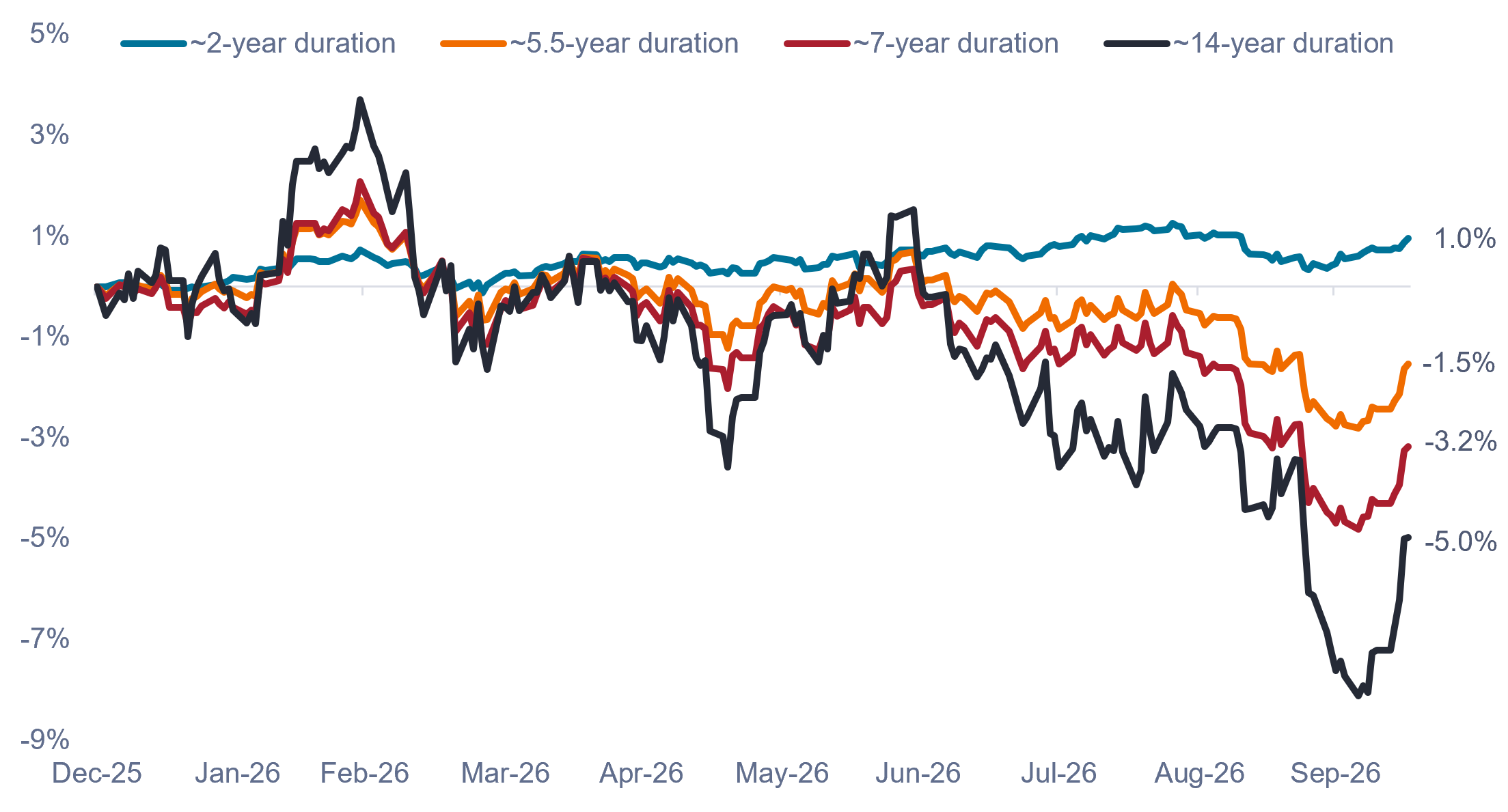
As is to be expected, longer-duration assets have suffered greater negative price movements compared to shorter-duration bonds, as shown in Exhibit 2.
Exhibit 2: Year-to-date returns for U.S. Treasury indices of varying duration
Duration has not been your friend in 2026.
Source: Bloomberg, as of 16 October 2026. Indices used to represent Treasury returns: ~2-year duration = Bloomberg U.S. Treasury: 1-3 Year Index, ~5.5-year duration = Bloomberg U.S. Treasury Index, ~7-year duration = Bloomberg U.S. Treasury 7-10 Year Index, ~14-year duration = Bloomberg U.S. Long Treasury Index. Past performance does not predict future returns.
Despite short-duration assets outperforming thus far in 2026, many investors are now asking when duration will be worth owning again. For some, the answer to that question hinges on a specific number, such as “6% on the 10-year Treasury”, which is the point at which 37% of fund managers in Bank of America’s October Global Fund Manager Survey said they would shift equities to bonds.
In our view, the decision is more nuanced: One must pay attention to the key themes driving bond markets and then watch for signals of a shift in those themes. Exhibit 3 breaks down the key signals we are paying attention to and what might precipitate a shift to adding duration.
Exhibit 3: Duration decision dashboard
Only once multiple signals begin to turn does the case for adding duration become more compelling.
| Signal | Stay underweight | Move toward neutral / add duration |
| Fed | Incremental tightening ✓ |
Aggressive, credibility-restoring tightening |
| Employment | Resilient labor market ✓ |
Sustained deterioration in claims and payrolls |
| Inflation | Sticky or reaccelerating ✓ |
Persistent, broad-based disinflation |
| Oil / Iran | Supply risk remains ✓ |
Durable resolution and falling oil prices |
| Risk assets | Equities resilient; spreads contained ✓ |
Material equity declines and spread widening |
| Growth | Economy remains resilient ✓ |
Clear evidence of material deceleration |
Source: Janus Henderson Investors, as of 16 October 2026.
For now, we believe the risks to longer-maturity yields are likely to persist, potentially with more volatility to come. Given these risks, we continue to favor a less volatile, lower-duration position that maximizes income per unit of risk by emphasizing carry while limiting drawdown risks and exposure to rate-sensitive assets.
While being underweight duration has made sense in 2026, a true active manager is prepared to adjust duration positioning to capture potential returns and add portfolio defense when conditions warrant a change. We continue to monitor the signals and stand ready to adjust our duration approach if, and when, the signals begin to turn.
IMPORTANT INFORMATION
Actively managed portfolios may fail to produce the intended results. No investment strategy can ensure a profit or eliminate the risk of loss.
Artificial intelligence (“AI”) focused companies, including those that develop or utilize AI technologies, may face rapid product obsolescence, intense competition, and increased regulatory scrutiny. These companies often rely heavily on intellectual property, invest significantly in research and development, and depend on maintaining and growing consumer demand. Their securities may be more volatile than those of companies offering more established technologies and may be affected by risks tied to the use of AI in business operations, including legal liability or reputational harm.
Credit spread risk is the potential for a financial loss on a debt security due to a widening of the spread (difference in yield) between that security and a risk-free benchmark, such as a U.S. Treasury bond. It represents changes in market value caused by increased market perception of credit risk, distinct from the actual risk of borrower default.
Diversification neither assures a profit nor eliminates the risk of experiencing investment losses.
Fixed income securities are subject to interest rate, inflation, credit and default risk. The bond market is volatile. As interest rates rise, bond prices usually fall, and vice versa. The return of principal is not guaranteed, and prices may decline if an issuer fails to make timely payments or its credit strength weakens.
Index performance does not reflect the expenses of managing a portfolio as an index is unmanaged and not available for direct investment.
The 10-Year Treasury Yield is the interest rate on U.S. Treasury bonds that will mature 10 years from the date of purchase.
Basis point (bp) equals 1/100 of a percentage point. 1 bp = 0.01%, 100 bps = 1%.
Carry is the income or return generated from holding a position over time, excluding changes in its market price.
Credit Spread is the difference in yield between securities with similar maturity but different credit quality. Widening spreads generally indicate deteriorating creditworthiness of corporate borrowers, and narrowing indicate improving.
Duration measures a bond price’s sensitivity to changes in interest rates. The longer a bond’s duration, the higher its sensitivity to changes in interest rates and vice versa.
U.S. Treasury securities are direct debt obligations issued by the U.S. Government. With government bonds, the investor is a creditor of the government. Treasury Bills and U.S. Government Bonds are guaranteed by the full faith and credit of the United States government, are generally considered to be free of credit risk and typically carry lower yields than other securities.
Volatility measures risk using the dispersion of returns for a given investment.
A yield curve plots the yields or interest rates of government bonds that have equal credit quality but different maturity dates.
These are the views of the author at the time of publication and may differ from the views of other individuals/teams at Janus Henderson Investors. References made to individual securities do not constitute a recommendation to buy, sell or hold any security, investment strategy or market sector, and should not be assumed to be profitable. Janus Henderson Investors, its affiliated advisor, or its employees, may have a position in the securities mentioned.
Past performance does not predict future returns. The value of an investment and the income from it can fall as well as rise and you may not get back the amount originally invested.
The information in this article does not qualify as an investment recommendation.
There is no guarantee that past trends will continue, or forecasts will be realised.
Marketing Communication.
Important information
Please read the following important information regarding funds related to this article.
- An issuer of a bond (or money market instrument) may become unable or unwilling to pay interest or repay capital. If this happens or the market perceives this may happen, the value of the bond will fall.
- When interest rates rise (or fall), the prices of different securities will be affected differently. In particular, bond values generally fall when interest rates rise (or are expected to rise). This risk is typically greater the longer the maturity of a bond investment.
- The Fund may incur a higher level of transaction costs as a result of investing in less actively traded or less developed markets compared to a fund that invests in more active/developed markets.
- While high yield (non-investment grade) bonds generally offer higher rates of interest than investment grade bonds, they are more speculative and more sensitive to adverse changes in market conditions.
- Asset-Backed Securities (ABS) and other forms of securitised investments may be subject to greater credit / default, liquidity, interest rate and prepayment and extension risks, compared to other investments such as government or corporate issued bonds and this may negatively impact the realised return on investment in the securities.
- Some bonds (callable bonds) allow their issuers the right to repay capital early or to extend the maturity. Issuers may exercise these rights when favourable to them and as a result the value of the Fund may be impacted.
- High exposure to a particular country or geographical region carries a higher level of risk than a more broadly diversified portfolio.
- Derivatives may be used to help achieve the investment objective. This can result in leverage (higher levels of debt), which can magnify an investment outcome. Gains or losses may therefore be greater than the cost of the derivative. Derivatives also introduce other risks, in particular, that a derivative counterparty may not meet its contractual obligations.
- When the Fund, or a share/unit class, seeks to mitigate exchange rate movements of a currency relative to the base currency (hedge), the hedging strategy itself may positively or negatively impact the value of the Fund due to differences in short-term interest rates between the currencies.
- Securities could become hard to value or to sell at a desired time and price, especially in extreme market conditions when asset prices may be falling, increasing the risk of investment losses.
- Some or all of the ongoing charges and other costs of the Fund may be taken from capital, which may erode capital or reduce potential for capital growth.
- In addition to income, this share class may distribute realised and unrealised capital gains and original capital invested. Fees, charges and expenses are also deducted from capital. Both factors may result in capital erosion and reduced potential for capital growth. Investors should also note that distributions of this nature may be treated (and taxable) as income depending on local tax legislation.
- Losses could be incurred if a counterparty became unwilling or unable to meet its obligations, or as a result of failure or delay in operational processes or the failure of a third party provider.