
Key takeaways:
- After years of low interest rates, bond markets are once again offering attractive levels of income. However, uncertainty around inflation, central bank policy and the future path of interest rates raises questions about how long today’s yields will remain available.
- Investors who are satisfied with current bond yields face a dilemma: future yields could move either higher or lower depending on economic and policy developments. This makes decisions around income generation increasingly dependent on uncertain interest-rate outcomes.
- A fixed maturity bond portfolio can help investors secure a known income stream and maturity profile, reducing reliance on accurately forecasting the direction of interest rates. It matters though how a fixed maturity portfolio is constructed.
Harvesting an attractive income for much of the last decade was challenging as low interest rates and correspondingly low bond yields led to slim pickings. In recent years there has been more abundance, as the rise in yields that took place from mid-2022 saw a return to a more normal yield environment.
But will the higher yields last? It is a question many investors have asked themselves and explains the recent popularity of fixed maturity bond funds. These are vehicles that are designed to help lock in existing yields. A fixed maturity bond fund combines the core features of a single bond (regular predictable coupon and fixed maturity date) with the key benefits offered by a fund (diversification across many bonds, together with security selection and monitoring by investment professionals).
These have proved attractive to investors in recent years and as inflation receded from its cyclical peak investors in shorter-dated bonds have typically benefited from positive real yields (i.e. yields that have been above inflation), helping to maintain purchasing power as seen in Italy, for example (Figure 1). Many fixed maturity bond portfolios are structured with terms of around three years to maturity, so Figure 1 uses asset classes and indices that have relatively short durations (between 2 to 3 ½ years).
Figure 1: Italian inflation and yields on European bonds
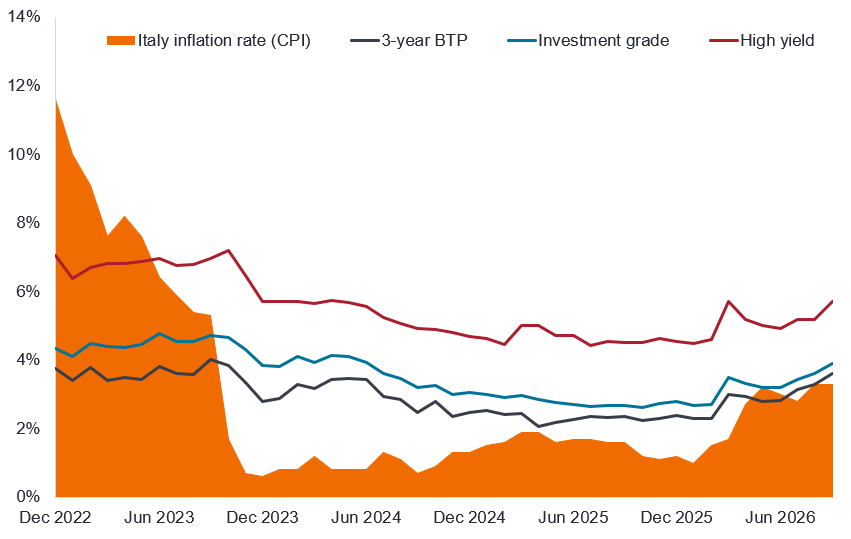
Source: Bloomberg, Italy inflation rate (consumer price index), year-on-year % change, 3-year BTP: Bloomberg generic 3-year Italian government bond, Euro investment grade: ICE BofA 1-3 Year BBB Euro Corporate Index, Euro high yield: ICE BofA BB-B Euro High Yield Index, yield to worst, 31 December 2022 to 15 September 2026. Yield to worst is the lowest yield a bond can achieve provided the issuer does not default and accounts for any applicable call feature (i.e. the issuer can call the bond back at a date specified in advance. Yields may vary over time and are not guaranteed.
Inflation expectations
Inflation in Italy rose early in summer on the back of the fallout from the Middle East conflict but it has since been hovering around 3%. For investors in fixed maturity bond portfolios, the preference would clearly be for inflation not to rise much from here since they would benefit from inflation falling as their fixed yields are more valuable in purchasing power terms.
While the European Central Bank (ECB) has raised rates twice this year to support a return to its 2% inflation target over time, consumers are more sanguine. The ECB conducts a survey of European consumers and in recent months respondents have lowered their expectations for where inflation will be over the next 12 months and the coming three years, with consumers expecting inflation to be below 3% over both time periods (Figure 2).
Figure 2: Inflation expectations have been heading lower
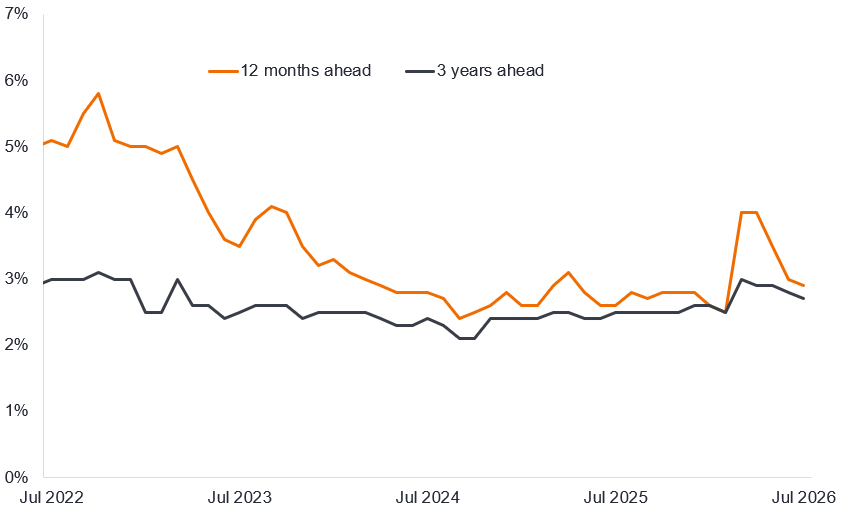
Source: ECB Consumer Expectations Survey Results – July 2026, released 21 August 2026. There is no guarantee that past trends will continue, or forecasts will be realised.
Rates uncertainty
We have noted before that the ECB was early in responding to higher inflation, with potentially further rate increases to come if energy prices remain high.1 It is not clear, whether the ECB could be making the same error they made back in 2011, when they raised rates into an energy price spike, only to have to reverse course six months later as the economy slowed. There has already been a recent uptick in Eurozone unemployment.
We also got some more colour around the thinking of Kevin Warsh, the new Chairman of the US Federal Reserve (Fed). At his Jackson Hole speech back in August, he explicitly reaffirmed the Fed’s inflation objective of 2%. More recently, the unanimous decision to raise interest rates by 25 basis points at the Fed’s policy meeting in September demonstrated a firm commitment to control inflation, boosting the Fed’s credibility with markets and removing any doubt about the Fed’s independence on setting monetary policy. While the rate hike will likely contribute to tighter financial conditions, it could actually lead to lower inflation/interest rates beyond the near term.
Corporate strength
One of the most notable factors of recent months has been the strength of corporate earnings. In the US, earnings on the S&P500 (the 500 largest-listed companies in the US) rose 52% year-on-year in Q2 2026. In Europe, the figure was lower but even here earnings were estimated to be up almost 24% in Q2 2026 compared with the same period a year ago.2 Higher energy prices are of course problematic, but an assuaging factor is that margins are currently high enough for companies to absorb a fair amount of the pressure. As a result, corporate fundamentals remain supportive for credit investors. However, while the outlook for issuers appears resilient, uncertainty around the future path of interest rates remains.
For investors, the key question then is not only whether corporate fundamentals remain supportive, but also whether current yields represent an attractive level of income to lock in. A fixed maturity bond portfolio is specifically designed to provide investors with a stable and relatively predictable level of income over a set investment period. This naturally involves a trade-off. Should interest rates fall, the income generated by the portfolio is expected to remain steady. Conversely, if rates rise, investors are unlikely to capture the full benefit of those higher market yields.
When evaluating a fixed maturity bond portfolio, investors should consider whether the current yield meets their income objectives over the investment horizon. Provided they are satisfied with that yield, fluctuations in interest rates become less significant, since the investment is intended to maintain an income stream close to today’s levels.
Different approaches, same goal
There are differences though in fixed income maturity portfolios, as there are various ways to construct them. One way is to create a portfolio of corporate bonds with maturities that are close to the maturity date. Another is to create a portfolio of corporate bonds synthetically using government bonds as a base, overlaid with credit default swaps (derivatives that can help generate additional income and offset risk, allowing a portfolio manager to express a view on a corporate bond). Both methods have their merits. The first is less complex but requires careful cash management as the maturity date approaches. The second involves more structuring work but can offer better alignment with the maturity date. Either method is ultimately seeking to deliver a regular level of income for investors.
Credit discipline
In our view, fixed maturity portfolios need to be built around a clear maturity date, income profile and risk budget and not simply be a static basket of bonds. Credit losses could potentially endanger the level of income paid out, so it is important to employ a management team with deep credit expertise and who can respond to changing circumstances. This is where a management team with experience in constructing and managing this type of portfolio is key. A global research footprint can help source the best opportunities, which may mean including high yield alongside investment grade to exploit price inefficiencies and enhance yield. The result is a more selective, conviction-led approach to income generation. In a market where European growth remains uncertain and credit dispersion is likely to persist, this matters to overall performance.
For investors content with current bond yields and keen to have a degree of certainty over the income their portfolio generates and a known maturity date, we believe a fixed maturity bond portfolio may offer a compelling proposition.
1Source: Bloomberg, World Interest Rate Projections, 16 September 2026.
2Source: LSEG, S&P500 Earnings Scorecard, 28 August 2026, STOXX 600 Earnings Outlook, 27 August 2026.
Fixed income securities are subject to interest rate, inflation, credit and default risk. The bond market is volatile. As interest rates rise, bond prices usually fall, and vice versa. The return of principal is not guaranteed, and prices may decline if an issuer fails to make timely payments or its credit strength weakens.
High-yield or “junk” bonds involve a greater risk of default and price volatility and can experience sudden and sharp price swings.
Asset allocation: The process of dividing investments among different asset classes such as equities, bonds and cash to help achieve specific investment objectives.
Bond: A debt security issued by a government, company or other organisation that typically pays a fixed rate of interest and repays principal at maturity.
Bond yield: The income return on a bond expressed as a percentage of its market price.
Central bank: An institution responsible for managing a country’s monetary policy, interest rates and money supply.
Corporate bond: A bond issued by a company to raise capital from investors.
Corporate earnings: The profits generated by a company over a specified period.
Corporate fundamentals: The financial and operational characteristics of a company, including earnings, cash flow, leverage and balance sheet strength, used to assess creditworthiness.
Coupon: The regular interest payment made by a bond issuer to investors.
Credit default swap (CDS): A derivative contract that transfers the credit risk of a borrower from one party to another in exchange for a premium payment.
Credit dispersion: The variation in valuations, credit spreads or performance among issuers, sectors or credit-quality segments within the bond market.
Credit loss: A loss resulting from a borrower’s failure to make interest or principal payments as required.
Credit risk: The risk that a borrower will fail to meet its financial obligations.
Derivative: A financial instrument whose value is derived from the performance of an underlying asset, index or security.
Diversification: A way of spreading investments across different securities, sectors or asset classes to help reduce risk.
Duration: A measure of a bond’s sensitivity to changes in interest rates.
European Central Bank (ECB): The central bank responsible for monetary policy across the euro area.
Fixed income: An asset class that typically provides regular payments and includes investments such as government and corporate bonds.
Fixed maturity bond portfolio: A portfolio of bonds constructed to mature at, or close to, a specified future date while seeking to provide a defined income profile over the investment period.
Forward guidance: Communication by a central bank about the likely future direction of monetary policy to help shape market expectations.
Government bond: A debt security issued by a national government to finance public spending.
High yield bond: A bond rated below investment grade that typically offers a higher yield to compensate for greater credit risk.
Income: The payments received from an investment, such as bond coupons or dividends.
Inflation: The rate at which the prices of goods and services rise over time, reducing purchasing power.
Inflation expectations: Estimates or perceptions regarding the future rate of inflation.
Investment grade bond: A bond considered to have a relatively low risk of default based on assessments by credit rating agencies.
Issuer: The government, company or organisation that creates and sells a security to raise capital.
Maturity: The date on which a bond’s principal is scheduled to be repaid.
Monetary policy: The actions taken by a central bank to influence inflation, economic activity and financial conditions.
Purchasing power: The amount of goods and services that can be bought with a given amount of money.
Real yield: The return on an investment after adjusting for inflation.
Risk budget: The amount of risk a portfolio is permitted to take in pursuit of its investment objectives.
Yield to worst: The lowest potential yield a bond can achieve, assuming the issuer does not default and taking into account any applicable call features.
These are the views of the author at the time of publication and may differ from the views of other individuals/teams at Janus Henderson Investors. References made to individual securities do not constitute a recommendation to buy, sell or hold any security, investment strategy or market sector, and should not be assumed to be profitable. Janus Henderson Investors, its affiliated advisor, or its employees, may have a position in the securities mentioned.
Past performance does not predict future returns. The value of an investment and the income from it can fall as well as rise and you may not get back the amount originally invested.
The information in this article does not qualify as an investment recommendation.
There is no guarantee that past trends will continue, or forecasts will be realised.
Marketing Communication.
Important information
Please read the following important information regarding funds related to this article.
- An issuer of a bond (or money market instrument) may become unable or unwilling to pay interest or repay capital. If this happens or the market perceives this may happen, the value of the bond will fall.
- When interest rates rise (or fall), the prices of different securities will be affected differently. In particular, bond values generally fall when interest rates rise (or are expected to rise). This risk is typically greater the longer the maturity of a bond investment.
- While high yield (non-investment grade) bonds generally offer higher rates of interest than investment grade bonds, they are more speculative and more sensitive to adverse changes in market conditions.
- Some bonds (callable bonds) allow their issuers the right to repay capital early or to extend the maturity. Issuers may exercise these rights when favourable to them and as a result the value of the Fund may be impacted.
- If the Fund holds assets in currencies other than the base currency of the Fund, or you invest in a share/unit class of a different currency to the Fund (unless hedged, i.e. seeks to mitigate exchange rate movements between the share/unit class currency and the base currency of the Fund), the value of your investment may be impacted by changes in exchange rates.
- Derivatives may be used to help achieve the investment objective. This can result in leverage (higher levels of debt), which can magnify an investment outcome. Gains or losses may therefore be greater than the cost of the derivative. Derivatives also introduce other risks, in particular, that a derivative counterparty may not meet its contractual obligations.
- When the Fund, or a share/unit class, seeks to mitigate exchange rate movements of a currency relative to the base currency (hedge), the hedging strategy itself may positively or negatively impact the value of the Fund due to differences in short-term interest rates between the currencies.
- Securities could become hard to value or to sell at a desired time and price, especially in extreme market conditions when asset prices may be falling, increasing the risk of investment losses.
- Some or all of the ongoing charges and other costs of the Fund may be taken from capital, which may erode capital or reduce potential for capital growth.
- In addition to income, this share class may distribute realised and unrealised capital gains and original capital invested. Fees, charges and expenses are also deducted from capital. Both factors may result in capital erosion and reduced potential for capital growth. Investors should also note that distributions of this nature may be treated (and taxable) as income depending on local tax legislation.