


Key takeaways:
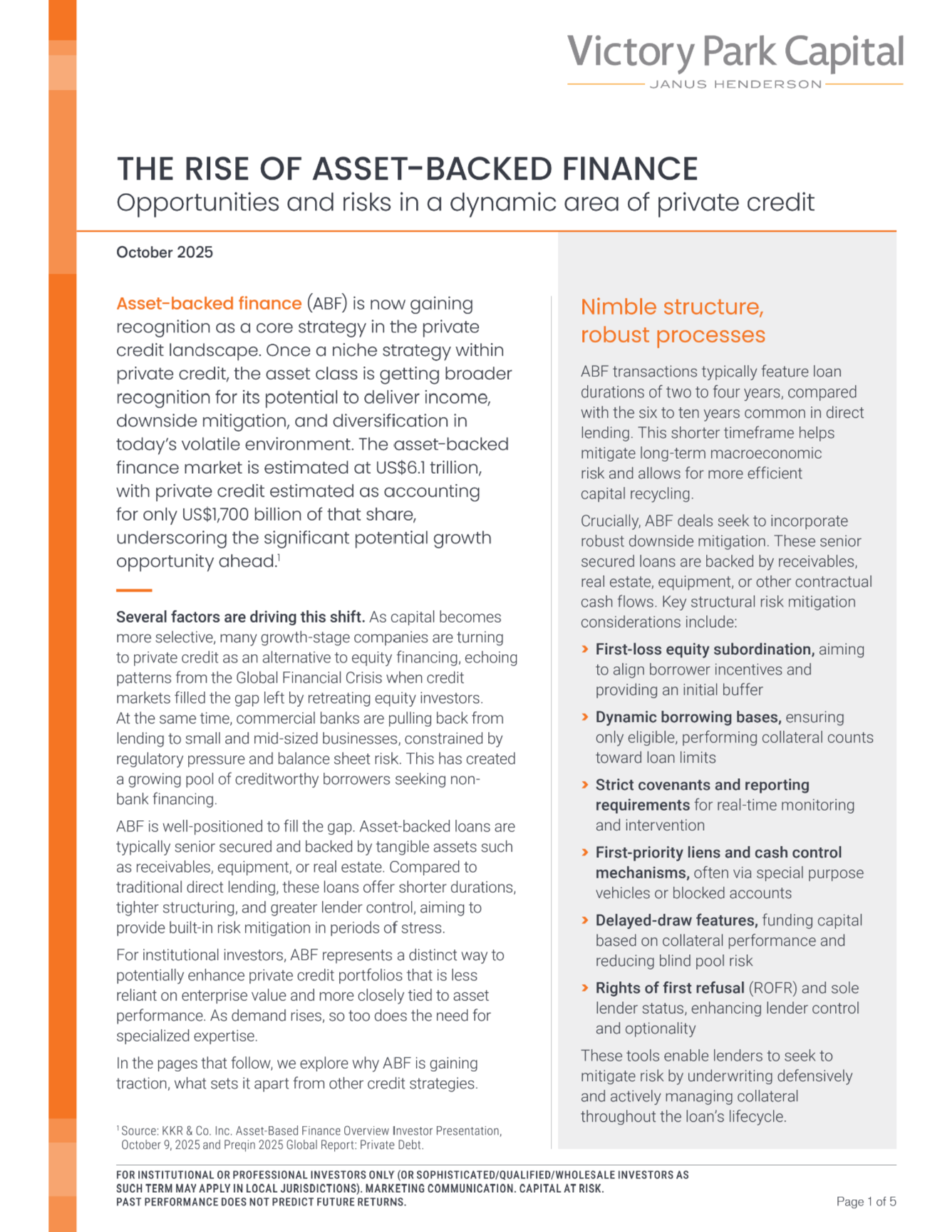
- Asset-backed finance (ABF) is now gaining recognition as a core strategy in the private credit landscape. The ABF market is estimated at US$6.1 trillion, with private credit estimated as accounting for only US$1.7 trillion of that share, underscoring the significant potential growth opportunity ahead.
- Once a niche strategy within private credit, ABF is getting broader recognition for its potential to deliver income, downside mitigation, and diversification in today’s volatile environment.
- For institutional investors, ABF represents a distinct way to potentially enhance private credit portfolios that is less reliant on enterprise value and more closely tied to asset performance. As demand rises, so too does the need for specialised expertise.
As capital becomes more selective, many growth-stage companies are turning to private credit as an alternative to equity financing, echoing patterns from the Global Financial Crisis when credit markets filled the gap left by retreating equity investors. At the same time, commercial banks are pulling back from lending to small and mid-sized businesses, constrained by regulatory pressure and balance sheet risk. This has created a growing pool of creditworthy borrowers seeking non-bank financing.
ABF is well-positioned to fill the gap. Asset-backed loans are typically senior secured and backed by tangible assets such as receivables, equipment, or real estate. Compared to traditional direct lending, these loans offer shorter durations, tighter structuring, and greater lender control, aiming to provide built-in risk mitigation in periods of stress. ABF activity is linked to borrowers’ ability to originate or manage specific collateral, rather than M&A or sponsor activity. This characteristic provides a different profile across market cycles, making ABF an effective diversifier within private credit portfolios.
1 Source: KKR & Co. Inc. Asset-Based Finance Overview Investor Presentation, October 9, 2025 and Preqin 2025 Global Report: Private Debt.
*Source: VPC at September 30, 2025
IMPORTANT INFORMATION
This paper is provided for educational and informational purposes only. The contents hereof should not be construed as investment, legal, tax or other advice. Unless otherwise noted, statements contained in this white paper are based on current expectations, estimates, projections, opinions and beliefs of VPC professionals regarding general market activity, trends and outlook as of the date hereof. Such statements involve known and unknown risks and uncertainties, and undue reliance should not be placed thereon. Neither VPC nor any of its affiliates makes any representation or warranty, express or implied, as to the accuracy or completeness of the information contained herein and nothing contained herein should be relied upon as a promise or representation as to past or future performance.
Asset-Backed Finance involves loans secured by assets, where the loan value is based on the value of the collateral offered. While it provides a security cushion, it carries risks such as collateral depreciation, borrower default, and potential liquidity constraints during market downturns.
Diversification neither assures a profit nor eliminates the risk of experiencing investment losses.
Any risk management process discussed includes an effort to monitor and manage risk which should not be confused with and does not imply low risk or the ability to control certain risk factors.
Private Credit refers to direct lending or debt financing outside of traditional banking, typically involving non-publicly traded companies. It may offer higher returns but comes with increased risk including limited liquidity, reliance on the borrower’s financial health, and less regulatory oversight compared to traditional bank lending.
Victory Park Capital Advisors, LLC, an SEC registered investment adviser, is an indirect subsidiary of Janus Henderson. Registration with the SEC does not imply a certain level of skill or training.
Definitions
Duration measures a bond price’s sensitivity to changes in interest rates. The longer a bond’s duration, the higher its sensitivity to changes in interest rates and vice versa.
A facility refers to a structured lending arrangement that provides a borrower with access to capital, typically secured by specific assets and governed by defined terms.
Senior Secured Loan: A loan that is backed by collateral and holds priority over other debts in case of borrower default.
Special Purpose Vehicles: A subsidiary created by a parent company for a specific business goal, such as financing or asset securitization, to isolate financial risk from the parent entity.