
Key takeaways:
- Not all CCCs are alike: performing credits can offer attractive yields and potentially improving fundamentals, creating opportunities for investors able to distinguish viable borrowers from distressed credits.
- The economic backdrop remains supportive with robust levels of nominal growth that can help companies grow revenues and deleverage, but investors should favor borrowers with sufficient interest coverage to withstand higher rates.
- Refinancing risk makes selectivity critical as looming maturity walls can expose weaker CCC borrowers, favoring rigorous credit selection and a keen understanding of a borrower’s operating environment and the covenants attached to a bond.
You may recall that in our previous article “Looking under the hood: Differentiating between CCC high yield bonds” we previously split the CCC cohort between those bonds that we viewed as highly distressed and those we saw as potentially performing.
Credit spreads are the difference in yield between a high yield corporate bond and a government bond of similar maturity. For the more distressed bonds, we are not convinced that spreads reflect the likely reduction in principal value of debt in these structures.
Exhibit 1: CCC spreads split into distressed and performing cohorts (basis points)
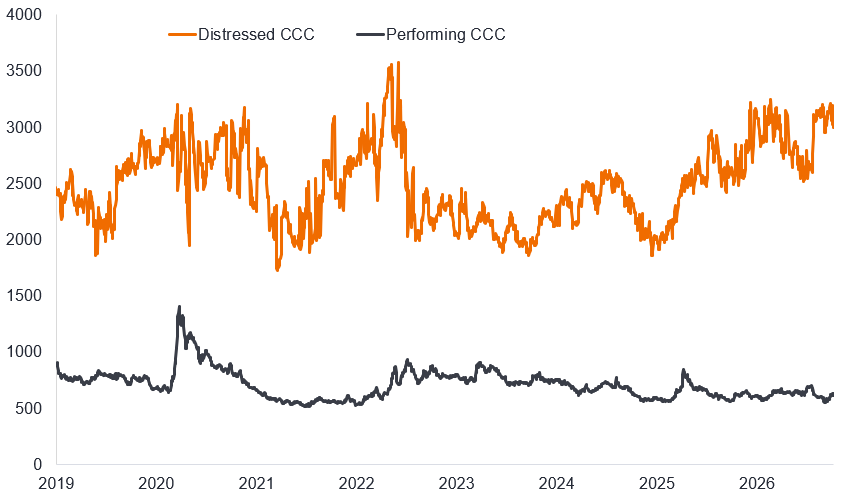
Source: Janus Henderson, Harbour, Bloomberg, Bloomberg US Corporate High Yield Index, option-adjusted spreads (OAS), daily market value weighted OAS for US HY CCC-or-below constituents split by price: distressed = bonds trading below $60 (out of face value of $100) and performing = bonds trading above $60. Bonds trading at exactly $60 are excluded from the two price cohorts. Data from 1 January 2019 to 7 October 2026. Past performance does not predict future returns.
We believe the likelihood of default among some of the distressed portion of CCC is high. As a result, holders could either receive a haircut on the par value of their debt or engage in a lengthy period of restructuring, which could result in coupon payments being turned off and low recovery values.
Spread as a risk trade-off
Conversely, within the performing cohort we believe there are opportunities to invest in improving credits that are engaged in deleveraging and offer attractive risk-adjusted returns. These performing CCCs trade much more like the rest of the high yield market. Exhibit 2 shows that the spread on the performing CCC cohort currently averages around 635 basis points (bp), a spread pick up of around 330bp versus the broader high yield index. That means while yields on US high yield bonds average around 8.2% (US Treasury yield of around 4.9% + spread), the yield on performing CCCs is closer to 11.5% (based on the spreads in Exhibit 2).1
Exhibit 2: Spreads on performing CCC versus broad US high yield (basis points)
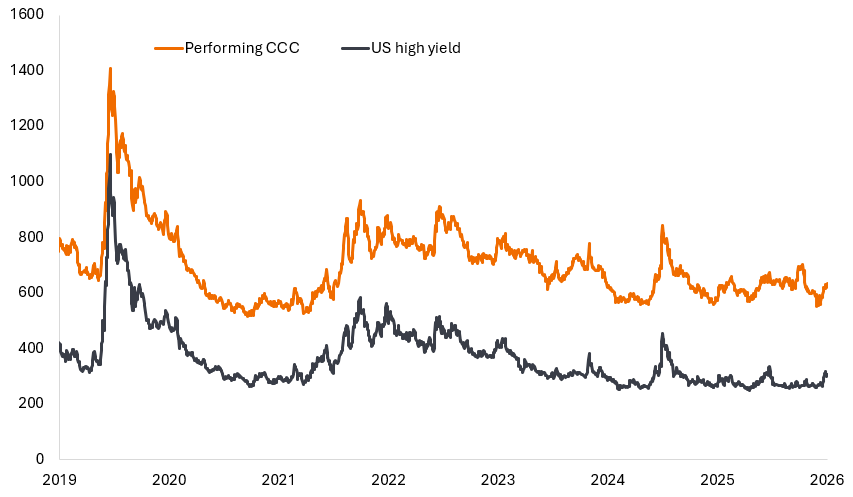
Source: Janus Henderson, Harbour, Bloomberg, Bloomberg US Corporate High Yield Index, option-adjusted spreads (OAS), daily market value weighted OAS for US High Yield and US High Yield CCC-or-below. Performing CCC = average spread on bonds trading above $60 within the CCC cohort. Broad US High Yield = average spread across all high yield ratings. Data from 1 January 2019 to 7 October 2026. Past performance does not predict future returns. Yields may vary over time and are not guaranteed.
Nominal growth offers support for performing bonds
In the performing cohort of CCC bonds, we believe conditions exist for most companies to operate without defaulting in the near term. This reflects both a macroeconomic and a fundamental view.
From an economic perspective, the current economic environment in the US appears favorable. Nominal growth is economic growth in monetary terms, i.e. unadjusted for inflation. We expect nominal gross domestic product (GDP) growth in the US to be in the 5% area over the coming year. This is a healthy amount of growth that allows companies to continue to drive revenue growth, achieve incremental margin improvement and grow into their capital structures, helping with deleveraging.
Exhibit 3: Nominal gross domestic product (GDP) growth (% change from year ago)
Shaded bands indicate recession periods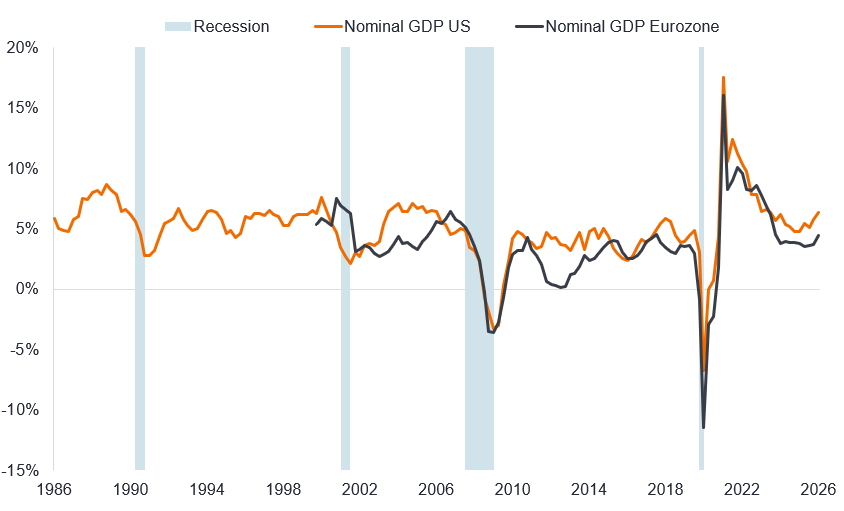
Source: US Bureau of Economic Analysis, nominal gross domestic product, Eurostat, Euro area gross domestic product, at market prices, quarterly datapoints, year-on-year % change, Q3 1986 to Q2 2026. Eurozone data starts at Q1 2000. Recession bands relate to periods where there was a recession in the US according to the National Bureau of Economic Research (NBER). Past performance does not predict future returns.
In Europe, growth is more uneven and has typically lagged the US. While there was evidence of an upturn in growth in the first half of 2026, recent purchasing manager index (PMI) data for the Eurozone, which is seen as a leading indicator of where the economy may be heading, weakened modestly in September and October, albeit still above the 50 level that indicates economic expansion. In contrast, the US and UK PMI data has remained buoyant over these months.2
A drawback of fairly robust growth is that it gives cover for central banks to pursue tighter monetary policy given recent inflationary pressures from supply shocks. With most developed market central banks raising interest rates, we need to identify capital structures that can weather a rising rate environment. This means making sure borrowers have sufficient interest coverage (earnings to meet interest payments), particularly if any rates-induced slowdown in the economy were to affect the borrower’s revenue and cash flow prospects.
Mindful of the maturity wall
A supportive growth environment is helpful, but it does not remove the biggest test for borrowing companies: whether they can refinance their debt.
CCC-rated debt often carries lower maturities. Partly, that is reflective of the fact that lenders are wary of lending over long periods to borrowers when there is less certainty around repayment, so longer dated bonds tend to be legacy. In the US, some 40% of CCC high yield bonds mature in the three years to 30 September 2029, which compares with just 23.9% of BB rated bonds and 25.5% of B rated bonds.3
In Europe, the weakest-rated cohort is more exposed than in the US, with 55% of CCC rated bonds facing maturity within three years, a figure that has generally been trending higher (see Exhibit 4).
Exhibit 4: Weakest rated issuers are most exposed to refinancing walls
% of EUR high yield maturing in less than three years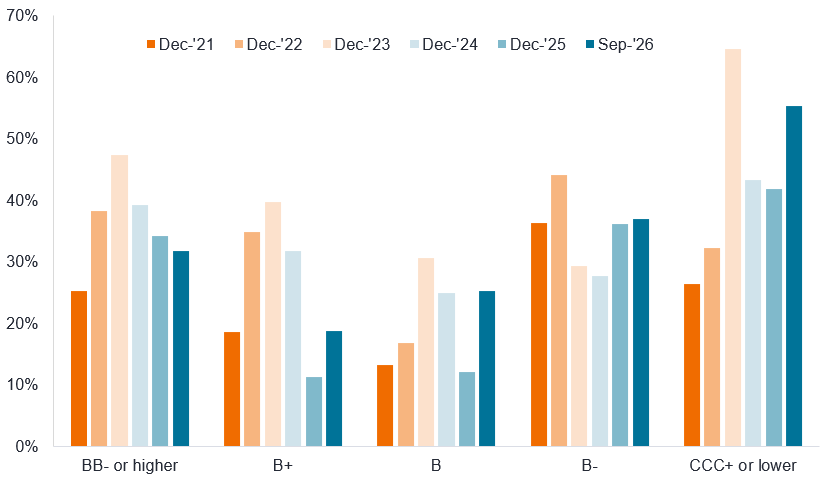
Source: Morgan Stanley Research, Bloomberg, ICE BofA Euro High Yield Index, 30 September 2026.
Maturity walls are the biggest hurdle that creates insolvency risk. When considering whether to invest in or hold credits rated CCC we believe it is important that the borrowing company has a runway for growth ahead of any maturity wall. By that we mean, some prospect of improving its financial position and crucially enough time to do so.
It is rare for bonds to be issued with a CCC rating at the outset, although it does happen, typically with bonds that are subordinate (lower-ranking) to other debt from the issuing entity or following a restructuring. For example, single B issuers may have lower-ranking debt that is a notch below their higher-ranking debt and therefore carries a CCC rating. For the most part, CCC-rated bonds have typically been downgraded from a higher rating, so investors are making a judgement on the ongoing creditworthiness of the borrower.
Risk management
It is this focus on assessing risk that is especially important for CCC-rated bonds. Investors need to apply the analytical rigor they would for any high yield bond but with even more focus. The capacity to generate cash to cover liabilities, the level of leverage (debt as a proportion of earnings) and other metrics need to be modelled, and stress tested under different scenarios.
By definition, companies with CCC-rated debt are more financially vulnerable, so it is especially important to look at areas such as collateral. What are the assets within the business? Are there signs of impairment? Do the covenants (the legally-binding rules applying to the bond) ensure that capital cannot be removed or key collateral stripped that might reduce recovery value? That is why another key factor to assess is management or sponsor (private equity owner) behavior. Do they have a reputation for being creditor-friendly or have they exhibited aggressive behavior in the past that could be of detriment to bondholders, such as excessive dividends or debt-fueled M&A?
All these considerations are more straightforward when a borrower is not facing secular decline. Advances in technology mean disintermediation is likely to accelerate. Artificial intelligence has already lowered the barriers to software development, potentially posing a risk to future high yield software cash flows. Satellite broadband could equally be disruptive to telecom-related sectors. As we noted earlier, there is plenty of economic growth taking place, so typically we would favor borrowers operating in areas that offer growth.
What lies beneath
Ultimately, the key is to achieve a deep understanding of the risks and opportunities in a credit. CCC offer large spreads relative to the wider high yield market but some of that spread is compensation for default losses. By taking a discriminatory approach to CCC and applying careful analysis investors can be in a stronger position to isolate those credits with the potential for improvement from those where default is an imminent risk. In doing so, investors can potentially capture the premium in an area of high yield that is often unloved and overlooked.
1Source: Spreads as per Exhibit 2, U.. Federal Reserve, U.S. Treasury yield taken from average of U.S. Treasury securities at 3-year and 5-year maturities, respectively 4.9% and 5.0%, at 7 October 2026. Yields may vary over time and are not guaranteed.
2Source: S&P Global Flash PMIs released on 23 September 2026 and 23 October 2026.
3Source: BofA Global Research, ICE BofA US High Yield, 1 October 2026.
Fixed income securities are subject to interest rate, inflation, credit and default risk. The bond market is volatile. As interest rates rise, bond prices usually fall, and vice versa. The return of principal is not guaranteed, and prices may decline if an issuer fails to make timely payments or its credit strength weakens.
High-yield or “junk” bonds involve a greater risk of default and price volatility and can experience sudden and sharp price swings.
Bloomberg US Corporate High Yield Index: This index measures the US dollar denominated high yield, fixed rate corporate bond market.
Bloomberg Caa US High Yield Index: This index measures the US dollar denominated, Caa-rated, fixed rate high yield corporate bond market. CCC sectors mentioned are subsets of this.
ICE BofA US High Yield Index: This index tracks US dollar denominated below investment grade corporate debt publicly issued in the US domestic market.
ICE BofA Euro High Yield Index: This index tracks EUR denominated below investment grade corporate debt publicly issued in the euro domestic or Eurobond markets.
Basis point (bp): One basis point equals 1/100 of a percentage point. 1 bp = 0.01%; 100 bps = 1%.
Bond: A debt security issued by a company or government as a way of raising money. The investor is effectively lending money to the issuer in exchange for interest payments and the eventual repayment of the original amount invested.
Borrowing: Where a company, individual or government takes on debt to fund spending or investment, usually in exchange for interest payments.
Capital structure: The combination of debt and equity used by a company to fund its operations and finance its assets.
Cash flow: The net balance of cash moving into and out of a company. Positive cash flow means more money is moving in than out, while negative cash flow means more money is moving out than in.
Cohort: A group that shares the same characteristics.
Corporate bond: A bond issued by a company. Corporate bonds typically provide investors with periodic interest payments and return the original money invested on the maturity date.
Coupon: A regular interest payment made on a bond, expressed as a percentage of the bond’s face value.
Credit: An agreement between a lender and a borrower. In investment markets, credit often refers to corporate borrowing through bonds, loans or other fixed-income securities.
Credit rating: An independent assessment of a borrower’s creditworthiness by a recognized agency such as Standard & Poor’s, Moody’s or Fitch. Standardized scores such as AAA or B are used, although agencies may present their ratings in different formats. CCC is the lowest rating cohort for high yield bonds.
Credit risk: The risk that a borrower will default on its obligation to make interest payments or repay a loan.
Credit spread: The difference in yield between securities with similar maturities but different credit quality. It is often used to describe the difference in yield between corporate and government bonds.
Default: The failure of a borrower, such as a bond issuer, to pay interest or return the original amount borrowed when it is due.
Deleveraging: A company reducing its borrowing or debt as a proportion of its balance sheet.
Disintermediation: The process of removing intermediaries or middlemen (such as wholesalers, retailers or brokers) from a transaction.
Distressed debt: A security issued by a company that is either in default or considered to be at high risk of default, involving significant investment risk.
Gross domestic product (GDP): The value of all finished goods and services produced by a country over a specific period. It is a broad measure of the size and health of an economy.
High-yield bond: A bond with a lower credit rating than an investment-grade bond. These bonds usually carry a higher risk of default, so they typically offer a higher interest rate to compensate investors for the additional risk.
Index: A statistical measure of a group or basket of securities or other financial instruments. Each index has its own calculation method and is usually expressed as a change from a base value.
Inflation: The rate at which the prices of goods and services are rising in an economy.
Leverage: This refers to the level of a company’s debt relative to its equity or earnings.
Maturity: The date when a bond’s principal investment and any final coupon payment are paid to investors.
Monetary policy: The policies of a central bank aimed at influencing inflation and economic growth. Monetary policy tools include setting interest rates and controlling the supply of money.
Option-adjusted spread (OAS): The difference in yield between two bonds or securities after accounting for the value of any additional rights embedded in their structures. It represents the compensation investors may receive for credit or liquidity risk.
Par value: The original value of a security, such as a bond, when it is first issued. Bonds are usually repaid at par value when they mature.
Principal: The original amount loaned to a bond issuer. The principal is separate from the coupon and must be returned to the lender at maturity.
Private equity: An investment in a company that is not listed on a stock exchange.
Purchasing Managers’ Index (PMI): A survey providing a leading indication of prevailing economic trends, based on factors including new orders, inventory levels, production, supplier deliveries and employment.
Recession: A sustained decline in economic activity, commonly perceived as two consecutive quarters of economic contraction.
Refinancing: The process of revising or replacing an existing borrowing agreement, including replacing debt with new borrowing before or when the existing debt matures.
Risk-adjusted return: An investment’s return or potential return after taking account of the amount of risk required to achieve it.
Risk premium: The additional return an investment is expected to provide above the risk-free rate. The riskier an asset is considered to be, the higher the risk premium generally required by investors.
Secular: A persistent or long-term trend within a sector or part of the economy. These trends move over extended periods, typically independent of the general direction of the economy.
Treasuries/US Treasury securities: Debt obligations issued by the US government. With government bonds, the investor is a creditor of the government. Treasury bills and US government bonds are guaranteed by the full faith and credit of the US government. They are generally considered to be free of credit risk and typically carry lower yields than other securities.
Yield: The level of income on a security over a set period, typically expressed as a percentage. For a bond, in its simplest form, it is calculated as the coupon payment divided by the current bond price.