Key takeaways:
- Rising AI-driven compute workloads increases cooling needs and energy generation, creating trade-offs between energy efficiency and direct water use.
- Because water risk is inherently local, siting decisions, community acceptance and regulation are becoming material to project timelines and licence to operate.
- The same constraints are driving innovation – in cooling design, water treatment, and enabling technologies. Active investors can identify and engage with companies that are improving transparency and corporate stewardship, as well as providing solutions to operate more sustainably.
Artificial intelligence (AI) is often discussed in terms of computing power, chip demand, and its growing energy requirements. Yet another key natural resource is essential to the growing demand for AI and digitalisation – water. Key issues include water used for cooling, upstream water withdrawals linked to electricity generation, and local water stress – all of which are emerging as both real-world operational constraints as well as a structural driver of investment opportunities.
Why are data centres so water intensive?
Data centres primarily use water onsite through cooling systems that remove heat from servers and other equipment. While there are different cooling methods, evaporative cooling is often favoured because it can be highly effective and more energy efficient than mechanical cooling systems that use little to no water in operation but are power-hungry. However, evaporative cooling introduces a genuine trade-off between power and water (given some is lost due to evaporation) within data centre design.This trade-off is becoming more important as AI workloads grow.
AI computing typically requires higher-density infrastructure, particularly where graphics processing units (GPUs) and other accelerated chips are used at scale. Denser computing environments generate more heat, which can increase cooling needs. Research by the Lawrence Berkeley National Laboratory suggests that direct water use by US data centres could increase by around two to four times by 2028 from 2023 levels 1 as AI-related infrastructure continues to expand.
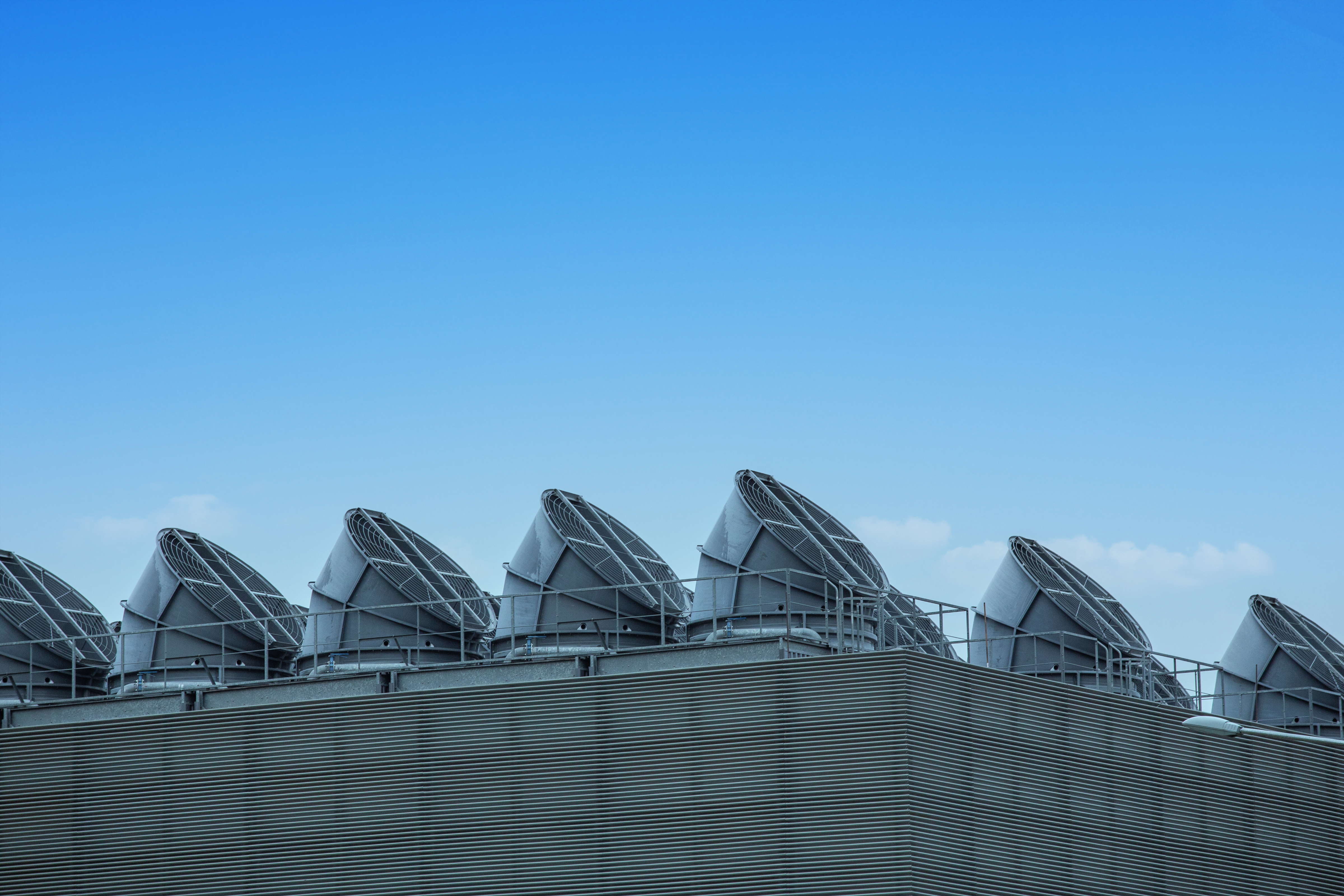
Sets of cooling towers in data centre building
The hidden upstream footprint: water in the power mix
Additionally, there is indirect water consumption via the generation of electricity to power data centres. This offsite footprint may be more significant than direct onsite cooling demand. Estimates have found that indirect water use associated with power generation could account for up to 75% of a data centre’s overall water footprint.2 That matters because electricity generation in many regional systems still relies heavily on thermal power plants, which use substantial volumes of water for cooling – electricity generation accounts for around 40% of total water withdrawals in the US.3
The water profile of AI infrastructure is therefore inseparable from the evolving power mix. While a higher share of variable renewables on the grid such as wind and solar could materially reduce indirect water demand, some lower-carbon technologies including geothermal, biomass, and carbon capture systems, can still be water-intensive. The net direction will depend on how grid composition evolves alongside data centre growth.
Local and regulatory response to water risks
At a national level, data centre water use is still modest relative to total water consumption – in 2023, US data centres made up roughly 0.3% of the contiguous US total public water supply.4 But water risk is inherently local, and that is where the issue becomes more material. Water availability varies sharply by geography, watershed (catchment) conditions, existing infrastructure, and competing demand from households, agriculture, and industry. In several jurisdictions, water availability has already begun to influence the siting and development of hyperscaler infrastructure. In Chile, for example, the approved Cerrillos data centre project was withdrawn in 2024 and reformulated following an environmental court ruling that raised concerns over groundwater use.5 In the US, strong community opposition to the “Project Blue” campus in Arizona over water demand contributed to design changes and Amazon’s withdrawal from the development.6
These cases illustrate that water availability is increasingly shaping not just where data centres are built, but how they are designed, with operators responding through cooling system changes and revised siting strategies.
The regulatory environment is also evolving. While some jurisdictions have announced restrictions or moratoriums on new data centre developments, others are focusing on standards, disclosure, and proactive incentives for more sustainable design and standard setting around reporting and water use:
- California has proposed tax credits for facilities meeting specific sustainability criteria, including adopting sustainable cooling systems.
- The EU’s Energy Efficiency Directive is creating a label for data centres that will include information on energy and water use, as well as renewable energy sources.
- China’s National Green Data Centre Evaluation Indicator System includes the water usage effectiveness (WUE) metric as a basis for determining a ‘green’ rating.
“Water is emerging as a critical consideration in the AI value chain. As investors, understanding how companies manage increasingly constrained natural resources can provide valuable insight into future risks, competitive advantages and long-term growth opportunities. We believe businesses that combine innovation with strong environmental stewardship are likely to be among the beneficiaries of this structural trend.”
– Hamish Chamberlayne, Head of Global Sustainable Equities
A wave of cooling innovation is underway
Although operational realities will keep evaporative cooling widely in use for some time, the industry is also responding to growing water and power density pressures with a new generation of cooling technologies. Direct-to-chip liquid cooling – where coolant is circulated in a closed loop through cold plates mounted directly on processors – is increasingly used in high-density AI environments and can significantly reduce facility-level water consumption. Immersion cooling, in which servers are submerged in non-conductive dielectric fluid, is also moving from niche deployments into mainstream data centre design. More experimental approaches such as microfluidic cooling, which embeds liquid channels directly within the chip itself, point to even greater long-term efficiency potential.
Some operators are also beginning to deploy fully closed-loop and “zero-water” cooling designs in new facilities, which recirculate coolant continuously and eliminate ongoing evaporative water withdrawals. The trade-off remains energy consumption – eliminating water use typically means using more electricity – but as cooling technologies improve, that gap is narrowing.
Beyond infrastructure design, AI itself is increasingly being deployed in tools to help manage water resources more effectively. Applications include leak detection in distribution networks, smart metering and demand forecasting, optimisation of irrigation in agriculture, and basin-level modelling to support water allocation decisions.
Insights from our engagements on water risks
Janus Henderson believes sustainability considerations can better inform stock selection and risk identification by highlighting environmental and social constraints that may affect long-term business models.
As the data centre buildout continues, companies that can demonstrate more transparent reporting and better local stewardship are likely to be better positioned as scrutiny intensifies. We engage with key data centre operators and cloud infrastructure providers on an ongoing basis to better understand how water availability is being incorporated into infrastructure siting and cooling design decisions. Discussions have focused on transparency around site‑level water use, the management of operations in water‑stressed regions, and how trade‑offs between energy efficiency and water use are considered in facility design.
As an example, all the large hyperscalers that we have engaged with are reporting on their data centres’ water usage to varying degrees of granularity, with the majority of them having water-related commitments in place:
- Meta and Google both provide water withdrawal and consumption data at the individual data centre level within their annual sustainability reporting, as well as overall annual water withdrawal and consumption metrics.
- Microsoft, Google, Meta, and Amazon all have commitments in place to replenish/ restore more water than the amount they have used globally by 2030.
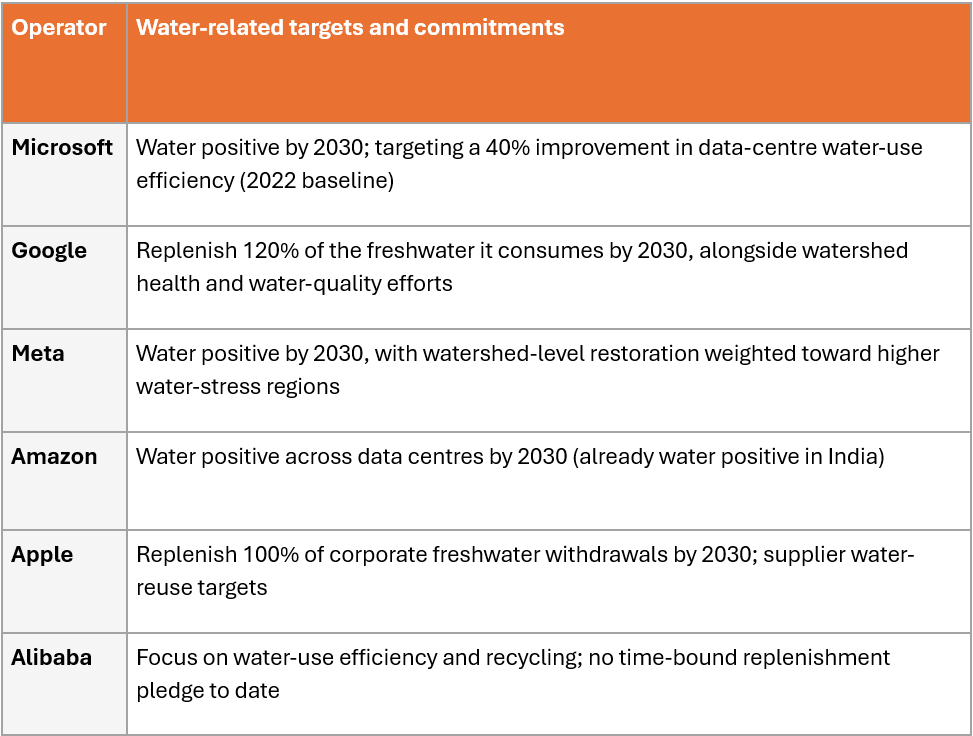
Source: Company reports, Janus Henderson Investors, as at July 2026.
Note: Reporting periods and methodologies differ across operators; commitments are shown for illustration and are not directly comparable.
These engagements have provided valuable insights into how various operators are managing constrained resources, helping to inform our investment teams’ understanding of both the potential operational risks and the evolving opportunity set linked to more efficient cooling technologies and water stewardship solutions.
Conclusion
Water supply risk is a global issue that affects all water-intensive industries, including the technology sector. Rising data centre demand driven by the AI tech wave can offer investment opportunities in companies enabling more efficient cooling, water treatment, and resource-management infrastructure. Water demand from AI infrastructure is a genuine constraint, but it is also catalysing meaningful innovation in cooling, design, and water stewardship. As active managers, we continue to integrate financially-material sustainability factors into our investment decisions as we believe this is key to help deliver long-term sustainable returns to our investors.
IMPORTANT INFORMATION:
References made to individual securities do not constitute a recommendation to buy, sell or hold any security, investment strategy or market sector, and should not be assumed to be profitable. Janus Henderson Investors, its affiliated advisor, or its employees, may have a position in the securities mentioned.
1 Source: Lawrence Berkeley National Laboratory; The water use of data center workloads: A review and assessment of key determinants; June 2025.
2 Source: Nature.com, 2021
3 Source: U.S. Geological Survey; Estimated Use of Water in the United States in 2015
4 Source: Shaolei Ren (UC Riverside), based on figures from Lawrence Berkeley National Laboratory; 2024 US Data Center Energy Usage Report; December 2024
5 Source: Business and Human Rights Centre, ‘Chile: Google to halt data centre project in Santiago to address environmental concerns’, 23 September 2024
6 Source: Fortune, ‘America’s data centers are thirsty. Rural towns are paying the price—from tanked water pressure to stolen desert groundwater’, 13 May 2026
Closed-loop cooling: Involves injecting chilled air into small, targeted areas – typically, individual server racks. So, instead of blowing air into the server room as a whole, closed-loop systems focus it on IT equipment. The “loop” is closed in the sense that it is restricted to a small area and is considered more energy efficient versus open loop cooling.
Data centres: Specialised facilities that house computer servers, networking equipment, storage systems and supporting infrastructure used to process, store and distribute digital data and applications.
Graphics processing units (GPUs): Highly parallel computer chips originally developed for graphics rendering but now widely used to accelerate artificial intelligence, machine learning and other data-intensive computing tasks.
Hyperscaler: A large cloud computing provider that operates vast global networks of data centres and IT infrastructure at scale, enabling the delivery of cloud services to millions of users. Examples include Amazon Web Services (AWS), Microsoft Azure and Google Cloud.
Open loop cooling system: A traditional method of cooling data centres by blowing chilled air through server rooms, with intake vents where warmer air might pool suck up hot air and move it to the chiller so it can be cooled down and piped back into the space. This approach is called an open loop system because it circulates air through an open space.
Watershed: Also known as a drainage basin or catchment, is a land area that channels rainfall and snowmelt to creeks, streams, and rivers, and eventually to outflow points such as reservoirs, bays, and the ocean.
Water usage effectiveness (WUE): A measure of data centre water efficiency by comparing water used for cooling with energy consumed by IT equipment.