Please ensure Javascript is enabled for purposes of website accessibility A chart that counts: European Smaller Companies Trust | Janus Henderson Investment Trusts | UK Investment Trusts
Back to Insights

A chart that counts: European Smaller Companies Trust

European smaller companies have historically beaten large caps over different stages of the stock market cycle.

Sometimes you need to see something to believe it.

We can write here repeatedly that smaller companies are a diversifying part of a portfolio – and have historically beaten large caps over different stages of the stock market cycle.

But, the chart below may convey this message more clearly.

European small caps have outperformed large caps in 14 of the last 23 years
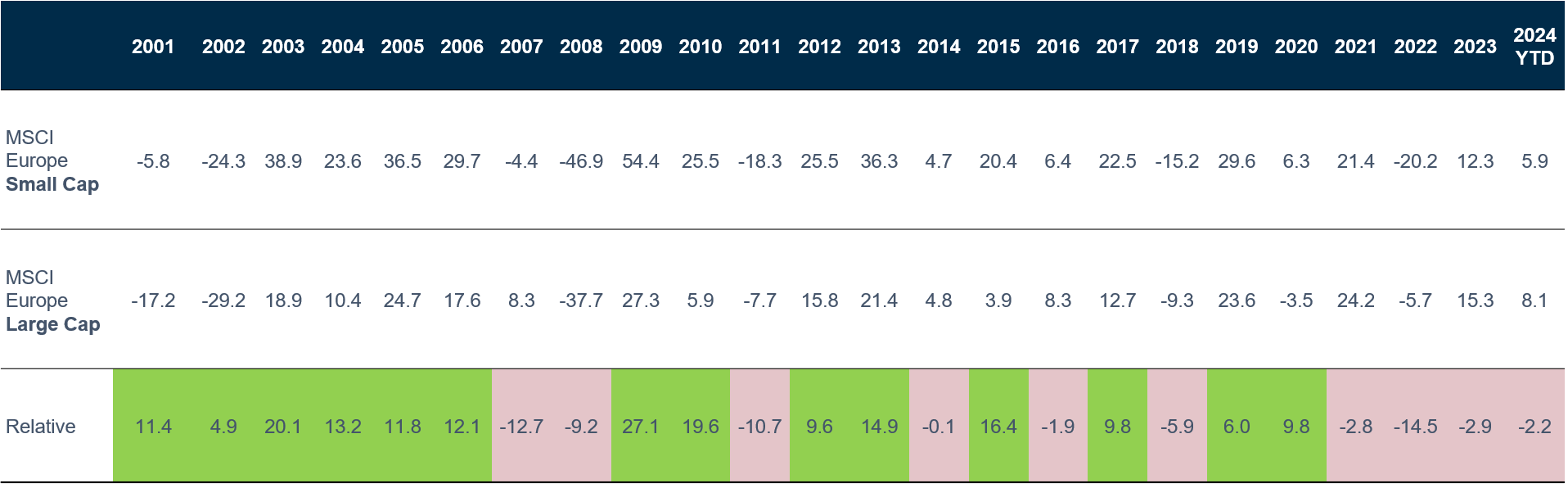
Source:  Refinitiv DataStream, Janus Henderson Investors Analysis, in Local currency, as at 11 November 2024. Note:  Indices used: European Small Caps = MSCI Europe Small Cap Index, European Large Caps = MSCI Europe Large Cap Index, US Equities = S&P 500 Index. Rebased to 100. Past performance does not predict future returns.


The green years are those when European smaller companies outperformed their larger peers. The red are those when they have not.

The first, and most obvious, question this chart throws up is: why have smaller companies done so much worse in the last half decade than they did in the rest of this period?

An extended stretch of ultra-low interest rates were immediately succeeded in 2021 by a period of significant economic uncertainty, a distinctly unfavourable environment for smaller companies. As markets fall and economic growth falters, smaller companies are often the first to suffer. However, historically smaller companies have also been the first to rebound as both markets and economies recover – food for thought.

Investing in European smaller companies

When it comes to investing in smaller companies, for us the chart above sends an even clearer message. That is, that the investing context of the next 2, 5 or 10 years is hard – or impossible – to predict. Rather than attempt to do this, we opt instead to look at individual companies, what they do and how they do it.

We consistently invest in a broad spread of smaller businesses, having examined their finances, operations and management in detail. Our emphasis is on businesses that generate cash: i.e. they sell things or services and actively make money from them. We also look for cases where that profile is underappreciated by the market. These can be in their first years of existence or long-established companies experiencing a turnaround – or indeed anywhere in between.

Most importantly, these companies often operate in niches untouched by their larger peers, making them a unique investment.

Click here to find out more about The European Smaller Companies Trust

 

Diversification

A way of spreading risk by mixing different types of assets/asset classes in a portfolio, on the assumption that these assets will behave differently in any given scenario. Assets with low correlation should provide the most diversification.

Large caps

Well-established companies with a valuation (market capitalisation) above a certain size, eg. $10 billion in the US. It can also be used as a relative term. Large-cap indices, such as the UK’s FTSE 100 or the S&P 500 in the US, track the performance of the largest publicly traded companies, rather than all stocks above a certain size.

Small caps

Companies with a valuation (market capitalisation) within a certain scale, eg. $300 million to $2 billion in the US, although these measures are generally an estimate. Small cap stocks tend to offer the potential for faster growth than their larger peers, but with greater volatility.

Portfolio

A grouping of financial assets such as equities, bonds, commodities, properties or cash. Also often called a ‘fund’.

These are the views of the author at the time of publication and may differ from the views of other individuals/teams at Janus Henderson Investors. References made to individual securities do not constitute a recommendation to buy, sell or hold any security, investment strategy or market sector, and should not be assumed to be profitable. Janus Henderson Investors, its affiliated advisor, or its employees, may have a position in the securities mentioned.


Before investing in an investment trust referred to in this article, you should satisfy yourself as to its suitability and the risks involved, you may wish to consult a financial adviser. Please refer to the AIFMD Disclosure document and Annual Report of the AIF before making any final investment decisions. Tax assumptions and reliefs depend upon an investor’s particular circumstances and may change if those circumstances or the law change.


Past performance does not predict future returns. The value of an investment and the income from it can fall as well as rise and you may not get back the amount originally invested.


The information in this article does not qualify as an investment recommendation.


There is no guarantee that past trends will continue, or forecasts will be realised.


Marketing Communication.


Glossary


Important information

Please read the following important information regarding funds related to this article.

Before investing in an investment trust referred to in this document, you should satisfy yourself as to its suitability and the risks involved, you may wish to consult a financial adviser. This is a marketing communication. Please refer to the AIFMD Disclosure document and Annual Report of the AIF before making any final investment decisions.
    Specific risks
  • Derivatives may be used with the aim of reducing risk or managing the portfolio more efficiently. However, this introduces other risks, in particular, that a derivative counterparty may not meet its contractual obligations.
  • Some of the administrative expenses are taken from capital. This allows more income to be paid but it may also restrict capital growth or even reduce the capital over time.
  • Losses could be incurred if a counterparty became unwilling or unable to meet its obligations, or as a result of failure or delay in operational processes or the failure of a third party provider.
  • If a Company's portfolio is concentrated towards a particular country or geographical region, the investment carries greater risk (as well as the potential for greater reward) than a portfolio that is diversified across more countries.
  • This investment should be held as part of a broader diversified portfolio. Balancing it with investments that have different risk profiles can help reduce the impact of any single investment underperforming.
  • The Company may borrow to invest, which could magnify gains or losses.
  • As the Company may borrow to invest, changes in interest rates could increase or decrease the cost of any borrowings.
  • The Company invests in the shares of other companies. These shares may become hard to value or to sell at a desired time and price, especially in extreme market conditions when asset prices may be falling, increasing the risk of investment losses.
  • Your return on investment is directly related to the market price of the Company's shares, which may be higher (trading at a premium) or lower (trading at a discount) than the value of its underlying net asset value assets. This means your returns may differ from the performance of those assets.
  • While active management techniques are typically positive for performance, this approach may also result in periods of underperformance relative to the benchmark and comparable passive and index-tracking funds, particularly during unexpected market shifts.
  • Shares can gain and lose value rapidly, and typically involve higher risks than bonds or money market instruments. The value of your investment may rise and fall in line with the underlying equity markets.
  • If the companies in which the portfolio is invested persistently reduce their dividend payments, the Company will find it more difficult to maintain or grow its own dividend payments each year.
  • The portfolio invests in currencies other than sterling, meaning fluctuations in exchange rates could affect returns.
  • The portfolio invests in smaller company shares, which may be more difficult to buy and sell, and their share prices may fluctuate more than those of larger companies.