The previous article, Beyond yield: three questions every income investor should ask, explored how sustainable dividends, disciplined capital allocation and sensible valuations are key inputs to find attractive income investments
These principles are important because the strongest long-term outcomes are not always generated by the highest-yielding shares. Companies that can grow their earnings, cash flows and dividends over many years often deliver stronger total returns than companies with just a high dividend yield.
Several long-term holdings in the HHI portfolio help illustrate this approach in practice.
RELX provides data, analytics and information services to professionals working in fields such as healthcare, law, insurance and scientific research. The company’s value lies less in physical assets and more in the information, data and insights that its customers use every day to make important decisions.
Over many years, RELX has invested consistently in its data and technology platforms at attractive returns to generate good organic growth. But it has balanced this with shareholder returns, paying out approximately 50% of cash flow each year as a dividend. Over the last 10 years the company has grown its dividend by an average 8.5% per year.
This compounding impact of growing dividends has had a significant impact for investors with the stock delivering a 187% 10-year total return since the end of 2015. More recently, artificial intelligence has provided another opportunity to increase the value of its datasets and analytical tools, helping customers extract more insight from the proprietary data and analytics RELX provides.
Cranswick supplies pork and chicken products to supermarkets and food service businesses in the UK. It operates in an industry where growth is often driven less by breakthrough innovation and more by investments to maximise quality, service and value for customers. This constant investment at good returns has seen Cranswick grow with its customers, winning market share, expanding categories and increasing capacity leading to sustainable profit, cash flow and dividend growth.
This year the company delivered its 36th year of consecutive dividend growth. The power of that dividend growth has also delivered for investors in total returns, with the stock returning 247% over the last 10 years.
ICG shows how companies can create value by adapting and expanding their business over time.
Originally focused on private lending to businesses, ICG has evolved into a global alternative asset manager, investing on behalf of pension funds, insurers and other institutions. This shift has created new opportunities for growth and helped the company generate more consistent earnings and cash flow. They have also invested to diversify the business into other private asset classes underpinning its dividend growth.
The business has increased its dividend for 16 consecutive years, with annual dividend growth averaging around 11% over that period.
ICG’s success shows that businesses do not need to stand still to remain successful. Companies that adapt, grow and seize new opportunities can often create significant value for shareholders, with ICG delivering a 10-year total return of 394%.
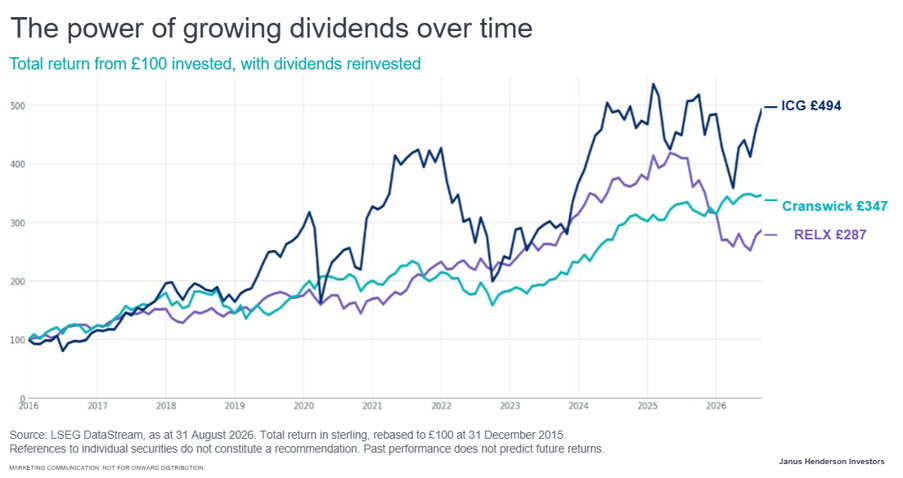
RELX, Cranswick and ICG may operate in different industries, but they share a common characteristic: each have invested appropriately to grow their businesses while increasing the income paid to shareholders.
Their stories highlight an important lesson for income investors. The highest-yielding shares are not always the most attractive opportunities. Companies that can steadily grow their profits and dividends often have the potential to deliver stronger long-term outcomes.
That’s why dividend growth is just as important as dividend yield when investing for the long term.
The final article in this series explores another way of building portfolio income, examining how a combination of equities and bonds can offer exposure to a wider range of income sources while supporting portfolio diversification.
Important information
Holdings are subject to change without notice. Yields may vary and are not guaranteed.
Use of third party names, marks or logos is purely for illustrative purposes and does not imply any association between any third party and Janus Henderson Investors, nor any endorsement or recommendation by or of any third party. Unless stated otherwise, trademarks are the exclusive property of their respective owners.