
Key takeaways:
- US Treasury yields at levels not seen since the Global Financial Crisis may stoke fears of a ‘crowding out’ effect within the US Treasuries (USTs) and investment grade (IG) credit markets. We believe there is demand for both as higher yields attract investors into fixed income markets.
- Despite strong hyperscaler issuance, the size of the US investment grade market is not out of sync with broader US fixed income and equity markets. Coupled with this supply, strong investor flows into investment grade have been driven by the attractive yields on offer.
- Supply still matters though, particularly when issuance is concentrated within individual sectors. Investors must assess whether borrowing is supporting productive investment or contributing to overcapacity and weaker fundamentals, and whether the yield available adequately compensates for those risks.
Back in demand? USTs at 5%
For much of the past decade, low interest rates and ergo bond yields were a headwind for fixed income demand. Today, we have arguably returned to a more normalised environment with positive real yields (yields above inflation) available in markets.
This creates two opposing forces. On one hand, higher cost of capital stokes concerns around the US ballooning fiscal deficits and asset valuations. On the other, with Treasury yields hitting 5%, investors are being offered income levels that have not been seen since the Global Financial Crisis. Could 5% or higher be the level at which it is high enough to attract the buyers needed to absorb higher levels of government debt?
For an investor who bought 10-year Treasuries at the October 2023 yield peak of 4.98%, they would subsequently have earned a total return of more than 15%.[1] Turning to today, Deutsche Bank estimate that a positive 12-month total return could be achieved provided yields remain below 5.5% over that period and 6.4% over two years. [2] After all, elevated yields mean higher coupons which provide a cushion against further increases in yield going forward.
Rather than being fixated on the actual level of yields, what matters is the driving forces behind yields. Higher real yields reflecting resilient growth have so far been manageable for markets, as corporate earnings and investment related to the artificial intelligence (AI) buildout have remained so positive. Nevertheless, investor concerns have been that AI-related corporate issuance combined with more government borrowing could equate to too much bond supply competing for investor capital. Rather than competing for a fixed pool of capital, we believe higher yields may be drawing fresh money into fixed income from cash and other asset classes.
More yield-sensitive buyers step into USTs
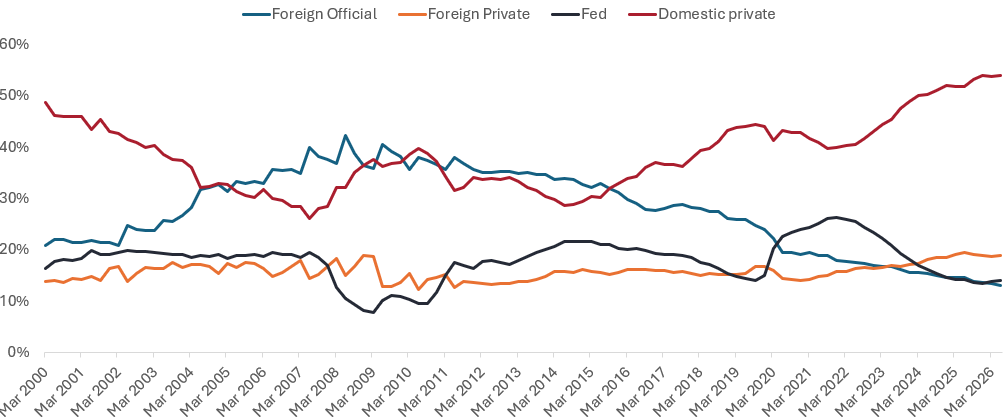
In the US Treasuries (UST) market, this could be from private investors. In recent years, with quantitative easing giving way to quantitative tightening, official buyers like the US Federal Reserve (Fed), central banks and reserve managers have stepped back from USTs. Domestic private ownership of the market has risen to 50% of the market from 30% (Figure 1), which means the market has become more price sensitive as yield sensitive buyers become more important.
Figure 1: The buyer base of USTs has become more price sensitive
Source: Barclays, Federal Reserve, 9 July 2026.
Higher UST yields raise the hurdle that corporate bonds must clear to justify their additional risk. As the 10-year UST approached 5%, high-yield primary transactions offering yields above 6% had been readily placed,[3] indicating that appetite remains for credit risk. Flipping the relationship around, could heavy hyperscaler issuance in investment grade crowd out demand for US Treasuries and force Treasury yields higher or is this alarmist? This is a particularly relevant debate as hyperscalers have been issuing long-dated debt. Deutsche Bank reported that nearly 40% of 30-year deals issued during 2026 had come from hyperscalers,[4] while earlier in the year Morgan Stanley said that 51% of hyperscaler bond supply had been issued at maturities longer than 10 years.[5]
Hyperscaler issuance crowding out US Treasuries?
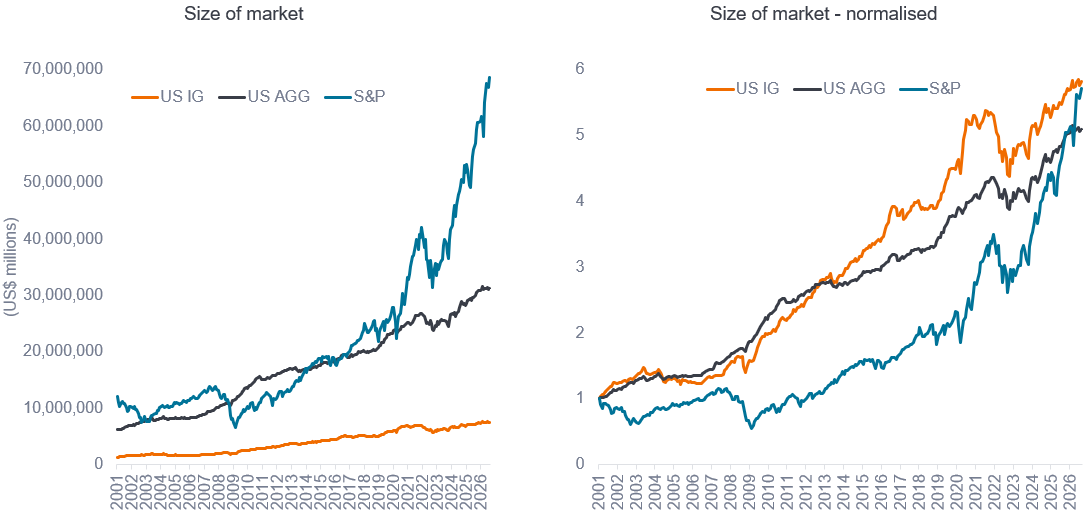
If the corporate bond market were genuinely crowding out everything else, you would expect its growth trajectory to be dramatically different from the broader bond market and equity market. By normalising the size of the market growth in the S&P, US Aggregate (where USTs are the largest component) and US IG by rebasing the starting point to one (Figure 3 on the RHS), we have seen growth by a factor of five to six for all markets over the last 25 years. Ergo we are not seeing corporate credit doing anything unusual relative to other markets.
Figure 2 & 3: The growth of credit markets does not overshadow other markets
Source: Bloomberg, Janus Henderson, from 31 January 2001 to 31 August 2026.
The crowding-out thesis assumes a limited pool of capital, but the readily available pool has significantly grown. US household cash balances have jumped from US$10 trillion to US$20 trillion over the last five years.[6] Strong investor flows have therefore been driven by the attractive yields on offer (US IG yields are currently at 5.8%).[7] This year US IG net supply is likely to be the highest on record, yet demand is also expected to be at a record.[8]
Supply still matters
Nevertheless, history shows that supply can have a meaningful sector-level impact, even if the broader market appears able to absorb it. Technical (or supply-driven) pressure from issuance can emerge before a deterioration in fundamentals becomes apparent. During the 2014-16 energy downturn, substantial debt-funded investment contributed to overcapacity across the US hydrocarbon supply chain. When oil prices subsequently collapsed, weaker operating conditions exposed stretched capital structures, ultimately leading to fundamental deterioration.
This is the nuance today: will AI-related investment generate the earnings and cash flows needed to support the borrowing, or ultimately contribute to overcapacity and weaker fundamentals? Supply is therefore only part of the picture. Focused credit research assesses how supply interacts with fundamentals and valuations, and whether the potential return adequately compensates investors for risks.
The same principle brings us back to Treasuries. A 5% yield may attract capital into fixed income, but it also raises the hurdle corporate credit must clear to compensate investors for additional risk. Whether issuance can be absorbed depends not only on the volume coming to market, but also on the fundamentals behind it and whether yields offer sufficient compensation. This underlines the importance of considering both macro conditions and issuer-level fundamentals when investing in fixed income.
Artificial intelligence (AI): The simulation of human intelligence processes by computer systems. AI commonly involves learning from data, identifying patterns and using these insights to make predictions or complete tasks.
Bond: A debt security issued by a company or a government used as a way of raising money. The investor buying the bond is effectively lending money to the issuer of the bond. Bonds offer a return to investors in the form of fixed-periodic payments (a coupon), and the eventual return at maturity of the original amount invested, the par value. Because of their fixed-periodic interest payments, they are also often called fixed-income instruments.
Central bank: A national institution responsible for managing a country’s currency, money supply and interest rates. Central banks may also oversee the banking system and act to maintain financial stability.
Coupon: A regular interest payment that is paid on a bond described as a percentage of the face value of an investment. For example, if a bond has a face value of £100 and a 5% annual coupon, the bond will pay £5 a year in interest.
Credit: Credit is typically defined as an agreement between a lender and a borrower. It is often narrowly used to describe corporate borrowings, which can take the form of corporate bonds, loans, or other fixed-interest asset classes.
Credit fundamentals: The factors used to assess a borrower’s ability to meet its debt obligations, such as revenues, earnings, cash flows, leverage and the strength of its balance sheet.
Credit risk: The risk that a borrower will default on its contractual obligations to make the required interest payments or repay the loan. Anything that improves conditions for a company can help to lower credit risk.
Credit spread: The difference in yield between securities with similar maturity but different credit quality, often used to describe the difference in yield between corporate bonds and government bonds. Widening spreads generally indicate a deteriorating creditworthiness of corporate borrowers, while narrowing indicates improving.
Crowding out: A situation in which substantial borrowing by one issuer or part of the market absorbs investor capital, potentially reducing demand for other borrowers’ debt or increasing the yields those borrowers must offer.
Duration: A measure of a bond price’s sensitivity to changes in interest rates. The longer a bond’s duration, the more sensitive its price is likely to be to changes in interest rates, and vice versa.
Federal Reserve (Fed): The central bank of the United States, which is responsible for conducting US monetary policy and supporting the stability of the country’s financial system.
Fixed income: See bond.
Global Financial Crisis: A severe disruption to the global financial system that reached its height in 2008, resulting in significant stress across banks, credit markets, economies and investment markets.
Hyperscaler: A very large technology company that operates extensive computing, cloud or data-centre infrastructure and can rapidly expand that infrastructure to meet demand.
Inflation: The rate at which the prices of goods and services are rising in an economy. The consumer price index (CPI) and retail price index (RPI) are two common measures; the opposite of deflation.
Investment-grade bond: A bond issued by a government or company with a relatively low risk of defaulting on its payments, reflected in the higher rating given by credit rating agencies.
Issuer: A company, government or other organisation that raises money by issuing securities such as bonds.
Maturity: The maturity date of a bond is the date when the principal investment (and any final coupon) is paid to investors. Shorter-dated bonds generally mature within five years, medium-term bonds within five to 10 years, and longer-dated bonds after 10+ years.
Overcapacity: A situation in which an industry or sector has greater productive capacity than is required to meet demand. This can place pressure on prices, profits and borrowers’ ability to service debt.
Primary market: The market in which new securities, such as bonds or shares, are issued and sold to investors for the first time.
Quantitative tightening (QT): A government monetary policy occasionally used to decrease the money supply by either selling government securities, or letting them mature and removing them from its cash balances.
Real yield: The yield on an investment after taking account of inflation. A positive real yield means the yield is above the prevailing rate of inflation.
Reserve manager: An institution responsible for managing a country’s foreign-exchange reserves, which may include foreign currencies, government bonds and other highly liquid assets.
Total return: The overall return from an investment over a specified period, taking account of both income received and any gain or loss in its value.
Treasuries/US Treasury securities: Debt obligations issued by the US government. With government bonds, the investor is a creditor of the government. Treasury bills and US government bonds are guaranteed by the full faith and credit of the US government. They are generally considered to be free of credit risk and typically carry lower yields than other securities.
Valuation: An assessment of what an asset or security is worth. In fixed income, valuations may be considered by comparing measures such as a bond’s yield or credit spread with those of similar securities or with their historical levels.
Yield: The level of income on a security over a set period, typically expressed as a percentage rate. For a bond, in its simplest form, this is calculated as the coupon payment divided by the current bond price.
Footnotes
[1] Source: Janus Henderson, LSEG Datastream, total return in USD, 19th October 2023 to 31 August 2026.
[2] Source: Deutsche Bank, 2 September 2026. There is no guarantee that past trends will continue, or forecasts will be realised.
[3] Source: Citi, Credit talks, 14 September 2026.
[4] Source: Deutsche Bank, 7 August 2026.
[5] Source: Morgan Stanley, 10 April 2026.
[6] Source: Federal Reserve, HSBC, as at 30 June 2026.
[7] Source: Bloomberg, ICE BofA US Corporate Index, as at 14 September 2026.
[8] Source: Deutsche Bank, 2 September 2026.
These are the views of the author at the time of publication and may differ from the views of other individuals/teams at Janus Henderson Investors. References made to individual securities do not constitute a recommendation to buy, sell or hold any security, investment strategy or market sector, and should not be assumed to be profitable. Janus Henderson Investors, its affiliated advisor, or its employees, may have a position in the securities mentioned.
Past performance does not predict future returns. The value of an investment and the income from it can fall as well as rise and you may not get back the amount originally invested.
The information in this article does not qualify as an investment recommendation.
There is no guarantee that past trends will continue, or forecasts will be realised.
Marketing Communication.