Key takeaways:
- Improving earnings have been an important contributor to strong Japanese equity returns year to date, while corporate governance reforms are improving capital efficiency and investor confidence.
- Beyond AI-related companies and financials, opportunities are broadening out to areas such as industrial automation, digitalisation, specialist manufacturing and the AI value chain.
- Japan can enhance portfolio diversification by offering exposure to companies benefiting from multiple tailwinds like ongoing corporate reforms, normalising interest rates, rising real wages and pro-growth policies.
IMPORTANT INFORMATION
There is no guarantee that past trends will continue, or forecasts will be realised.
The TOPIX Index Value and the TOPIX Marks are subject to the proprietary rights owned by JPX Market Innovation & Research, Inc. or affiliates of JPX Market Innovation & Research, Inc.
Sources and Definitions
1 Datastream/Morningstar, total return in yen terms, comparison to major indices in USD terms, year-to-date to 30 September 2026. Past performance does not predict future returns.
2 Bloomberg, TOPIX Index as at 31 October, 2026. Past performance does not predict future returns.
3 Bloomberg as at 2 November 2026; JP Morgan Japan Equity Strategy; 6 October, 2026. There is no guarantee that past trends will continue, or forecasts will be realised.
4 MSCI.com; MSCI World Factsheet; 30 September 2026.
Capital expenditure (capex): Money invested to acquire or upgrade fixed assets such as buildings, machinery, equipment, vehicles, software, and technology systems in order to maintain or improve operations and foster future growth.
Consumer price inflation (CPI): A measure that examines the price change of a basket of consumer goods and services over time. It is used to estimate inflation. ‘Headline’ CPI inflation is a calculation of total inflation in an economy, and includes items such as food and energy where prices tend to be more volatile. ‘Core’ CPI inflation is a measure of inflation that excludes transitory or volatile items such as food and energy.
Corporate governance: The system of rules and practices by which a company is managed and overseen, including how it balances the interests of shareholders and other stakeholders.
Diversification: A way of spreading risk by mixing different types of assets or investments within a portfolio.
Earnings per share (EPS): EPS is the bottom-line measure of a company’s profitability, defined as net income (profit after tax) divided by the number of outstanding shares.
Forward earnings: A version of the P/E ratio used to value a company’s shares that utilises forecasted earnings in its calculation. Price-to-earnings (P/E) is a popular ratio used to value a company’s shares compared to other stocks or a benchmark index. It is calculated by dividing the current share price by its earnings per share.
M&A (mergers and acquisitions): Transactions in which companies combine with, purchase or sell businesses.
Multiple: A financial metric/ratio used to gauge a company’s performance, financial health, and expectations for future earnings, e.g. price-to-earnings ratio (P/E) and ROE.
Real wages: Wages adjusted for inflation, providing an indication of changes in workers’ purchasing power.
Return on equity (ROE): A company’s net income (income minus expenses and taxes) over a specified period, divided by the amount of money its shareholders have invested. It is used as a measurement of a company’s profitability compared to its peers. A higher ROE generally indicates that a management team is more efficient at generating a return from investment.
Takaichi trade: Japanese prime minister Sanae Takaichi’s pro-growth, pro-stimulus economic policies have helped push stocks to record highs, however investors playing this trade are also selling government debt and the yen.
View transcript
What has driven the strong performance of Japanese equities year-to-date?
In the first three quarters of 2026, the Nikkei 225 rose by more than 30%, while the TOPIX gained more than 20%.1 Both performed strongly compared with major global markets. Several factors have supported this performance. Corporate earnings are growing, helped by strong demand, rising real wages and companies’ ability to raise prices. This has supported profit margins, which are improving at a similar pace to those in the US.
Corporate governance reform has also continued to improve capital efficiency and investor confidence. And finally, we have seen the so-called ‘Takaichi trade’. The government has put economic growth at the centre of its agenda, with long-term investment plans across areas such as technology, defence, energy and life sciences.
After such a strong rally, do Japanese equities still look attractive?
Yes, we think they do. Importantly, the rally has been supported by earnings growth, rather than just higher valuations. Around half of the market’s gains have come from improving earnings. 2 Even after the rally, the TOPIX trades at around 16 times forward earnings, with earnings expected to grow by around 10% both this year and next. The multiple is slightly above its 10-year average, but still looks reasonable relative to other developed markets and given Japan’s growth outlook. 3
Looking ahead, we also see further potential for corporate profitability and shareholder returns to improve. Further margin expansion should support cash flow and help companies achieve stronger returns on equity. At the same time, corporate governance reform is entering a new phase. The focus is moving beyond simply improving shareholder returns and capital efficiency. Companies are increasingly being encouraged to invest for long-term growth through capex, M&A and corporate restructuring.
AI-related companies and financials have led the gains this year. Which other areas look attractive?
We are starting to see opportunities broaden across the market. Areas such as industrial automation, digitalisation, and specialist manufacturing are benefiting from stronger domestic demand and improving consumer and business sentiment.
At the same time, we continue to see AI as a durable global investment theme. What makes Japan particularly interesting is the breadth of companies involved in the AI value chain. The opportunity goes well beyond semiconductor equipment and chip manufacturers. It also includes component suppliers, materials companies and semiconductor packaging businesses. So, while AI remains important, we think the opportunity set in Japan is becoming much broader.
What role can Japanese equities play in a global equities portfolio when investors are concerned about concentration risk?
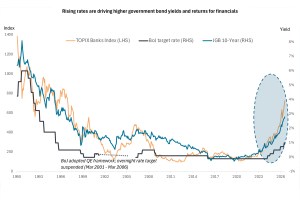
Japan can provide a useful source of diversification for global investors. Japan is around 6% of the MSCI World,4 but many global investors still have limited exposure to the market. It gives investors access to high-quality companies and opportunities that are different from other major markets. There are, of course, near-term risks, including how higher government spending and tax cuts will be funded, as well as a weaker yen and higher government bond yields.
But we also see several long-term tailwinds. These include improving economic and market fundamentals, ongoing corporate governance reform, normalising interest rates, rising real wages and a more inflationary environment. All of these are positive for equity returns. The government’s pro-growth policies should also encourage investment across a wide range of industries.
Taken together, we think these changes create a strong foundation for Japan’s long-term growth. And importantly for us as active investors, the breadth and depth of the Japanese market continue to create exciting opportunities for stock selection.
Related insights


These are the views of the author at the time of publication and may differ from the views of other individuals/teams at Janus Henderson Investors. References made to individual securities do not constitute a recommendation to buy, sell or hold any security, investment strategy or market sector, and should not be assumed to be profitable. Janus Henderson Investors, its affiliated advisor, or its employees, may have a position in the securities mentioned.
Past performance does not predict future returns. The value of an investment and the income from it can fall as well as rise and you may not get back the amount originally invested.
The information in this article does not qualify as an investment recommendation.
There is no guarantee that past trends will continue, or forecasts will be realised.
Marketing Communication.
Important information
Please read the following important information regarding funds related to this article.
The Janus Henderson Horizon Fund (the “Fund”) is a Luxembourg SICAV incorporated on 30 May 1985, managed by Janus Henderson Investors Europe S.A. Janus Henderson Investors Europe S.A. may decide to terminate the marketing arrangements of this Collective Investment Scheme in accordance with the appropriate regulation. This is a marketing communication. Please refer to the prospectus of the UCITS and to the KIID before making any final investment decisions.
- Shares can lose value rapidly, and typically involve higher risks than bonds or money market instruments. The value of your investment may fall as a result.
- High exposure to a particular country or geographical region carries a higher level of risk than a more broadly diversified portfolio.
- When a portfolio is concentrated (has a significant portion of its assets invested in a limited number of holdings), an adverse event impacting even a small number of holdings could create significant volatility or losses.
- Derivatives may be used with the aim of reducing risk or managing the portfolio more efficiently. However, this introduces other risks, in particular, that a derivative counterparty may not meet its contractual obligations.
- If the Fund holds assets in currencies other than the base currency of the Fund, or you invest in a share/unit class of a different currency to the Fund (unless hedged, i.e. seeks to mitigate exchange rate movements between the share/unit class currency and the base currency of the Fund), the value of your investment may be impacted by changes in exchange rates.
- When the Fund, or a share/unit class, seeks to mitigate exchange rate movements of a currency relative to the base currency (hedge), the hedging strategy itself may positively or negatively impact the value of the Fund due to differences in short-term interest rates between the currencies.
- Securities could become hard to value or to sell at a desired time and price, especially in extreme market conditions when asset prices may be falling, increasing the risk of investment losses.
- Losses could be incurred if a counterparty became unwilling or unable to meet its obligations, or as a result of failure or delay in operational processes or the failure of a third party provider.
Specific risks
- Shares can lose value rapidly, and typically involve higher risks than bonds or money market instruments. The value of your investment may fall as a result.
- High exposure to a particular country or geographical region carries a higher level of risk than a more broadly diversified portfolio.
- When a portfolio is concentrated (has a significant portion of its assets invested in a limited number of holdings), an adverse event impacting even a small number of holdings could create significant volatility or losses.
- Derivatives may be used with the aim of reducing risk or managing the portfolio more efficiently. However, this introduces other risks, in particular, that a derivative counterparty may not meet its contractual obligations.
- If the Fund holds assets in currencies other than the base currency of the Fund, or you invest in a share/unit class of a different currency to the Fund (unless hedged, i.e. seeks to mitigate exchange rate movements between the share/unit class currency and the base currency of the Fund), the value of your investment may be impacted by changes in exchange rates.
- Securities could become hard to value or to sell at a desired time and price, especially in extreme market conditions when asset prices may be falling, increasing the risk of investment losses.
- Losses could be incurred if a counterparty became unwilling or unable to meet its obligations, or as a result of failure or delay in operational processes or the failure of a third party provider.