
Key takeaways:
- China’s growth model is evolving towards technology, healthcare innovation, advanced manufacturing and new consumption, creating new sources of structural growth.
- Attractive valuations, differentiated economic drivers and China’s distinct policy cycle offer investors a potentially valuable source of portfolio diversification.
- Greater dispersion between corporate winners and losers strengthens the case for active stock selection grounded in fundamental research and local market knowledge.
In recent years, China’s equity market has often been viewed through the lens of slowing growth, weak investor confidence and policy risk. But this viewpoint may mean that investors are missing out on a growing and durable opportunity set. Today, China offers investors exposure to a deepening innovation ecosystem, improving policy support for capital markets and still-low global investor positioning. The case for China equities is becoming less about gaining market exposure and more about accessing the select companies shaping China’s next phase of growth.
Four key reasons to invest in China equities now:
1. A new growth model is emerging
The drivers of China’s long-term growth are no longer property investment, infrastructure spending and export manufacturing, which characterised the double-digit growth rates achieved across the 1990s and 2000s. Today, to deliver more modest single-digit growth targets, China is looking towards artificial intelligence (AI), technology and healthcare innovation, advanced manufacturing, spanning new consumption shifts (across material goods like cars and property, services like healthcare, experiences, travel, dining, and digital services), to industrial upgrades that can power this growth (e.g. AI-augmented, green-energy-powered, self-reliance).
As before, government policy is a key tailwind to ensuring this new economic growth model gains traction. The 15th Five-Year Plan (2026–2030) aims to shift China’s economy from being quantity-led growth to quality-led growth via four key areas:
- Technology innovation and intensification (AI, semiconductors, biotechnology)
- Security and resilience (defence, energy, rare earths)
- Capital markets (improving shareholder value via dividends, share buybacks, quality new stock listings)
- Social safety net (improving social welfare)
2. Innovation is expanding the opportunity set
Leading Chinese innovators are competing in the global arena. Efforts to localise production, supply chains, distribution and services are becoming key priorities to better meet customer demand and needs. Scaled capabilities across AI, robotics, electric vehicles, clean energy, industrial automation, semiconductors and advanced manufacturing are broadening out the investment opportunity set. According to Goldman Sachs research, there are multiple export opportunities linked to China’s AI industrialisation, including transformers, switchgear, uninterruptible power supply, data centre cooling, relays, humanoid robots, energy storage, industrial automation and robotics.1
In our view, the most attractive opportunities lie in structural themes including:
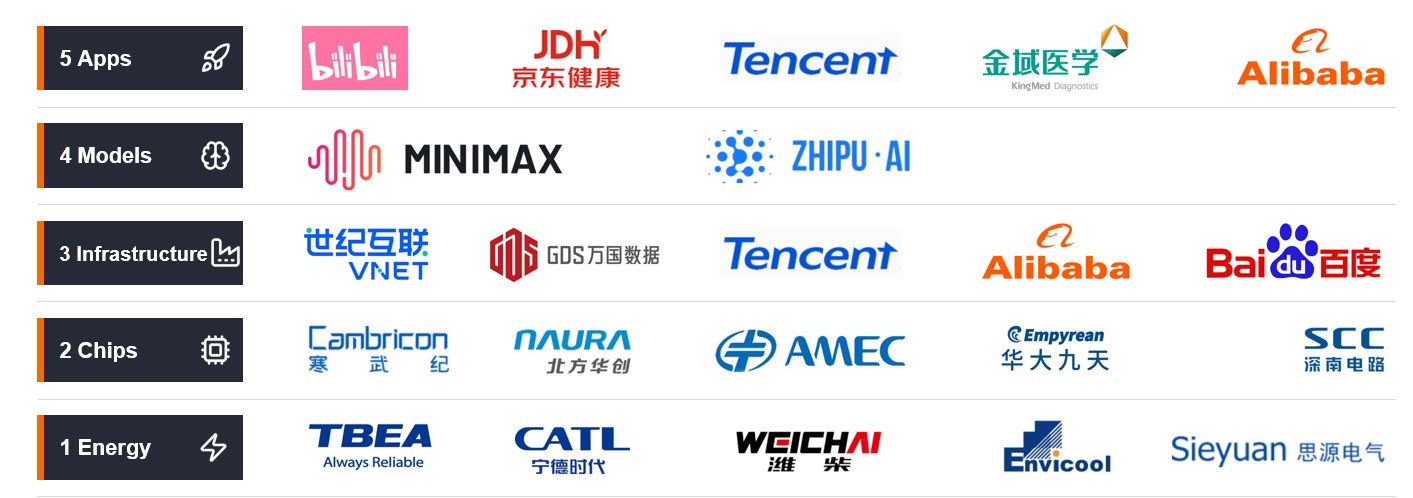
AI+: Beyond large language models, opportunities exist across the AI ecosystem. This ranges from computing infrastructure and intelligent hardware to companies that can use AI to improve productivity and create new revenue – robotics, automation, autonomous driving, biotech, AI devices, to name a few.
Figure 1: China’s AI ecosystem encompasses the full stack
Source: Janus Henderson Investors, as at 31 May 2026. Use of third-party names, marks or logos is purely for illustrative purposes and does not imply any association between any third party and Janus Henderson Investors, nor any endorsement or recommendation by or of any third party. Unless stated otherwise, trademarks are the exclusive property of their respective owners. References made to individual securities do not constitute a recommendation to buy, sell or hold any security, investment strategy or market sector, and should not be assumed to be profitable. Janus Henderson Investors, its affiliated advisor, or its employees, may have a position in the securities mentioned.
Biotechnology: China is moving from generic drugs and contract manufacturing towards novel drug discovery and globally competitive innovation. Opportunities lie in those companies that can translate scientific innovation into successful clinical results, licensing income and international sales.
Figure 2: China’s share of biotech deals and innovative drug originations is growing
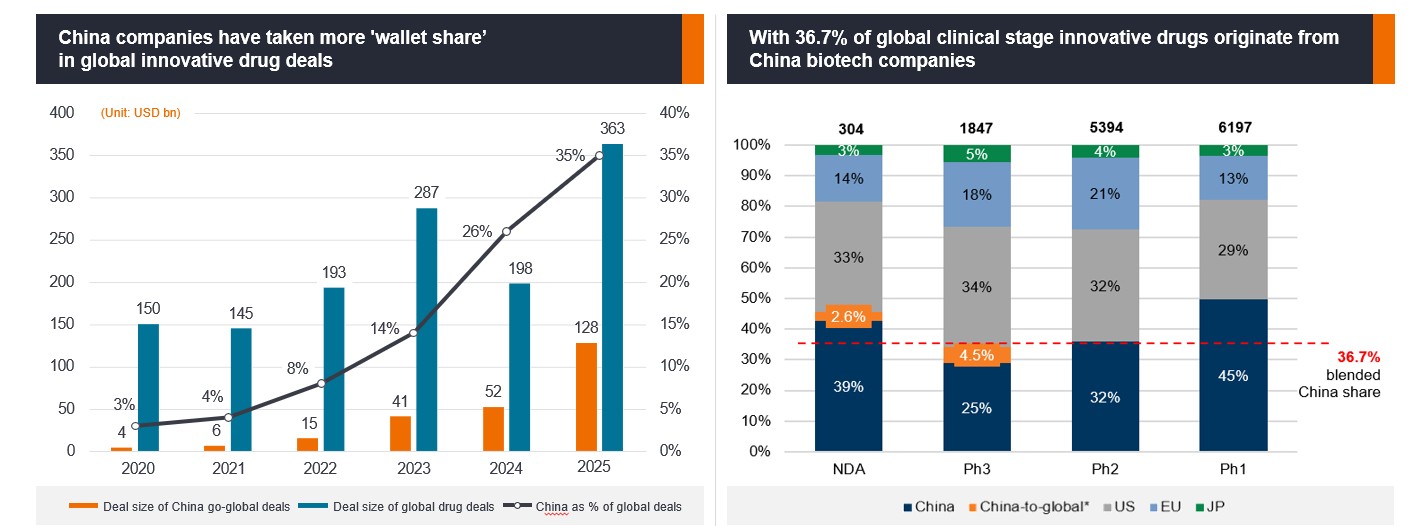
Source: NMPA, CDE, NHSA, PharmCube, Goldman Sachs, as at September 2026. NDA = formal application submitted to the US Food and Drug Administration (FDA) seeking approval to market. Ph 1, 2, 3 = Phase 1, 2, 3 clinical trials in the drug development process.
Net Zero 2.0: As the world’s largest energy consumer and greenhouse gas emitter, China is seeking to reduce its reliance on carbon-intensive power generation and accelerate its transition to clean energy. This includes the build out of the broader energy system for solar panels, batteries and electric vehicles, including power grids, storage, nuclear energy and intelligent energy management.
Natural resources: Resources are becoming strategically important as geopolitical tensions reshape access to energy, metals and critical minerals, needed for electrification. AI infrastructure and advanced manufacturing all require more copper, aluminium, lithium, rare earths and power. China plays a key role in the demand and supply in these areas. Its focus on global green technology leadership via innovation drives significant demand for lithium, cobalt, nickel, and graphite. Meanwhile, China is also the world’s largest supplier, processor, and refiner of rare earth materials. Chinese companies offer exposure to multiple investment opportunities tied to the green transition, at a time of greater geopolitical uncertainty and a focus on resource security.
3. Diversification benefits and attractive valuations
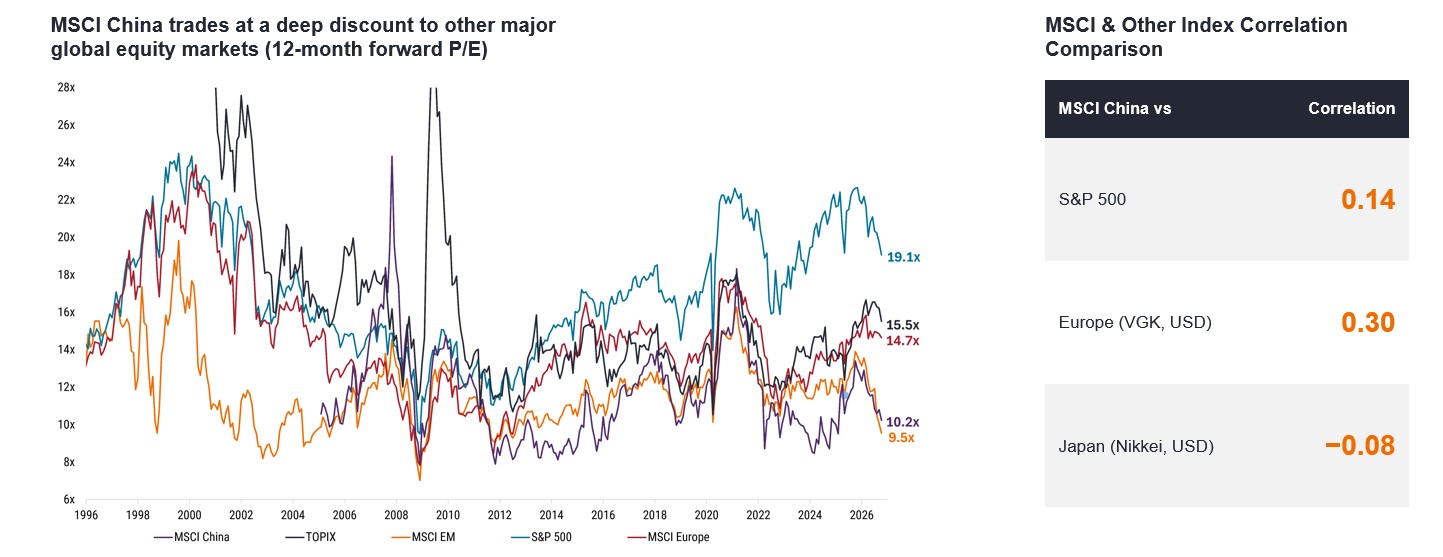
Exposure to China stocks offers valuable portfolio diversification* benefits because the factors that drive its macro background (government policy, liquidity, economic cycles and domestic investor behaviour) are differentiated versus developed markets. For example, inflation below desired levels, weaker domestic demand and greater scope for monetary and fiscal support means Chinese markets may not always move in tandem with developed markets.
Figure 3: Attractive valuation and historically low correlation versus major markets
Source: Bloomberg, FactSet, Morgan Stanley Research, as at 2 September, 2026. Past performance does not predict future results.
China’s stock markets remain undervalued versus US, Japan and Europe, despite relatively attractive valuations, differentiated earnings drivers and genuine portfolio diversification. In our view, this merits a strategic, rather than a tactical allocation in a diversified global equities portfolio.
4. Focus on enhancing shareholder value
In line with Asia’s ‘value up’ drive that aims to reduce the valuation discount on stocks that trade below their intrinsic value, China has implemented corporate governance and capital market reforms to improve long-term value for investors. Greater emphasis on dividends, share buybacks, capital efficiency and corporate governance means investors can potentially benefit not only from earnings growth, but also from improving shareholder returns and valuation re-rating. The ‘New National Nine Articles’ and the China Securities Regulatory Commission’s market value guidelines and other initiatives aim to improve corporate value and enhance shareholder returns. Over the long-term these improvements also have the potential to be a catalyst for a re-rating of the whole market, along with more sustainable shareholder returns.
Figure 4: New National Nine Articles aimed at improving shareholder returns
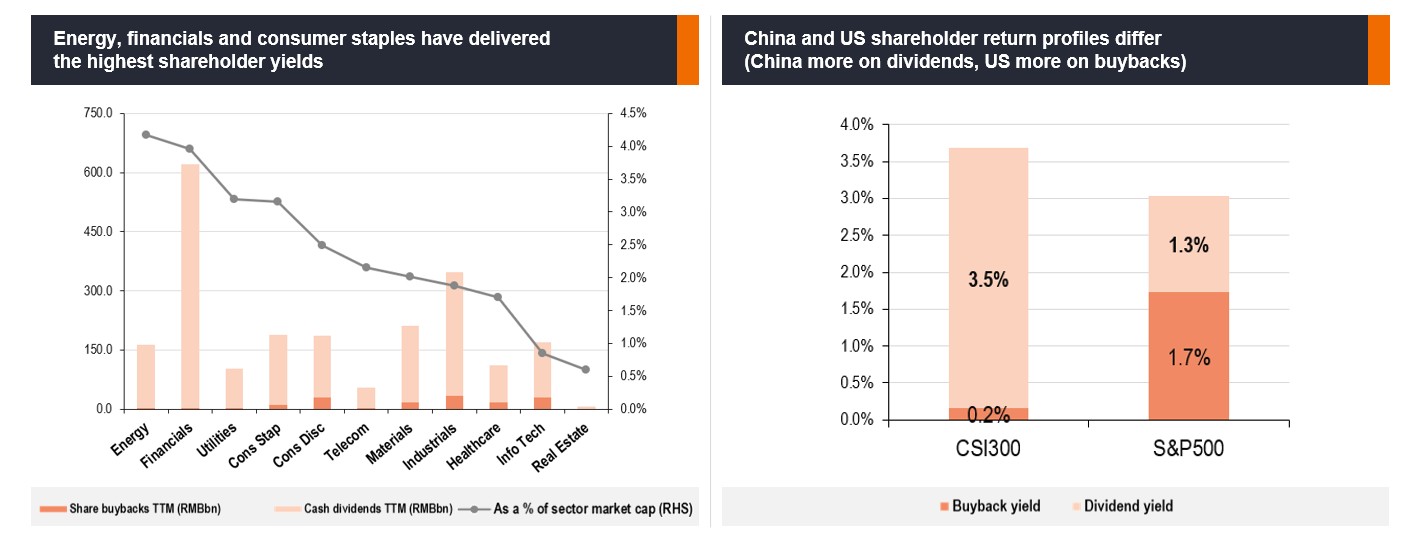
Source: WIND, HSBC Qianhai Securities, as at September 2026. Yields may vary and are not guaranteed.
Rising market dispersion strengthens the case for active management
China is currently in transition. The structural shift from quantity-led growth to quality-led growth is driving more divergence in company performance. This has created a more pronounced ‘K-shaped’ market that is widening the gap between the winners and losers. These conditions call for greater selectivity in stock selection, which can only be informed by local knowledge and deep fundamental research.
Leveraging quantitative and fundamental research, looking at factors such as business and management quality, valuation, earnings momentum, capital efficiency, corporate governance and shareholder alignment, we believe an active manager can build a diversified portfolio of companies well positioned to navigate China’s transformation and emerge as its long-term winners.
Conclusion: China’s economic reset offers new structural growth opportunities
We believe there are three key reasons why China equities merit an allocation in a diversified globally equity portfolio:
1) Economic transition towards innovation-led growth
2) Attractive stock valuations provide a potentially favourable entry point
3) Access to return drivers that differ from those dominating developed markets
While risks undoubtedly remain such as a depressed property sector, consumer weakness, deflationary pressures, geopolitics, regulation and policy execution, China’s economic reset is creating new growth drivers, with widening sector and stock dispersion strengthening the case for active stock selection. By focusing on identifying businesses positioned to benefit from the structural trends reshaping China and its role in the global economy, investors can potentially identify and benefit from differentiated sources of long-term growth.
IMPORTANT INFORMATION
There is no guarantee that past trends will continue, or forecasts will be realised.
*Diversification neither assures a profit nor eliminates the risk of experiencing losses.
Emerging market investments have historically been subject to significant gains and/or losses. As such, returns may be subject to volatility.
1 Goldman Sachs research; 11 August 2026. Active investing: An investment management approach where a fund manager actively aims to outperform or beat a specific index or benchmark through research, analysis, and the investment choices they make. The opposite of passive investing. Buyback: Where a company buys back their own shares from the market, thereby reducing the number of shares in circulation, with a consequent increase in the value of each remaining share. It increases the stake that existing shareholders have in the company, including the amount due from any future dividend payments. Buybacks typically signal the company’s optimism about the future and a possible undervaluation of the company’s equity. Buyback yield: A financial metric that measures the percentage of a company’s market capitalization that has been used to repurchase its own shares over a given period (usually the trailing 12 months). Capital efficiency: A measure of how effectively a company uses its financial resources to generate profits or growth. Correlation: How far the price movements of two variables (e.g., equity or fund returns) move in relation to each other. A correlation of +1.0 means that both variables have a strong association in the direction they move. If they have a correlation of –1.0, they move in opposite directions. A figure near zero suggests a weak or non-existent relationship between the two variables. Deflation: A decrease in the price of goods and services across the economy, usually indicating that the economy is weakening. It differs from ‘disinflation’, which implies a decrease in the level of inflation. Deflation is the opposite of inflation. Discount: Refers to a situation when a security is trading for lower than its fundamental or intrinsic value. The opposite of trading at a premium. Dispersion: The extent to which a distribution of data points is stretched or squeezed. If the data points cluster around certain values, then dispersion is low, whereas if they are more spread out, then dispersion is high. For example, dispersion in stocks measures the range of returns for a group of stocks. Higher dispersion creates opportunities for stock pickers to outperform by selecting the winners and avoiding the losers, given that stock returns are spread more widely on either side of the benchmark. Diversification: A way of spreading risk by mixing different types of assets or asset classes in a portfolio on the assumption that these assets will behave differently in any given scenario. Assets with low correlation should provide the most diversification. Dividend: A variable discretionary payment made by a company to its shareholders. Dividend yield: The income received on an investment relative to its price, expressed as a percentage. Earnings momentum: The direction and pace at which a company’s profits, or expectations for those profits, are changing. K-shaped market: Occurs where different parts of the economy, industries, or consumer groups grow at drastically different rates after a recession or shock, creating a divergence that looks like the letter K. Large language model (LLM): An artificial intelligence model trained on large quantities of data to understand and generate human-like language. Liquidity: Liquidity is a measure of how easily an asset can be bought or sold in the market. Assets that can be easily traded in the market in high volumes (without causing a major price move) are referred to as ‘liquid’. Monetary policy/support: Policies of a central bank aimed at influencing the level of inflation and growth in an economy. Monetary policy tools include setting interest rates and controlling the supply of money. Monetary support/stimulus refers to a central bank increasing the supply of money and lowering borrowing costs. Price-to-earnings (P/E) ratio: A popular ratio used to value a company’s shares compared to other stocks or a benchmark index. It is calculated by dividing the current share price by its earnings per share. Re-rating: Occurs when investors are willing to pay a higher price for shares, usually in anticipation of higher future earnings. Shareholder return: The financial return received by shareholders through changes in a company’s share price and/or distributions such as dividends.
These are the views of the author at the time of publication and may differ from the views of other individuals/teams at Janus Henderson Investors. References made to individual securities do not constitute a recommendation to buy, sell or hold any security, investment strategy or market sector, and should not be assumed to be profitable. Janus Henderson Investors, its affiliated advisor, or its employees, may have a position in the securities mentioned.
Past performance does not predict future returns. The value of an investment and the income from it can fall as well as rise and you may not get back the amount originally invested.
The information in this article does not qualify as an investment recommendation.
There is no guarantee that past trends will continue, or forecasts will be realised.
Marketing Communication.
Important information
Please read the following important information regarding funds related to this article.
- Shares can lose value rapidly, and typically involve higher risks than bonds or money market instruments. The value of your investment may fall as a result.
- Active management techniques that have worked well in normal market conditions could prove ineffective or negative for performance at other times.
- Emerging markets expose investors to higher volatility and greater risk of loss than developed markets; they are susceptible to adverse political and economic events, and may be less well regulated with less robust custody and settlement procedures.
- The Fund may invest in China A-shares via a Stock Connect programme. This may introduce additional risks including operational, regulatory, liquidity and settlement risks.
- High exposure to a particular country or geographical region carries a higher level of risk than a more broadly diversified portfolio.
- Derivatives may be used with the aim of reducing risk or managing the portfolio more efficiently. However, this introduces other risks, in particular, that a derivative counterparty may not meet its contractual obligations.
- If the Fund holds assets in currencies other than the base currency of the Fund, or you invest in a share/unit class of a different currency to the Fund (unless hedged, i.e. seeks to mitigate exchange rate movements between the share/unit class currency and the base currency of the Fund), the value of your investment may be impacted by changes in exchange rates.
- Securities could become hard to value or to sell at a desired time and price, especially in extreme market conditions when asset prices may be falling, increasing the risk of investment losses.
- Losses could be incurred if a counterparty became unwilling or unable to meet its obligations, or as a result of failure or delay in operational processes or the failure of a third party provider.
Specific risks
- Shares can lose value rapidly, and typically involve higher risks than bonds or money market instruments. The value of your investment may fall as a result.
- The Fund follows a growth investment style that creates a bias towards certain types of companies. This may result in the Fund significantly underperforming or outperforming the wider market.
- Emerging markets expose investors to higher volatility and greater risk of loss than developed markets; they are susceptible to adverse political and economic events, and may be less well regulated with less robust custody and settlement procedures.
- The Fund may invest in China A-shares via a Stock Connect programme. This may introduce additional risks including operational, regulatory, liquidity and settlement risks.
- High exposure to a particular country or geographical region carries a higher level of risk than a more broadly diversified portfolio.
- Derivatives may be used with the aim of reducing risk or managing the portfolio more efficiently. However, this introduces other risks, in particular, that a derivative counterparty may not meet its contractual obligations.
- If the Fund holds assets in currencies other than the base currency of the Fund, or you invest in a share/unit class of a different currency to the Fund (unless hedged, i.e. seeks to mitigate exchange rate movements between the share/unit class currency and the base currency of the Fund), the value of your investment may be impacted by changes in exchange rates.
- Securities could become hard to value or to sell at a desired time and price, especially in extreme market conditions when asset prices may be falling, increasing the risk of investment losses.
- Losses could be incurred if a counterparty became unwilling or unable to meet its obligations, or as a result of failure or delay in operational processes or the failure of a third party provider.
Specific risks
- Shares can lose value rapidly, and typically involve higher risks than bonds or money market instruments. The value of your investment may fall as a result.
- The Fund follows a growth investment style that creates a bias towards certain types of companies. This may result in the Fund significantly underperforming or outperforming the wider market.
- Emerging markets expose investors to higher volatility and greater risk of loss than developed markets; they are susceptible to adverse political and economic events, and may be less well regulated with less robust custody and settlement procedures.
- The Fund may invest in China A-shares via a Stock Connect programme. This may introduce additional risks including operational, regulatory, liquidity and settlement risks.
- High exposure to a particular country or geographical region carries a higher level of risk than a more broadly diversified portfolio.
- When a portfolio is concentrated (has a significant portion of its assets invested in a limited number of holdings), an adverse event impacting even a small number of holdings could create significant volatility or losses.
- Derivatives may be used with the aim of reducing risk or managing the portfolio more efficiently. However, this introduces other risks, in particular, that a derivative counterparty may not meet its contractual obligations.
- If the Fund holds assets in currencies other than the base currency of the Fund, or you invest in a share/unit class of a different currency to the Fund (unless hedged, i.e. seeks to mitigate exchange rate movements between the share/unit class currency and the base currency of the Fund), the value of your investment may be impacted by changes in exchange rates.
- Securities could become hard to value or to sell at a desired time and price, especially in extreme market conditions when asset prices may be falling, increasing the risk of investment losses.
- Losses could be incurred if a counterparty became unwilling or unable to meet its obligations, or as a result of failure or delay in operational processes or the failure of a third party provider.