Key takeaways:
- Today’s energy shocks are slowing the transition in the short term but accelerating it over the long term. Energy-security pressures and surging AI power demand are extending reliance on fossil fuels for now, while strengthening the case for investment in domestic, lower-carbon alternatives.
- The fastest-growing clean technologies are not always the best investments. Solar is now the cheapest and fastest power to deploy, yet it has been a volatile and difficult investment. When technologies scale easily, supply can overwhelm demand.
- Supply bottlenecks in energy grids and critical materials can support pricing power. Demand for grid equipment, cabling, and materials such as copper and silver is growing faster than supply. New capacity takes years to build, which can leave producers able to charge more.
The investment challenge
Structural change rarely follows a single path. Geopolitics, energy security, and technological development can reinforce or compete with one another, affecting the pace and direction of investment across sectors. For investors, understanding how these forces interact can help identify where demand is changing, where constraints are emerging, and where additional capital may be needed.
The energy system provides a clear example. Fossil fuels still supply more than four-fifths of global energy, and many major economies remain heavily reliant on imports. Near-term energy security needs can increase reliance on existing infrastructure, even as countries invest in new sources of domestic power and grid capacity. Yet, unlike past energy shocks, this comes at a time when viable alternatives are available at scale.
Artificial intelligence (AI) adds another dimension. Growth in data centres is increasing electricity demand after decades of limited growth in the US and Europe (Exhibit 1), and creating additional requirements for generation, transmission, and supporting infrastructure. The International Energy Agency (IEA) expects data-centre consumption to roughly double by 2030. Meeting that demand involves a mix of near-term and longer-term responses, with some hyperscalers now turning to on-site gas turbines to secure ‘speed to power’ at a potential cost to their own climate commitments.
Exhibit 1: AI is reshaping power demand
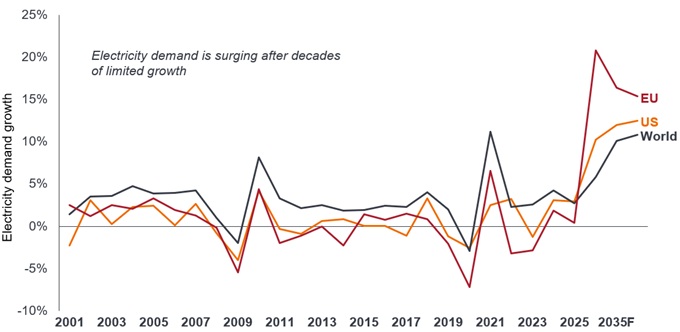
A step change in demand. Data-centre electricity consumption is expected to nearly double by 2030, with AI-optimised servers driving most of the growth. In the US, data centres account for around half of expected demand growth to 2030.
Source: IEA, Janus Henderson Investors, UC Berkeley ExecEd, as at 31 December 2025, 1 January 2001 to 31 December 2035. Data after 31 December 2025 is a forecast. There is no guarantee that past trends will continue, or forecasts will be realised.
How we – and Berkeley – think about it
Near-term pressures may favour existing energy sources, but the longer-term economics are moving in the other direction. New energy technologies rarely grow in a straight line: they tend to build slowly, then accelerate sharply once they reach scale, a pattern linear forecasts can easily miss.
Part of the reason is that clean energy is manufactured rather than extracted. Technologies such as solar panels and batteries benefit from learning curves: the more that is produced, the cheaper and better they become. The global average cost of solar power, for example, has fallen from $378 to $68 per megawatt hour (Exhibit 2). Fossil fuels do not follow that pattern, because their economics remain tied to the availability, production, and transportation of physical commodities.
Exhibit 2: A fundamental shift from resource extraction to manufacturing equipment
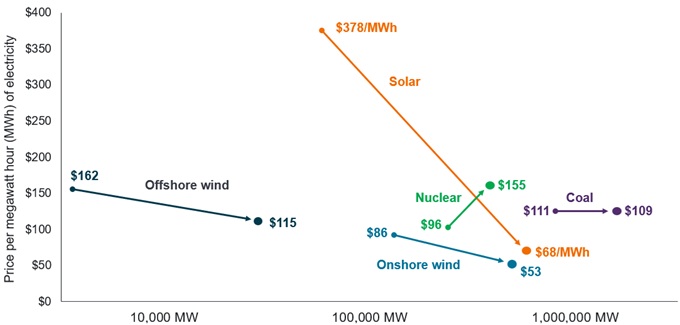
Manufactured energy gets cheaper the more we build. As deployment has scaled, the cost of solar has fallen from $378 to $68 per MWh and the cost of onshore wind from $86 to $53. Over the same period, the cost of coal has barely moved, and the cost of nuclear power has risen. Source: IRENA, Our World in Data, Janus Henderson Investors, UC Berkeley ExecEd. Global weighted average of the levelised costs of energy for inflation, as at 31 December 2025.
Location matters too. Emissions mix globally, but nature impacts are local, so the location of new mines, supply chains, and infrastructure shapes their risks. As frameworks such as the Taskforce on Nature-related Financial Disclosures (TNFD) produce more location-specific data, using it well is becoming one of the more immediate opportunities for investors.
In practice
For investors, these shifts can create opportunities across different sectors and parts of the value chain. Some technologies, including solar, wind, batteries, and electric vehicles, are already scaling, while others remain at earlier stages of development and commercialisation. The investment case therefore varies by technology, market, and time horizon, and scale is no guarantee of returns. Solar now accounts for the large majority of new US power capacity, yet it has been a challenging investment amid intense competition and volatile pricing.
More durable opportunities may lie in the infrastructure bottlenecks that rapid deployment creates. Rising power demand requires investment not only in generation, but also in the energy grids, storage, and interconnection needed to deliver and balance electricity. AI and data-centre growth are adding to those requirements, increasing the importance of power availability, reliability, and efficiency. Capacity constraints in areas such as transformers and electrical cabling can support pricing power.
The same logic applies further up the supply chain, where some critical materials face persistent supply shortages. Copper grades have fallen by around 25% over the past decade, and the silver market has been in deficit for six consecutive years. But scarcity alone does not create an investment case, as mining carries environmental and social costs, from water use and biodiversity loss to impacts on local communities.
The opportunity isn’t simply owning those critical minerals. It’s owning the companies capable of supplying them responsibly.
Tal Lomnitzer, Senior Investment Manager, Global Sustainable Equities
AI, meanwhile, could help ease some of the very bottlenecks it is adding to. It is already being used to balance supply and demand on the grid and reduce the need for wind curtailment, while advances in chip design are delivering the same performance with significantly less power.
Ultimately, structural demand does not necessarily translate into a good investment, and its effects will vary across companies and markets. For active investors, fundamental research at the company level, covering business models, competitive positioning, capital requirements, and valuations, is what separates thematic exposure from a compelling investment case. The shift to a low-carbon economy is a tailwind for demand growth. The harder question is where demand turns into returns. That is where the most durable opportunities are likely to be found.
Capital: A reference to any asset, resource or money that can be put to work to generate wealth or business activity, including borrowing money for development.
Energy systems: The interconnected infrastructure, technologies and supply chains that generate, store and distribute energy, be that electricity or fuel.
Hyperscaler: A large technology firm that builds, owns, and operates data centre infrastructure to deliver cloud computing, storage, and networking services on a large scale.
Speed to power. A measure of how quickly reliable electricity can be delivered to a project, facility, or the grid, which can be a critical bottleneck for AI data centers and other systems with a large demand for energy.
Valuation: A company’s theoretical or intrinsic value, used to determine whether the current market price for its shares are cheap or expensive.
Value chain: The full series of activities in the design, production, marketing, delivery, and support, for a product or service, that can add value at each step.
Wind curtailment: The intentional reduction or shutdown of wind turbines electricity output, in response to energy grid bottlenecks, when supply exceeds demand, or when electricity prices are low or negative (making production uneconomic).