
Key takeaways:
- China is addressing AI chip constraints through larger computing clusters and super-nodes, benefiting pick-and-shovel companies such as optical-module, cooling and data centre infrastructure suppliers.
- While its frontier-model ecosystem is advancing quickly, strong competition means companies offering cloud infrastructure, with enterprise relationships and established distribution networks may offer more balanced exposure to AI.
- Policy support and increasing deployment activity are creating opportunities across equipment, components and automation supply chains.
The World Artificial Intelligence Conference (WAIC) is China’s flagship AI industry event, bringing together policymakers, technology companies, researchers, investors and enterprise buyers across the AI value chain. Held in Shanghai every July, this year the event attracted around 400,000 visitors, with more than a thousand exhibitors showcasing their products. Participants ranged from major tech platforms and infrastructure vendors to domestic chipmakers, frontier-model developers and humanoid-robot companies.
Why WAIC 2026 matters for investors
We think WAIC provides a useful read-through on where capital is being deployed, which technologies are approaching commercial adoption and where new supply-chain bottlenecks are emerging. This year’s clearest message was that China’s AI industry is moving beyond individual chips and model benchmarks towards system-level computing, enterprise deployment and industrial automation robots.

Here we highlight four notable insights for investors from the event:
1. China is addressing its AI chip constraints by shifting from chip-level competition to system-level optimisation
Domestic vendors are connecting more accelerators (AI chips) through larger super-nodes (linking more chips together in larger systems to boost computing power) to compensate for weaker individual-chip performance.
This seems to be a practical near-term solution. But as more accelerators are connected, moving data efficiently through the system becomes more challenging. This is because larger clusters increase communication loss, power consumption and cooling requirements. The implication is that these factors may keep the cost per token for Chinese companies higher compared to foreign platforms.
It is difficult to pick the winner in domestic chips, or super-node vendor, particularly given continued uncertainty around manufacturing capacity, software compatibility, customer adoption and cost competitiveness.
As such, we prefer the ‘pick-and-shovel’ suppliers that are likely to benefit due to larger clusters needing bigger data centres. Among these companies are those that supply optical modules and components; specialised optical fibre; high-end printed circuit boards (PCBs) as well as liquid cooling solutions.
2. China’s frontier AI models are advancing rapidly, but a clear winner has yet to emerge
WAIC 2026 highlighted the progress and latest offerings from DeepSeek, MiniMax, Moonshot AI (its Kimi 3 launch claims to be a rival to OpenAI and Anthropic) and Zhipu AI, the top four leading frontier-model developers. All featured rapid technical progress, improving inference efficiency, lower token prices and strong reported annual recurring revenue (ARR) growth.
However, model performance changes quickly, and leadership on individual AI performance benchmarks may last only until the next model release. Annual recuring revenue (ARR) and token growth does not guarantee sustainable revenue, profit or cash flow. Agentic AI could drive substantial token demand, but value will be created only if customer revenue and productivity gains grow faster than inference costs. Rapid model upgrades, intensive competition, compute constraints, limited product differentiation and continued capital funding requirements make the longer-term investment case and identifying which is the clear AI model winner difficult at present.
China’s frontier models are scaling rapidly, but size does not determine commercial success
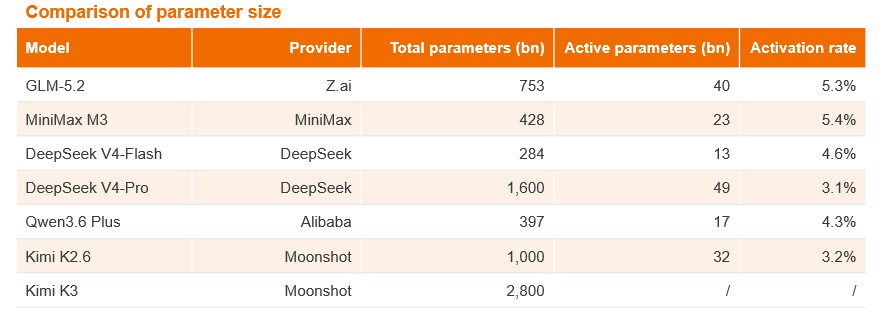
Source: Company data, Hugging Face, CLSA as at 6 July 2026. Model parameters are the learned values within a machine learning model that determine how it maps input data to outputs. The values of these parameters determine a model’s predictions and ultimately the model’s performance on a given task. The number of parameters in a model directly influences the model’s ability to capture patterns across data points. Activation rate is the percentage of a large language model’s total parameters that actively compute data for a single token or query.
3. Semiconductor equipment, packaging and components: Pick-and-shovel AI opportunities
China’s semiconductor localisation effort is broadening across wafer-fabrication equipment, chip testing and advanced packaging. China’s semiconductor-equipment localisation rate appears to be progressing ahead of expectations. Good progress has been made in areas such as etching and cleaning. While metrology, inspection, ion implantation and lithography remain substantially less localised, the opportunity is significant.
We view semiconductor equipment as one of the clearest ‘pick-and-shovel’ opportunities behind China’s domestic chip industry. The investment case does not require us to identify which GPU designer ultimately wins. The process of domestic chipmakers adding capacity and replacing imported tools allows local equipment suppliers to benefit from higher spending across multiple customers.
4. Industrial humanoids are moving closer to early commercial deployment
WAIC 2026 showed that China’s humanoid-robot industry is moving towards early commercial deployment, particularly in factories, logistics centres and warehouses.
Policy support is accelerating this transition. Humanoid robots form part of China’s developmental priorities under its 15th Five-Year Plan,1 while a joint government initiative aims to put more than 10,000 humanoids into commercial use by the end of 2026.2 Adding to this, China’s Ministry of Industry and Information Technology expects domestic humanoid production to exceed 100,000 units in 2026, demonstrating strong policy intent.3
Industrial applications look set to be the first route to commercialisation. Factories and warehouses have repetitive, structured tasks, making robot utilisation, labour savings and customer payback easier to measure. They also provide controlled operating environments that are less demanding than homes or other consumer settings.
However, high prices, limited AI brain functionality, short battery life and uncertain customer payback means investment opportunities remain in the early stages. Therefore, we favour component suppliers that are more likely to benefit from strong demand across multiple manufacturers.
Where can the most attractive AI exposure in Chinese equities likely be found?
Infrastructure companies powering China’s AI expansion and the large platforms that distribute models to enterprise customers and integrate them into existing workflows, in our view, may offer more attractive risk-adjusted exposure in the next three to five years than pure model providers. These companies can potentially monetise AI through cloud consumption, enterprise software, as well as advertising and productivity tools using either proprietary or third-party models. Meanwhile, given the early developmental stages of humanoid robots, companies providing critical components and enabling technologies can provide exposure to this transformative theme.
References made to individual securities do not constitute a recommendation to buy, sell or hold any security, investment strategy or market sector, and should not be assumed to be profitable. Janus Henderson Investors, its affiliated advisor, or its employees, may have a position in the securities mentioned.
1 China Daily, Beijing targets humanoid robots as priority industry, 2 June 2026.
2 Caixin Global, China Targets 10,000 Humanoid Robots in Commercial Use by End-2026, 10 June 2026.
3 China Daily, China’s output of humanoid robot to exceed 100,000 this year: senior official, 7 July 2026.
Agentic AI: AI systems that can autonomously plan, make decisions and perform tasks with limited human input.
AI accelerator: Also known as an AI chip, deep learning processor or neural processing unit (NPU), is a hardware accelerator that is built to speed AI neural networks, deep learning and machine learning.
Advanced packaging: Semiconductor packaging techniques that improve performance by connecting multiple chips in a single package.
ARR: Annual Recurring Revenue reflects the total predictable subscription-based revenue a company expects to earn each calendar year.
API (Application Programming Interface): Software that allows different applications to communicate and exchange data.
Frontier model: A highly advanced AI model operating at the leading edge of current technological capability.
Inference: The process of using a trained AI model to generate outputs or make decisions.
Infrastructure: The physical systems and facilities that support AI operations, including data centres, networking equipment and power systems.
Large Language Model (LLM): A type of AI model trained on vast amounts of text that can understand and generate human-like language.
Localisation: The replacement of imported products or technologies with domestically-produced alternatives.
Optical module: A component that transmits data using light signals across networking infrastructure.
Pick-and-shovel: A company that supplies products or services needed to support an industry, regardless of which end-market competitor succeeds.
Printed circuit board (PCB): A mechanical base used to hold and connect the components of an electric circuit, used in including phones, tablets, smartwatches, wireless chargers, power supplies and other electronic devices.
Super-node: A high-performance computing architecture that connects large numbers of processors or accelerators to increase overall computing power.
Token: The basic unit of text processed by an AI model. AI providers often charge customers based on the number of tokens used.
These are the views of the author at the time of publication and may differ from the views of other individuals/teams at Janus Henderson Investors. References made to individual securities do not constitute a recommendation to buy, sell or hold any security, investment strategy or market sector, and should not be assumed to be profitable. Janus Henderson Investors, its affiliated advisor, or its employees, may have a position in the securities mentioned.
Past performance does not predict future returns. The value of an investment and the income from it can fall as well as rise and you may not get back the amount originally invested.
The information in this article does not qualify as an investment recommendation.
There is no guarantee that past trends will continue, or forecasts will be realised.
Marketing Communication.
Important information
Please read the following important information regarding funds related to this article.
- Shares can lose value rapidly, and typically involve higher risks than bonds or money market instruments. The value of your investment may fall as a result.
- The Fund follows a growth investment style that creates a bias towards certain types of companies. This may result in the Fund significantly underperforming or outperforming the wider market.
- Emerging markets expose investors to higher volatility and greater risk of loss than developed markets; they are susceptible to adverse political and economic events, and may be less well regulated with less robust custody and settlement procedures.
- The Fund may invest in China A-shares via a Stock Connect programme. This may introduce additional risks including operational, regulatory, liquidity and settlement risks.
- High exposure to a particular country or geographical region carries a higher level of risk than a more broadly diversified portfolio.
- Derivatives may be used with the aim of reducing risk or managing the portfolio more efficiently. However, this introduces other risks, in particular, that a derivative counterparty may not meet its contractual obligations.
- If the Fund holds assets in currencies other than the base currency of the Fund, or you invest in a share/unit class of a different currency to the Fund (unless hedged, i.e. seeks to mitigate exchange rate movements between the share/unit class currency and the base currency of the Fund), the value of your investment may be impacted by changes in exchange rates.
- Securities could become hard to value or to sell at a desired time and price, especially in extreme market conditions when asset prices may be falling, increasing the risk of investment losses.
- Losses could be incurred if a counterparty became unwilling or unable to meet its obligations, or as a result of failure or delay in operational processes or the failure of a third party provider.
Specific risks
- Shares can lose value rapidly, and typically involve higher risks than bonds or money market instruments. The value of your investment may fall as a result.
- The Fund follows a growth investment style that creates a bias towards certain types of companies. This may result in the Fund significantly underperforming or outperforming the wider market.
- Emerging markets expose investors to higher volatility and greater risk of loss than developed markets; they are susceptible to adverse political and economic events, and may be less well regulated with less robust custody and settlement procedures.
- The Fund may invest in China A-shares via a Stock Connect programme. This may introduce additional risks including operational, regulatory, liquidity and settlement risks.
- High exposure to a particular country or geographical region carries a higher level of risk than a more broadly diversified portfolio.
- When a portfolio is concentrated (has a significant portion of its assets invested in a limited number of holdings), an adverse event impacting even a small number of holdings could create significant volatility or losses.
- Derivatives may be used with the aim of reducing risk or managing the portfolio more efficiently. However, this introduces other risks, in particular, that a derivative counterparty may not meet its contractual obligations.
- If the Fund holds assets in currencies other than the base currency of the Fund, or you invest in a share/unit class of a different currency to the Fund (unless hedged, i.e. seeks to mitigate exchange rate movements between the share/unit class currency and the base currency of the Fund), the value of your investment may be impacted by changes in exchange rates.
- Securities could become hard to value or to sell at a desired time and price, especially in extreme market conditions when asset prices may be falling, increasing the risk of investment losses.
- Losses could be incurred if a counterparty became unwilling or unable to meet its obligations, or as a result of failure or delay in operational processes or the failure of a third party provider.