
Financial markets and betting markets serve very different purposes, yet in 2026 investors increasingly appear to be treating them as one and the same. Financial markets support capital formation by helping companies raise capital, invest and create jobs. Betting markets, by contrast, simply allow participants to wager on outcomes. In our view, investors would be better served focusing on fundamentals than speculation.
This speculative environment is evident in options trading. The leverage embedded within options offers the potential for higher returns but comes with significantly greater risk. Despite this, total options trading volume has more than tripled over the past five years, highlighting the increasingly speculative nature of markets (Exhibit 1).
Exhibit 1: Rocketing options volumes illustrate the increasingly speculative nature of markets
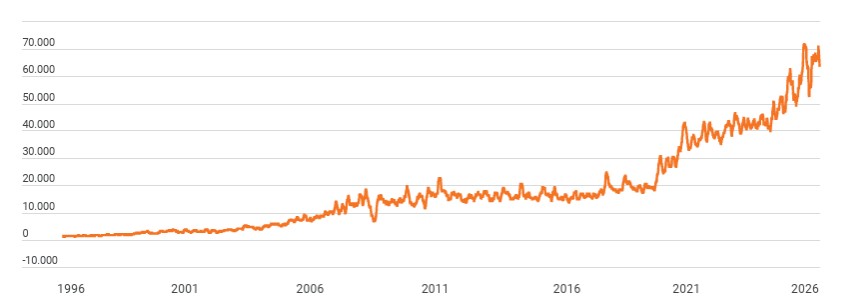
Bloomberg, US total equity and index call (buy) and put (sell) options traded on all Options Price Reporting Authority-participating US exchanges, 30-day moving average daily volume (000s), 1996 to 2026.
Investors are reassessing the Fed
At the start of 2026, one of our key assumptions was that the US Federal Reserve (Fed) would be unable to cut interest rates as aggressively as markets expected. We even viewed additional rate hikes as a possibility.
That once-contrarian view is becoming more widely accepted. Futures markets have dramatically revised their expectations. At the end of 2025, markets anticipated a series of rate cuts throughout 2026, with interest rates remaining below current levels until 2030. Today, expectations are for rates to trend upward over the next several years.
Even that near-term optimism may prove excessive. Our real-time measure of nominal (inflation-unadjusted) GDP growth – combining the Atlanta Fed’s GDPNow estimate with one-year inflation breakevens – suggests the US economy remains exceptionally strong. Nominal GDP growth exceeded 8% in the third quarter of 2025, marking the first such reading in roughly two decades outside the pandemic period. After a temporary slowdown in the fourth quarter caused by the government shutdown, nominal growth rebounded to more than 5.5% in the first quarter of 2026 and is currently tracking above 5% in the second quarter.
Such robust nominal growth is likely to constrain the Fed’s flexibility. We continue to believe policymakers will gradually adopt a tightening bias and may ultimately need to raise, rather than lower, interest rates.
Fundamentals matter when liquidity fades
Periods of speculation are often fuelled by abundant liquidity, and history shows that speculative excesses tend to unwind when the Fed tightens policy. As liquidity becomes scarcer, investors typically place greater emphasis on fundamentals rather than momentum and recent performance.
Lower valuations, combined with stronger return expectations, indicate more attractive opportunities. By this measure, dividend-oriented and non-US equities appear considerably more appealing than current market favourites, including the Magnificent 7 stocks and the broader technology sector.
Not a time for credit risk
While higher-risk assets have historically generated stronger long-term returns, valuation and entry point matter. When equity valuations are elevated or credit spreads are exceptionally tight, investors are often receiving inadequate compensation for the risks they assume.
High-yield corporate bond spreads provide a clear example. Spreads have been narrower than current levels only twice in the past 30 years, and both instances were followed by significant credit market disruptions. Given this backdrop, we continue to favour shorter-duration, higher-quality fixed income sectors such as Treasuries and mortgage-backed securities.
If nominal economic growth remains stronger than consensus expectations and the Fed cannot ease policy as aggressively as markets anticipate, maintaining shorter duration exposures may also prove advantageous relative to benchmark allocations.
Staying disciplined
Investor sentiment often swings between extreme caution and excessive risk-taking. Early in the current bull market, investors favoured quality dividend stocks and Treasuries. Today, distinctions between investing and speculation appear increasingly blurred, with many investors seeking ever-higher levels of risk.
Rather than following the crowd, we remain focused on fundamentals. Current valuations and economic conditions continue to support a preference for dividend-paying equities, non-US stocks and shorter-term, higher-quality fixed income. In our view, these “boring” investments remain among the most attractive opportunities for the second half of 2026.
Credit spread: The difference in yield between a corporate bond and a comparable government bond, reflecting the additional risk investors take when lending to a lower-credit-quality borrower.
Dividend: A portion of a company’s earnings paid to shareholders, typically in cash, as a return on their investment.
Duration: A measure of a bond’s sensitivity to changes in interest rates, indicating how much its price is likely to rise or fall when rates change.
Equities: Shares of ownership in a company, commonly known as stocks, which may provide returns through capital appreciation and dividends.
Fixed income: An asset class consisting of investments that pay regular income, such as bonds, where investors lend money to an issuer in exchange for interest payments and return of principal.
High-yield bonds: Bonds issued by companies with lower credit ratings that offer higher interest rates to compensate investors for greater risk of default (the risk of not being repaid).
Inflation: The rate at which the general price level of goods and services rises over time, reducing purchasing power.
Interest rates: The cost of borrowing money or the return earned on savings or fixed income investments, typically expressed as a percentage.
Leverage: The use of borrowed funds or financial instruments (such as derivatives) to increase the potential return of an investment, which also increases potential risk.
Mortgage-backed securities (MBS): Fixed income securities backed by a pool of mortgage loans, where investors receive payments derived from the underlying homeowners’ mortgage payments. Nominal GDP: The total value of all goods and services produced in an economy, measured using current prices without adjusting for inflation.
Options: Financial derivatives that give the holder the right, but not the obligation, to buy or sell an asset at a predetermined price within a specified time period.
Treasuries: Debt securities issued by the US government, considered low-risk, used to finance government spending.
These are the views of the author at the time of publication and may differ from the views of other individuals/teams at Janus Henderson Investors. References made to individual securities do not constitute a recommendation to buy, sell or hold any security, investment strategy or market sector, and should not be assumed to be profitable. Janus Henderson Investors, its affiliated advisor, or its employees, may have a position in the securities mentioned.
Past performance does not predict future returns. The value of an investment and the income from it can fall as well as rise and you may not get back the amount originally invested.
The information in this article does not qualify as an investment recommendation.
There is no guarantee that past trends will continue, or forecasts will be realised.
Marketing Communication.