
Recent economic data has softened, while geopolitics has added another layer of uncertainty. Growth has stagnated in the eurozone (just 0.1% in the first quarter of 2026), while inflationary pressures have re-emerged, driven largely by higher energy costs related to the conflict in the Middle East.
Business activity surveys also point to cooling momentum. Meanwhile, central banks remain cautious across the bloc. The European Central Bank raised interest rates in June and left open the option of further tightening.
While the near-term macro picture may appear challenging, we believe it obscures a more constructive story for European equities. Markets are already looking through cyclical softness
(a temporary economic slowdown aligning with economic or seasonal cycles), focusing instead on a set of powerful structural drivers that are reshaping the opportunity set:
European equity returns outstrip economic growth
European equities ≠ European GDP
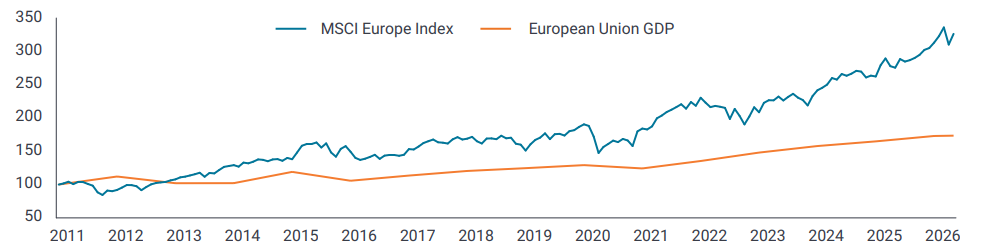
Source: Bloomberg, Janus Henderson Investors Analysis, as at 31 March 2026.
Note: MSCI Europe EUR Net Total Return Index and European Union Gross Domestic Product (GDP) rebased to 100 on 01 January 2010. From 2026, European Union GDP is an estimate using ECB projections.
- Competition for critical resources
From rare earths to energy, global supply is tight after years of underinvestment,
an imbalance that won’t fix quickly. Companies linked to commodities, and the equipment needed to extract or process them, are entering what could be a long upswing. - Rising policy support
Renewables are a clear priority as the region seeks to reduce reliance on imported fossil fuels. At the same time, sectors like steel and chemicals are gaining backing after years of decline. Progress is uneven, but the direction of travel is clear.
- A push for innovation
Europe has lagged in cutting-edge innovation, but pockets of strength are emerging. Areas such as semiconductors, electrification and advanced industrial technology offer faster growth potential than traditional ‘mid-tech’ industries.
Together, these forces suggest that the European market is not only resilient to current headwinds, but is positioned to benefit from longer-term shifts in how economies produce, consume and invest.
Crucially, Europe’s stock market is not the same as its economy. Large publicly-listed companies in Europe are generally global businesses, and their fortunes have significantly outpaced domestic GDP growth over the past decade (see chart). That disconnect looks set to continue.
For investors, this means European equities still offer a compelling mix: exposure to global structural growth trends, alongside potential upside if domestic reforms and investment begin to gain traction.
In a world of shifting regimes, selectivity matters more than ever, but the opportunity set remains alive and well in Europe.
These are the views of the author at the time of publication and may differ from the views of other individuals/teams at Janus Henderson Investors. References made to individual securities do not constitute a recommendation to buy, sell or hold any security, investment strategy or market sector, and should not be assumed to be profitable. Janus Henderson Investors, its affiliated advisor, or its employees, may have a position in the securities mentioned.
Past performance does not predict future returns. The value of an investment and the income from it can fall as well as rise and you may not get back the amount originally invested.
The information in this article does not qualify as an investment recommendation.
There is no guarantee that past trends will continue, or forecasts will be realised.
Marketing Communication.