
Key takeaways:
- Uncertainty is high, but a resilient global economy, robust US growth supported by AI capex and a search for diversification is driving risk appetite. Markets are pricing a potential global slowdown rather than a recession. EM is increasingly viewed as a structural diversification play, and not just a simple risk‑on beta.
- Energy is the swing factor; selection matters more than direction. A short‑lived energy shock is absorbable, but a prolonged one risks de-anchoring inflation, tightening financial conditions and weakening growth. Stronger EM starting fundamentals mean dispersion, not uniform stress.
- We believe relative value is shifting toward EM as DM fiscal risks rise. Persistent developed‑market deficits and debt sustainability concerns are improving EM’s relative valuation case, especially where policy credibility and institutional strength are durable.
This research note is based on our participation in the IMF and World Bank Spring Meetings2026 and reflects our takeaways from meetings, discussions and public sessions held during the week.
Executive Summary
Discussions at the 2026 IMF and World Bank Spring Meetings reinforced a central paradox: global uncertainty is historically elevated, yet risk appetite remains resilient. This partly reflects that the global economy is expected to remain resilient and that increasing downside risks remain risk scenarios and not baseline. From an emerging markets (EM) perspective, our key takeaway was that this do not reflect complacency, but a rational shift in the search for diversification and coming into the crisis with fundamental strength. In a world increasingly shaped by US policy uncertainty, geopolitical tail risks and large fiscal imbalances in developed markets, EM is benefiting from renewed interest in diversification, improving fundamentals and greater policy credibility.
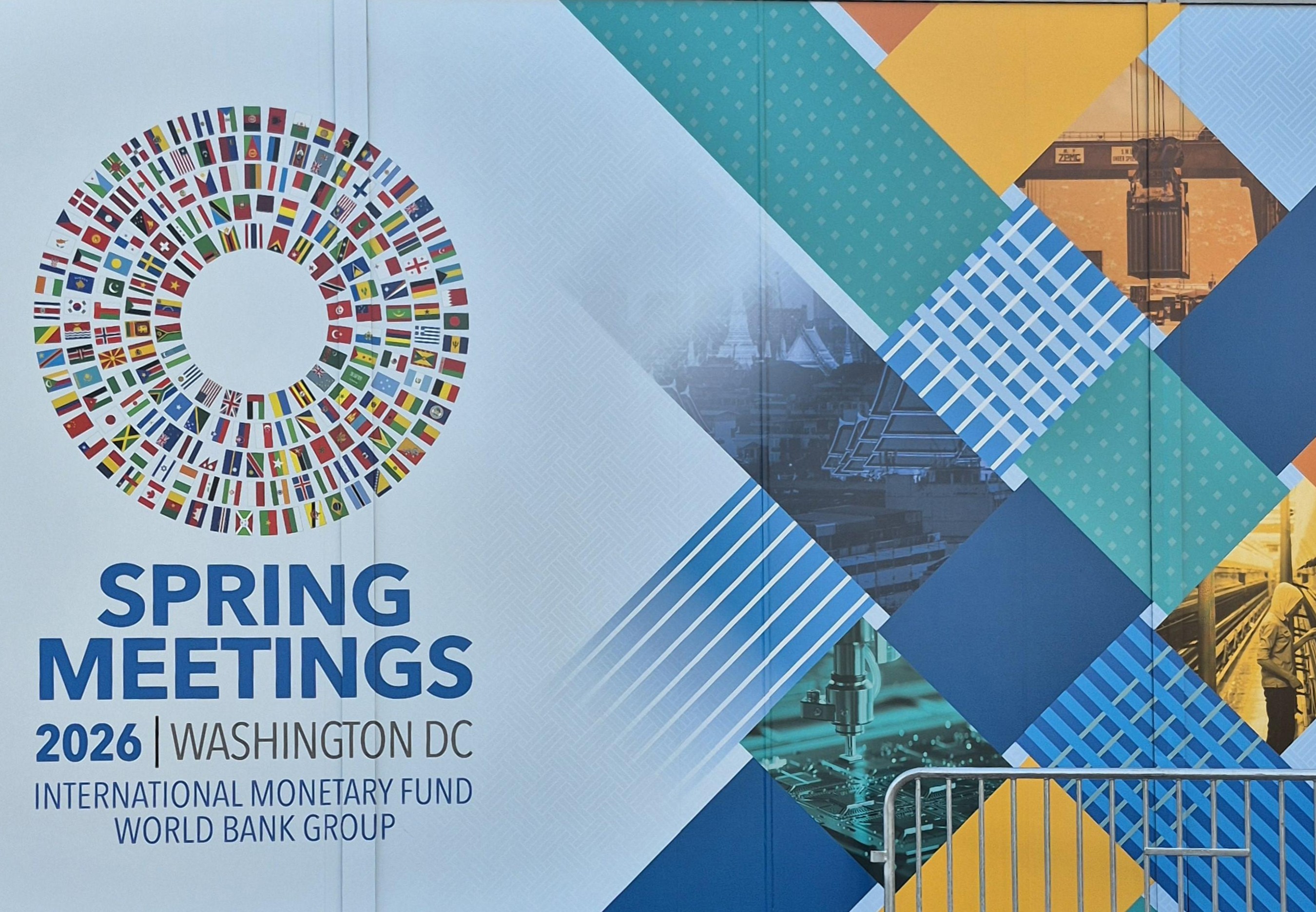
Image credit: Janus Henderson Investors
Global macro backdrop: From benign disinflation to energy-driven uncertainty
Into April, markets were trying to reconcile resilient activity and still anchored inflation expectations with a geopolitical shock that works through energy prices, supply chains and confidence. The key macro question is not simply the direction of oil, but the duration of elevated energy costs and uncertainty.
The global economy entered 2026 with growth running modestly above potential, supported by strong labour markets, robust capital expenditure – particularly linked to artificial intelligence (AI) and infrastructure – and still‑supportive financial conditions. This favourable starting point provided resilience as geopolitical tensions in the Middle East escalated and energy prices rose. Our takeaway from the Spring meetings is that the baseline scenario remains a contained scenario where the global economy absorbs the shock with manageable growth downgrades and limited second round inflation. Many conversations were more focused on the adverse scenarios where the same shock becomes macro relevant through de-anchoring risks, tighter financial conditions, and a broader “tax on growth” via weaker capex and confidence. The outlook was therefore seen as highly dependent on the duration and scope of the conflict.
We believe tail risks now include a transition from a regional geopolitical shock into a broader global macro shock, with meaningful downside risks to growth and renewed upside pressure on inflation. Policy trade‑offs would become more acute in such a scenario, particularly for central banks seeking to preserve hard‑won inflation credibility. Importantly, margins of resilience are narrowing, yet financial markets are still widely perceived as under-pricing these downside risks. We think, against this more fragile and asymmetric global backdrop, that the renewed focus on diversification – and the relative positioning of EM – should be assessed.
One of the clearest positive takeaways from the meetings was the remarkable resilience of EM through a period of significant global stress. This resilience has not gone unnoticed. A recurring theme across panels and bilateral discussions was that investors are actively revisiting the investment case for EM as a source of fundamental diversification. After years of US exceptionalism dominating allocations, the combination of improved EM fundamentals, recent strong returns, and a growing desire to reduce portfolio concentration is drawing capital back toward the asset class. This marks a potentially meaningful shift in investor sentiment and positioning that is likely here to stay.
Overall tone across the meetings was cautiously constructive:
- More constructive baseline than feared: Resilient global economy but buffers are becoming thinner; IMF and official discussions emphasized that many EMs entered this shock with larger buffers and improved policy frameworks than in 2022. The home shoring of vital goods such as fertilizers, oil and gas in combination with significant investments in renewable energy sources has added to the resilience.
- Tight valuation awareness: There was broad agreement that financial markets are surprisingly calm for today’s risk environment
- Fat‑tail risk remains meaningful: The “contained baseline vs. non‑linear tails” framing was repeated frequently, particularly around energy supply, inventories, and confidence effects.

Image credit: Janus Henderson Investors
Three EM‑centric themes stood out in our Spring Meetings conversations:
1. Diversification is no longer optional
Uncertainty today is predominantly driven by US policy—fiscal drift, trade policy risk and geopolitical signalling—rather than by a synchronised global downturn. In this environment, investors are increasingly focused on scenario analysis rather than point forecasts, and the hunt for genuine diversification has meaningfully intensified.
Diversification away from the US dollar is slow but real. Asset owners reportedly sold more dollars in April than in the past ten years. EM saw inflows for the first time in a decade last year. Even a small rotation out of USD has an outsized impact on smaller EM markets. This trend reinforces the broader narrative of investors seeking fundamental diversification beyond traditional developed-market allocations.
EM stand out in this context. The asset class is highly diverse across growth models, commodity exposure and policy regimes, and it is no longer well described as a single beta trade. Improved macro frameworks in many countries, combined with selective idiosyncratic opportunities, are underpinning renewed investor interest.
Implication: EM exposure should be framed as a source of structural diversification rather than cyclical risk‑on beta, with a strong emphasis on country selection and dispersion.
2. Energy shock risks exist, but the starting point is stronger
Geopolitical tensions and energy security are once again central to the global outlook. The macro transmission of energy shocks today differs meaningfully from past episodes. Global energy dependency has declined, supply chains are more flexible, and policy responses are broader and more coordinated. The usual dollar strength that has historically been seen in episodes of stress – energy shocks in particular – has not amplified pressure on EM.
The global economy and EM entered this shock from a position of relative strength. Across EM, external vulnerabilities are generally lower than in previous cycles, reserves are higher, and macro frameworks are more credible. A strong multi‑year record of sovereign ratings upgrades reflects these improvements. EM fundamentals were generally seen as in relatively better shape than during the 2022 Russia-Ukraine shock.
Energy remains a first order differentiator. The key risk for EM is not the energy shock itself, but whether it undermines policy credibility for specific countries. Net importers face the classic twin challenge (current account pressure + fiscal pressure) and, in some cases, a higher probability of policy slippage via renewed subsidies. Exporters can gain fiscal and external support, but only if frameworks prevent pro cyclical spending and preserve credibility. The key point is that the same oil price can be credit positive or credit negative depending on whether the country’s policy response is targeted and financed, or distortionary and open ended.
Implication: Energy volatility should increase dispersion within EM rather than act as a uniform headwind. Policy credibility is the key differentiator.
3. Relative value favours EM in a debt burdened Developed Market world
A defining feature of the global macro landscape is the combination of large, persistent fiscal deficits in developed markets and an unprecedented investment cycle linked to AI and energy infrastructure. Concerns around developed‑market debt sustainability are becoming a more prominent part of investor discussions.
This backdrop materially improves the relative valuation case for EM. While EM assets still trade at a risk premium, the justification for extreme differentials has weakened. Many EM sovereigns now exhibit stronger inflation anchoring, improved fiscal discipline and more credible institutions than in prior decades.
Implication: Relative valuations increasingly favour EM, particularly where improving fundamentals align with credible policy frameworks.

Image credit: Janus Henderson Investors
Select Regional and Country Takeaways
Latin America: Relative attractiveness, politics as the swing factor
A repeated investor framing was that Latin America benefits from “geopolitical distance” in a conflict heavy world, and that politics—not macro alone—will drive dispersion. Security and elections were repeatedly emphasized as key near-term drivers with upcoming elections in Brazil and Colombia. The region still tends to offer attractive carry in select high yield names, but the theme is not uniform; the highest impact elections and the credibility of fiscal management under pressure remain the key differentiators.
Argentina
Consensus market sentiment is bullish. President Javier Milei’s shock therapy is working, and the 2025 mid-terms marked a political turning point — Peronism lost its Senate majority for the first time in 40 years. The reform agenda is expanding across deregulation, tax, pensions, and mining/oil and gas under the Incentive Regime for Large Investments (RIGI – Régimen de Incentivo para Grandes Inversiones), though foreign direct investments is lagging as regaining investor trust remains a long process. FX reserve accumulation is credible, with market access likely in H2. Rating agencies are constructive but want to see balance of payments sustainability confirmed.
Ecuador
The IMF is positive and markets are giving the benefit of the doubt, justified by political stability and strong fiscal delivery under the IMF umbrella. The key weakness is the absence of a clear growth strategy beyond fiscal consolidation — mining policy is inconsistent and foreign direct investment has stalled. Oil is hedged at US$75 per barrel. Messaging was largely consistent with what we heard on our visit to Quito earlier this year.
Panama
Growth is the main driver — the economy is performing exceptionally well, with canal revenue supported by liquefied natural gas (LNG) demand at full capacity. Mine reopening is the critical swing factor; polls now show over 50% public support, but there is no clear timeline. Moody’s negative outlook is expected to be resolved this year, with the investment grade rating seen as safe if the mine reopens and the fiscal responsibility law is met.
El Salvador
El Salvador continues to deliver on IMF programme execution, having met all fiscal targets and sustaining growth of 4% – a rate level above the country’s 30-year average. The two remaining obstacles are government accumulation of Bitcoin and pension reform, though the general tone from official circles suggested the programme is viewed more as a tool to reinforce investor confidence than a policy necessity.
Colombia
The highest-stakes election in the region, scheduled for end-May 2026, with likely sharply divergent outcomes. Experts were reluctant to predict a winner given the closeness of polls. There was broad consensus that the outcome would be highly consequential for the economy, fiscal trajectory, and institutional credibility and that Colombia is at an existential crossroad. Fiscal challenges will be large no matter who wins, but a left win would likely lead to further fiscal slippage and pressure on Colombian markets. Messaging was largely consistent with our takeaways from our visit to Bogota earlier this year.
Brazil
The election is going to be very close — Flávio is tied or ahead in second-round polls, with the outcome hinging on whether the economy or security dominates the narrative. Debt-to-GDP is expected to exceed 80% by year-end, and the next government will need to limit spending growth below 1% to avoid a crisis. Brazil was highlighted as a relative winner from the Middle East crisis, benefiting from its position as a net energy exporter and improved terms of trade — with the IMF upgrading its growth forecast to 1.9% for 2026.
Peru
Chronic political instability persists – the country will have had 10 presidents in 10 years by the time this cycle ends. The feared left-wing scenario under left wing candidate Sanchez remains on the table after the first round. The economy is growing at 2.5% when it could be doing 5-6%, with illegal mining expanding and criminal groups capturing congress and the judiciary. Velarde at the central bank remains the anchor but that is contingent on the political outcome.
Africa: Resilience narratives meet financing realities
The Africa conversation was more bifurcated. Some credits are benefiting from improved buffers and stronger policy frameworks, while others face binding financing constraints, rollover challenges, or credibility shocks that keep spreads vulnerable. The overarching lesson is that in a tighter global risk environment, credible policy plus financing plans matter more than headline growth.
Senegal
Debt is widely seen as unsustainable, with IMF estimates of total public debt at 130–132% of GDP including state-owned enterprises (SOEs) and arrears. Programme negotiations have been ongoing since October. Growth is driven by oil production that peaked in 2025 under Phase 1 only, while non-hydrocarbon growth is weak at 1.1%. The Middle East shock is hitting via subsidies. Financing is increasingly reliant on the regional market, with rising rollover risk and rising yields. A new LIC DSA (Low Income Country – Debt Sustainability Assessment) framework expected by summer 2027 would make domestic debt inclusion in any restructuring more likely — the longer the situation continues, the worse it gets for external creditors.
Angola
Angola is running a debt level of 45% of GDP with inflation at 13%, down from 31%. The non-oil part of the economy is improving. An oil price higher than US$ 60 per barrel will allow Angola to repay debt to China ahead of schedule. While a higher oil price will lead to higher revenues there is a risk that it will also increase imports, which off-sets some of the positives, this has occurred in the past. Angola is planning to issue a “Debt for education” with World Bank guarantee later this year.
Asia: Buffers, FX policy and subsidy management
South and East Asia were clearly discussed as one of the main losers from high energy prices and first in line to be hit by physical shortage of energy due to the closure of the Strait of Hormuz. For the energy importers in the region, reserve adequacy and the ability to manage subsidy frameworks and second round inflation effects were central. The key question is whether policymakers can “see through” the supply shock without losing inflation credibility, while maintaining enough flexibility (FX, fiscal targeting) to avoid destabilizing adjustments. The Asian refinery infrastructure is closely configured to handle gulf crude oil, and Asian countries have long-term LNG contracts anchoring trade flows between the regions, both hard to adjust short term.
China
Chinese lending activities to developing countries have been very common for many years. Today the total Chinese overseas lending equals US$ 2.13 trillion. 50% of the portfolio is lending to EM. China is lending US$ 140 billion annually, which is down from 200 billion in 2016. The composition has changed, from low-middle income countries to middle-high income countries. China is pulling out of Africa and investing more in the Middle East, especially Saudi Arabia, Qatar, UAE and Oman. China has shifted from US$ loans to RMB loans, even for renewals of US$ loans, they only offer loans in RMB and aim to switch the full loan portfolio out of US$.
Pakistan
The country is a large net importer of both oil, gas and fertilizer and a prolonged conflict will have substantial impact on both inflation and growth. Pakistan has in recent years significantly increased its investments in renewable energy to ease the dependency on fossil energy and is planning to increase the build-out of renewables in coming years, both in wind and solar. 24% of Pakistan’s economy is based on agriculture, and phosphates as fertilizer are crucial for their economy. The agricultural side of the economy may benefit from the extensive stockpiling of fertilizers which will last throughout this year.
Uzbekistan
High gold prices have benefitted Uzbekistan, but non-commodity revenues are also strong. The fiscal deficit is down, and growth is strong at 6.8%. The conflict in the Middle East does not have any significant impact apart from some trade routes which were shut down. Privatization remains a strong focus, where the smaller state-owned banks and telecom are a priority. IMF is positive to the privatization efforts so far and emphasizes the importance to lower the role of the state in the economy.
Kazakhstan
Inflation levels are at 9%, due to a government action plan. The share of oil exports to Russia is shrinking but compensated by exports to China. Kazakhstan benefits from a higher oil price but the export routes have been affected to some extent, and they try to utilize alternative routes via Azerbaijan and China.
Middle East: Energy shock, uneven pain
The conflict has had a material first-order macroeconomic impact on the Middle East, primarily through disruptions to energy production, shipping, and trade, with the Strait of Hormuz emerging as the key transmission channel. Oil and gas infrastructure damage and shipping disruptions have raised energy prices and sharply increased uncertainty, weighing on growth, inflation, and non‑oil sectors such as tourism and aviation across the region. While higher oil prices are supportive in theory, exporters directly affected by production or export constraints have seen the negative volume and confidence effects dominate, leading to weaker fiscal and external outcomes.
Bahrain
The main oil field Abu Safah, joint-owned with Saudi Arabia closed in early March due to the US-Iran conflict. Bahrain is one of the worst impacted countries in the region. 70% of the tourism to Bahrain comes from Saudi Arabia, and was heavily impacted by the conflict, but rebounded fast after the ceasefire. The aluminium production, which is a core industry in Bahrain was impacted, since no raw material could come in from Australia and none of their products could be shipped out. Bahrain runs a 10% budget deficit, plus significant off-budget spending. The recent energy reform – with a price mechanism closer to markets – is positive but will likely take a few years to be fully implemented.
Investment takeaways
- Global resilience is fading but not broken: downside risks have risen materially, and tail risks are asymmetric. Uncertainty is likely to persist, calling for continued search for fundamental diversification.
- Duration of the energy shock is the swing variable. The longer uncertainty and elevated energy costs persist, the more the macro impact migrates from “shock” to “regime” impacting inflation and global growth.
- EM fundamentals are stronger than in past cycles: policy credibility and lower external vulnerabilities underpin resilience and supports the relative fundamental attractiveness of EM.
- Dispersion dominates: EM should be approached as a differentiated opportunity set, not a single asset class.
- Relative value is improving: developed‑market fiscal risks strengthen the relative case for EM in diversified portfolios.
IMPORTANT INFORMATION
Diversification neither assures a profit nor eliminates the risk of experiencing investment losses.
Asset allocation: The allocation of a portfolio between different asset classes, sectors, geographical regions, or types of security to meet specific objectives of risk, performance, or time horizon.
Commodity: A physical good such as oil, gold, or wheat.
Credit rating: An independent assessment of the creditworthiness of a borrower by a recognised agency such as Standard & Poors, Moody’s, or Fitch. Standardised scores such as ‘AAA’ (a high credit rating) or ‘B’ (a low credit rating) are used, although other agencies may present their ratings in different formats.
Credit spread: The difference in yield between securities with similar maturity but different credit quality, often used to describe the difference in yield between corporate bonds and government bonds. Widening spreads generally indicate a deteriorating creditworthiness of corporate borrowers, while narrowing indicates improving.
Current account deficit: Where the value of goods and services that is imported by a country exceeds the value of the goods and services that it exports.
Deficit: A deficit occurs when expenses exceed revenues (or taxation), imports exceed exports, or liabilities exceed assets over a specific time period.
Disinflation: A fall in the rate of inflation.
Diversification: A way of spreading risk by mixing different types of assets or asset classes in a portfolio on the assumption that these assets will behave differently in any given scenario. Assets with low correlation should provide the most diversification.
Emerging market: The economy of a developing country that is transitioning to become more integrated within the global economy. This can include making progress in areas such as depth and access to bond and equity markets and development of modern financial and regulatory institutions.
High-yield bond: A bond with a lower credit rating than an investment-grade bond, also known as a sub-investment grade bond, or ‘junk’ bond. These bonds usually carry a higher risk of the issuer defaulting on their payments, so they are typically issued with a higher-interest rate (coupon ) to compensate for the additional risk.
Inflation: The rate at which the prices of goods and services are rising in an economy. The consumer price index (CPI) and retail price index (RPI) are two common measures; the opposite of deflation.
Liquidity/Liquid assets: Liquidity is a measure of how easily an asset can be bought or sold in the market. Assets that can be easily traded in the market in high volumes (without causing a major price move) are referred to as ‘liquid’.
Valuation metrics: Metrics used to gauge a company’s performance, financial health, and expectations for future earnings, e.g. P/E ratio and ROE.
Volatility: The rate and extent at which the price of a portfolio, security, or index, moves up and down. If the price swings up and down with large movements, it has high volatility. If the price moves more slowly and to a lesser extent, it has lower volatility. The higher the volatility, the higher the risk of the investment.
These are the views of the author at the time of publication and may differ from the views of other individuals/teams at Janus Henderson Investors. References made to individual securities do not constitute a recommendation to buy, sell or hold any security, investment strategy or market sector, and should not be assumed to be profitable. Janus Henderson Investors, its affiliated advisor, or its employees, may have a position in the securities mentioned.
Past performance does not predict future returns. The value of an investment and the income from it can fall as well as rise and you may not get back the amount originally invested.
The information in this article does not qualify as an investment recommendation.
There is no guarantee that past trends will continue, or forecasts will be realised.
Marketing Communication.