
Over the past year, the news cycle has become more relevant to investors’ portfolios, as fast-changing politics and policy increasingly feed through to company earnings, valuations, and returns.
The world feels less predictable
A big shift has been the move away from ‘just in time’ globalisation. Terms like industrial repatriation, onshoring and nearshoring have moved from jargon to practical decisions in response to tariffs and supply chain risks. This is leading to higher capital spending, more complex logistics, and tougher trade-offs between resilience and efficiency.
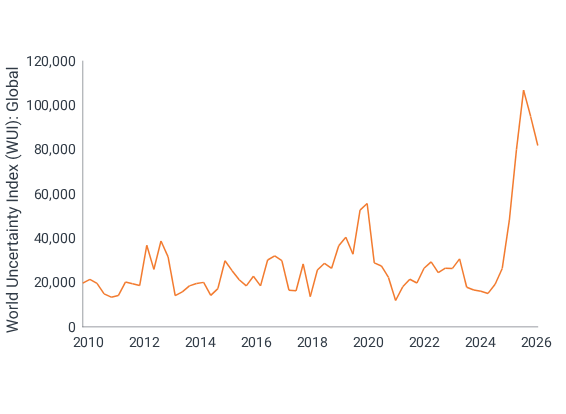
Source: World Uncertainty Index, GDP-weighted average, 1 January 2010 to 31 March 2026. Note: The WUI is computed by counting the percent of word “uncertain” (or its variants) in the Economist Intelligence Unit country reports, spanning 143 countries, before multiplying by 1,000,000. A higher number indicates higher uncertainty and vice versa. For example, an index of 200 corresponds to the word uncertainty accounting for 0.02 percent of all words.
Alongside this, there has been a structural shift in markets. The cheap borrowing that inflated valuations and reduced pressure on companies to deliver efficient growth is now gone. Companies now face greater pressure to demonstrate real earnings and cash flow, creating a disciplined backdrop where company-specific factors are once again shaping outcomes.
A consistent way of investing through the noise
While the world has changed, a few factors have stayed consistent for absolute return investors using a long/short approach: focus on companies, stay flexible, and avoid being forced into a single market outcome. Rather than relying on markets going up, the objective is to build a portfolio that can find opportunities on both the long and short sides. That typically involves two complementary mindsets working together:
- A fundamental core book: On the long side looking for businesses characterised by resilient models, sensible balance sheets, and dependable revenues. Similarly, on the short side, firms where the outlook is already priced in, displaying structural weaknesses or poor management.
- A tactical overlay: Designed to respond to a changing environment, adopting a trading-oriented mindset to deal with volatility (the ups and downs of the market) and market anomalies, allocating to both long and short positions as suitable.
This flexibility extends with strategies able to adjust net and gross exposure, increasing sensitivity when visibility improves and reducing it when uncertainty rises, helping investors stay engaged without making all-or-nothing decisions.
An all-weather approach to investing
No approach can eliminate uncertainty. But a flexible, fundamentals-led, long/short approach can potentially make the path more manageable. The world has changed quickly. The discipline required to navigate it is, if anything, more timeless.
Absolute return: A type of investment strategy that seeks to generate a positive return over time, regardless of market conditions or the direction of financial markets, typically with a low level of volatility.
Balance sheet: A financial statement that summarises a company’s assets, liabilities and shareholders’ equity at a particular point in time. Each segment gives investors an idea as to what the company owns and owes, as well as the amount invested by shareholders.
Long position: A security that is bought with the intention of holding over a long period in the expectation that it will rise in value.
Long/short: A portfolio that can invest in both long and short positions. The intention is to profit from combining long positions in assets in the expectation that they will rise in value, with short positions in assets expected to fall in value. This type of investment strategy has the potential to generate returns regardless of moves in the wider market, although returns are not guaranteed.
Net/gross exposure: The amount of a portfolio’s exposure to the market. Net exposure is calculated by subtracting the amount of short exposure as a percentage of a portfolio from the amount of long exposure. For example, if a portfolio is 100% long and 20% short, net exposure is 80%. Gross exposure is calculated by combining the total value of both long and short positions as a percentage of a portfolio. For example, if a portfolio is 100% long and 20% short, gross exposure is 120%.
Short position (shorting): Fund managers use this technique to borrow then sell what they believe are overvalued assets, with the intention of buying them back for less when the price falls. The position profits if the security falls in value.
These are the views of the author at the time of publication and may differ from the views of other individuals/teams at Janus Henderson Investors. References made to individual securities do not constitute a recommendation to buy, sell or hold any security, investment strategy or market sector, and should not be assumed to be profitable. Janus Henderson Investors, its affiliated advisor, or its employees, may have a position in the securities mentioned.
Past performance does not predict future returns. The value of an investment and the income from it can fall as well as rise and you may not get back the amount originally invested.
The information in this article does not qualify as an investment recommendation.
There is no guarantee that past trends will continue, or forecasts will be realised.
Marketing Communication.