
The rise of artificial intelligence (AI) is proving to be both the most disruptive force investors have faced and one of the most compelling structural opportunities. AI is not just changing individual business models; it is reshaping the economy itself and, in turn, the very framework through which we evaluate what constitutes a sustainable, durable business.
AI is unfolding as a multi-year, capital-intensive infrastructure build-out constrained by physical bottlenecks: land, grid connections, electricity, chips, cooling and capital. For sustainable investors, that shifts the debate from ‘software adoption’ to ‘industrial expansion’ – and it demands a more realistic view of near-term carbon trade-offs.
Tokens: The output of “intelligence factories”
Nvidia’s CEO Jensen Huang argues we should stop thinking about AI data centres as cost centres that
store files and start thinking of them as “intelligence factories”. Their output is tokens: the units of input and output AI models process to generate useful work. In that framing, the AI economy’s key throughput metric is token consumption – how much intelligence the system is being asked to produce.
The demand signal is already extreme. Weekly token consumption across the AI ecosystem has risen more than 3,800% over the past year. 1 Looking ahead, forecasts suggest agentic AI (systems that execute multi-step tasks on a user’s behalf) could push token consumption 24x to around 120 quadrillion tokens per month by 2030 2, with enterprise agents a major multiplier (Figure 1).
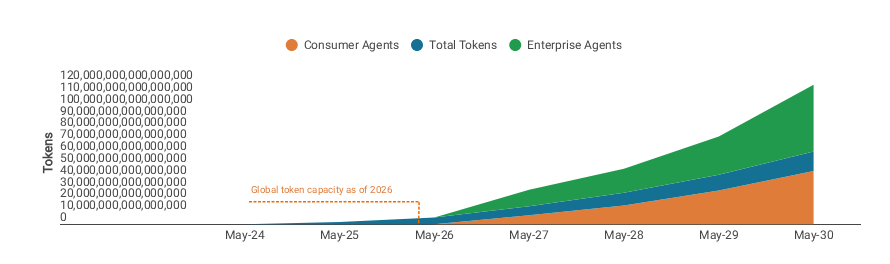
Source: Strategas, as at 25 November 2025. There is no guarantee that past trends will continue or forecasts will be realised.
Power is the binding constraint – efficiency is the moat
Token growth runs into a hard ceiling: power. Operators can build “land, power and shell”, but once facilities exist, many are power limited. The implication is stark. In a world where every data centre operator is power-constrained, the operator who can generate 50x more tokens from the same power envelope generates 50x more revenue. Within a fixed electricity envelope, competitive advantage is determined by how many tokens can be produced per unit of energy.
This is why the arms race is shifting from “how much compute” to “how much compute per watt” and, increasingly, “tokens per watt”. Hardware, memory, networking and cooling are now evaluated as one production line converting electricity into tokens. Small gains in efficiency can translate into outsized gains in throughput (and economics) when power is scarce.
The scale of the build-out reflects both demand and constraint. Some estimates imply AI computing capacity is doubling roughly every seven months this decade, while broader industry analysis suggests global data centre spending could reach US$7 trillion by 2030.3 Physical constraints – grid capacity, manufacturing lead times and supply chain bottlenecks – are not dampening demand; they may extend the cycle.
The sustainability paradox: Higher near-term intensity, potential long-term benefit
Here is the uncomfortable reality: the AI build-out is carbon intensive. Semiconductor fabrication, heavy electrical equipment, grid reinforcement and cooling are energy hungry, asset heavy activities. Then, once data centres are built, they require continuous electricity, often from grids that still rely materially on fossil fuels.
Yet AI also has the potential to be a powerful productivity and efficiency multiplier for the broader economy: accelerating materials science for clean energy, optimising grid operations and industrial processes, and reducing the resource intensity of activities from drug discovery to infrastructure design. The sustainability question is not whether AI has a footprint – it does – but whether system-wide efficiency gains can outweigh transition costs over time.
What it means for sustainable investing: A systems-level lens
This is why we frame our approach as systems-level sustainability. Instead of judging companies solely on their standalone operational emissions, we assess whether they enable a more efficient, resilient and ultimately lower carbon economic system, including by improving the efficiency and carbon intensity of AI itself.
Practically, that points investors toward the bottlenecks where incremental efficiency gains can unlock disproportionate value: power and electrical infrastructure; thermal management and cooling; core computing and advanced manufacturing; memory/bandwidth and storage; and energy storage and
power management.
Stewardship matters. Engagement on credible transition plans, capital allocation discipline and transparent reporting becomes central, including acknowledging that portfolio carbon intensity may rise at times as exposure shifts towards the physical backbone of the AI economy.
Conclusion: Sustainability was always physical
For years, sustainability narratives often sat comfortably alongside capital light digital models. AI is a reminder that the modern economy runs on physical inputs: energy, metals, grids, factories and infrastructure. As token consumption surges, the scarcity value of power and efficiency rises with it.
For sustainable investors, the task is to invest in the AI infrastructure supercycle without ignoring its near-term costs – focusing on the technologies and assets that raise tokens per watt, reduce carbon intensity over time, and enable a more productive, resilient economy.
1 Source: Open Router
2 Source: Goldman Sachs Research, ‘Decoding the Agentic Economy: The coming Inflection in AI Usage and Margins’, 5 May 2026
3 Source: McKinsey, ‘The $7 trillion data center build-out: How industrials can capture their share’, 27 March 2026.
Artificial Intelligence (AI): A broad category of technologies that enable machines and software to perform tasks that typically require human intelligence, such as learning, reasoning, pattern recognition and decision making.
Capital expenditure: Money invested to acquire or upgrade fixed assets such as buildings, machinery, equipment, or vehicles in order to maintain or improve operations and foster future growth.
Environmental, Social, and Governance (ESG) factors relate to the quality and functioning of the natural environment, the rights, well being and interests of people and communities, and the governance of companies & their stakeholders.
“Land, power and shell” refers to the core components of modern, hyperscale data centre development, particularly for AI infrastructure. It is a formula where developers secure land with guaranteed power access, constructing a “shell” building that is ready for a client to install
their own IT equipment.
Moat (economic moat): A company’s sustainable competitive advantage that protects its long-term profitability from competitors, such as network effects, scale, intellectual property or regulatory barriers.
A supercycle is an extended period – often 10 to 25 years – of abnormally strong demand and sustained price increases for commodities or economic sectors, where demand consistently
outpaces supply.
Volatility: The rate and extent at which the price of a portfolio, security, or index, moves up and down. If the price swings up and down with large movements, it has high volatility. If the price moves more slowly and to a lesser extent, it has lower volatility. The higher the volatility, the higher the risk of the investment.
These are the views of the author at the time of publication and may differ from the views of other individuals/teams at Janus Henderson Investors. References made to individual securities do not constitute a recommendation to buy, sell or hold any security, investment strategy or market sector, and should not be assumed to be profitable. Janus Henderson Investors, its affiliated advisor, or its employees, may have a position in the securities mentioned.
Past performance does not predict future returns. The value of an investment and the income from it can fall as well as rise and you may not get back the amount originally invested.
The information in this article does not qualify as an investment recommendation.
There is no guarantee that past trends will continue, or forecasts will be realised.
Marketing Communication.