

GEOPOLITICS AND PUBLIC SPENDING
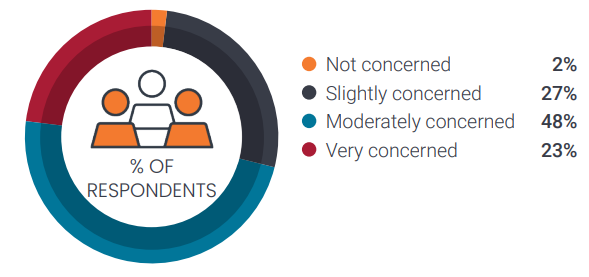
- How would you describe your current level of concern about geopolitical risks affecting markets and investments?(Select one)
Concern is widespread, but mostly moderate rather than extreme, with 75% of respondents either moderately or slightly concerned about geopolitical risks affecting markets and investments.
- Which geopolitical issue do you believe poses the greatest threat to global markets today? (Select one)
Middle East conflict was the standout geopolitical concern, cited by
58%
of respondents as the greatest threat to global markets. Global trade fragmentation followed
at
26%,
while US-China relations and the Russia-Ukraine war each received
8%.
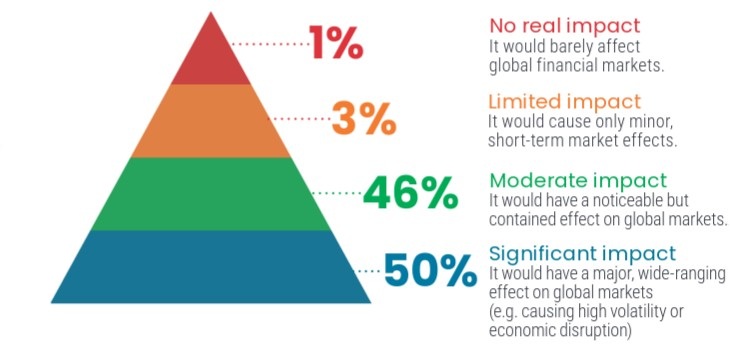
- If conflict in the Middle East were to escalate further (for example, a widening confrontation involving Iran), what impact do you anticipate it would have on global financial markets?(Select one)
Respondents also expected any escalation in Middle East tensions to affect markets. Half anticipated a significant impact, while 46% expected a moderate but contained effect. Only 3% foresaw a limited impact and just 1% expected no meaningful market consequences.
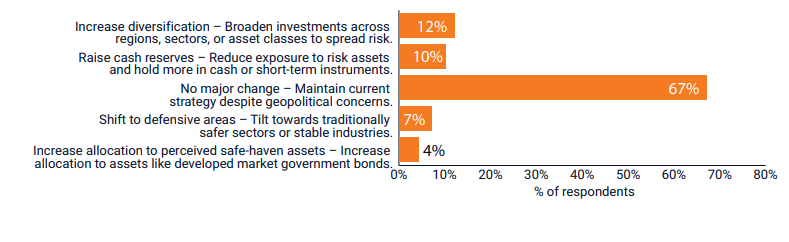
- How do you typically adjust your investment portfolio in response to rising geopolitical uncertainty?(Select one)
Despite geopolitical concerns, most investors are not changing course. More than two-thirds of respondents (67%) said they would make no major adjustments to their portfolios, choosing instead to maintain their current strategy.
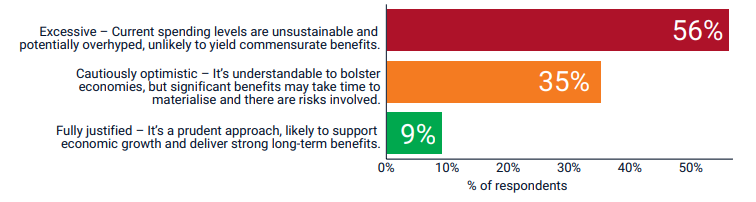
- Leading economies have significantly increased public spending, often funded by substantial borrowing. What is your view of this elevated level of government expenditure?(Select one)
More than half of respondents (56%) said government spending is too high and potentially unsustainable, while only 9% felt heavy borrowing was justified to support growth.
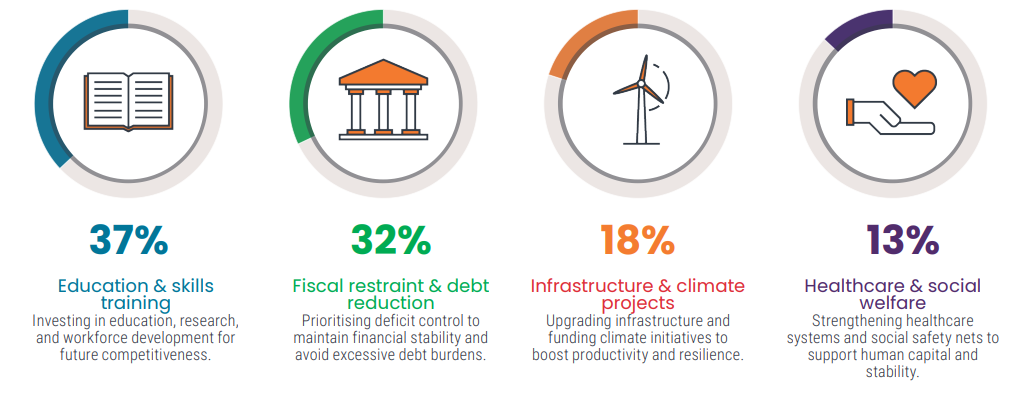
- In your view, which type of public spending is most critical for long-term economic health and growth?(Select one)
Education and skills training was the top spending priority (37%), followed by fiscal restraint and debt reduction (32%). Infrastructure and climate projects (18%) and healthcare and social welfare (13%) ranked lower
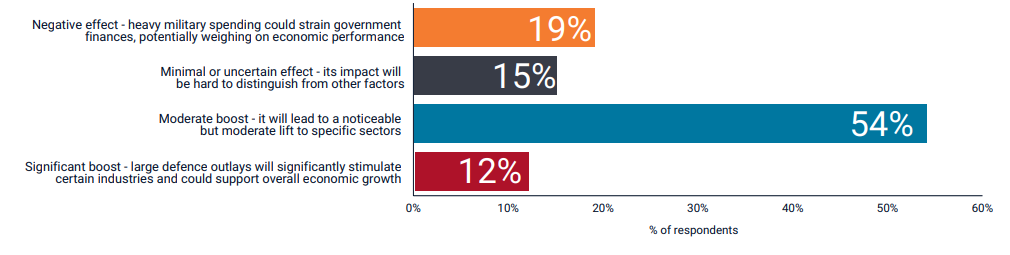
- Over the next five years, how do you expect rising global defence expenditures will affect economic growth and financial markets?(Select one)
Despite concerns about borrowing, respondents were relatively positive on defence spending. Most expected higher defence budgets to deliver a moderate economic benefit and 12% expected a significant boost. However, 19% believed increased military spending could have a negative impact.
Customer Panel
If you are interested in participating in the Customer Panel Surveys, please email customer.panel@janushenderson.com with your name and email address and we will get in touch with you. Existing members will continue to be included and do not need to reapply. To join the Panel you must be 18 years of age or over and hold an investment directly with Janus Henderson Investors. The survey is conducted a few times each year; participation is voluntary. Please note that your individual responses are confidential and remain anonymous but we may publish the aggregate results from time to time.
The Customer Panel Survey was conducted between 12 June and 26 June 2026. 332 respondents took part.
These are the views of the author at the time of publication and may differ from the views of other individuals/teams at Janus Henderson Investors. References made to individual securities do not constitute a recommendation to buy, sell or hold any security, investment strategy or market sector, and should not be assumed to be profitable. Janus Henderson Investors, its affiliated advisor, or its employees, may have a position in the securities mentioned.
Past performance does not predict future returns. The value of an investment and the income from it can fall as well as rise and you may not get back the amount originally invested.
The information in this article does not qualify as an investment recommendation.
There is no guarantee that past trends will continue, or forecasts will be realised.
Marketing Communication.