Chart to Watch: ROE, reform and re‑rating – A turning point for international markets?
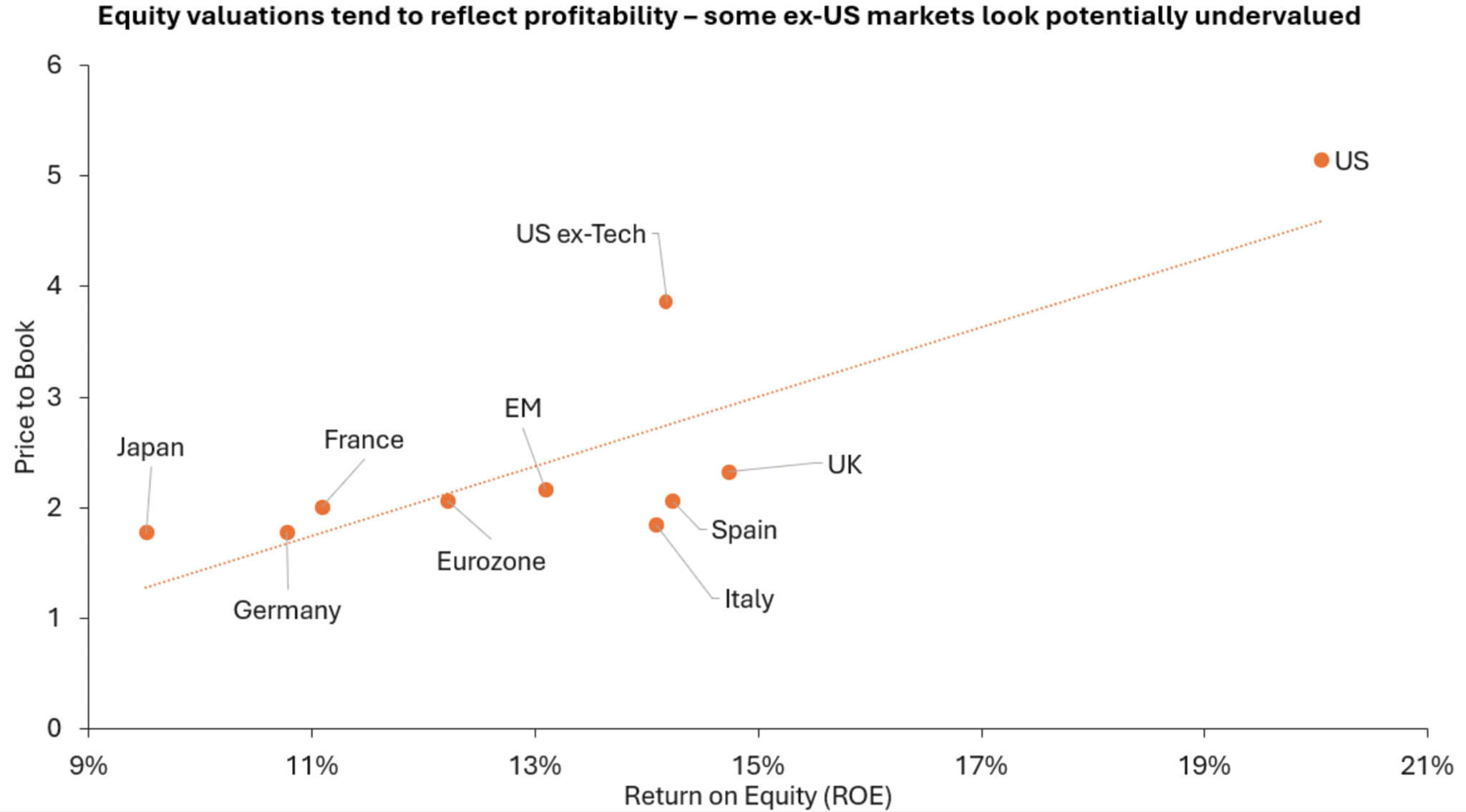
US valuation strength reflects higher ROE, but structural reforms may help discounted international markets close the gap, according to Portfolio Managers Faizan Baig and Ben Lofthouse.
Source: Barclays Investment Research, Janus Henderson Investors, LSEG Workspace, indices represented by the Datastream index for the representative region. Data as at 8 May 2026. Past performance does not predict future results.
International markets have consistently traded at a lower valuation multiple since the Great Financial Crisis, due to lower profitability (measured by ROE). This gap has not gone unnoticed by investors. Today, international markets still trade at a discount to the US. However, if these initiatives translate into sustained improvements in ROE, we see meaningful potential for a re-rating and a narrowing of the valuation gap over time.
Key takeaways
- The ROE–valuation relationship suggests that equity valuations should largely reflect profitability – the US has been at the top on both measures and benefited from higher valuations.
- Meanwhile, international markets have lower ROE and therefore trade at a discount versus the US, but many now sit below what their profitability alone would imply. The ROE–valuation relationship suggests scope for re-rating if profitability improves.
- Corporate and governance reforms could drive a narrowing of the gap – creating the potential for sustained ROE improvement and higher valuations over time.
The chart shows that equity valuations broadly follow profitability. Markets with higher return on equity (ROE) tend to trade on higher multiples (the ROE–valuation relationship). The US currently sits at the top end, with both highest profitability and highest valuation. While international markets (World excluding US), have lower ROE and trade at a discount relative to the US.
But importantly, many international markets sit slightly below where we would expect based on that relationship, suggesting they’re not just delivering lower profitability, but potentially are undervalued. As such, across many regions, regulators and policymakers are increasingly focused on improving corporate returns. In markets such as Japan and Korea, this is being driven by stock exchange initiatives and government-backed programmes. In other regions, change is being driven from within companies, with activist investors pushing for simpler corporate structures, improved governance, and higher shareholder returns through dividends and buybacks. We believe valuations, therefore, have room to move higher, and there are more reasons today for why this is more likely to occur.
Activist investor: An investor who takes a significant stake in a company and actively pushes for change, such as improved governance, simplified structures, or higher dividends and buybacks – to unlock shareholder value.
Corporate governance: The system of rules, practices, and processes by which a company is directed and controlled. Improved governance can support higher ROE by encouraging better capital allocation, accountability, and alignment with shareholder interests
Discount: Refers to a situation when a security is trading for lower than its fundamental or intrinsic value. The opposite of trading at a premium.
Dividend: A variable discretionary payment made by a company to its shareholders.
Equity: A security representing ownership, typically listed on a stock exchange. ‘Equities’ as an asset class means investments in shares, as opposed to, for instance, bond. To have ‘equity’ in a company means to hold shares in that company and therefore have part ownership.
Return on equity (ROE): A company’s net income (income minus expenses and taxes) over a specified period, divided by the amount of money its shareholders have invested. It is used as a measurement of a company’s profitability compared to its peers. A higher ROE generally indicates that a management team is more efficient at generating a return from investment.
Re-rating: Occurs when investors are willing to pay a higher price for shares, usually in anticipation of higher future earnings. In terms of bonds, a re-rating can be assigned when the bond issuer’s ability to service and repay its debt improves (credit quality). Also see de-rating.
Share buybacks: Where a company buys back their own shares from the market, thereby reducing the number of shares in circulation, with a consequent increase in the value of each remaining share. It increases the stake that existing shareholders have in the company, including the amount due from any future dividend payments. It typically signals the company’s optimism about the future and a possible undervaluation of the company’s equity.
Valuation metrics: Metrics used to gauge a company’s performance, financial health, and expectations for future earnings, e.g. P/E ratio and ROE.
These are the views of the author at the time of publication and may differ from the views of other individuals/teams at Janus Henderson Investors. References made to individual securities do not constitute a recommendation to buy, sell or hold any security, investment strategy or market sector, and should not be assumed to be profitable. Janus Henderson Investors, its affiliated advisor, or its employees, may have a position in the securities mentioned.
Past performance does not predict future returns. The value of an investment and the income from it can fall as well as rise and you may not get back the amount originally invested.
The information in this article does not qualify as an investment recommendation.
There is no guarantee that past trends will continue, or forecasts will be realised.
Marketing Communication.
Important information
Please read the following important information regarding funds related to this article.
- Shares can lose value rapidly, and typically involve higher risks than bonds or money market instruments. The value of your investment may fall as a result.
- Derivatives may be used with the aim of reducing risk or managing the portfolio more efficiently. However, this introduces other risks, in particular, that a derivative counterparty may not meet its contractual obligations.
- If the Fund holds assets in currencies other than the base currency of the Fund, or you invest in a share/unit class of a different currency to the Fund (unless hedged, i.e. seeks to mitigate exchange rate movements between the share/unit class currency and the base currency of the Fund), the value of your investment may be impacted by changes in exchange rates.
- Securities could become hard to value or to sell at a desired time and price, especially in extreme market conditions when asset prices may be falling, increasing the risk of investment losses.
- Some or all of the ongoing charges and other costs of the Fund may be taken from capital, which may erode capital or reduce potential for capital growth.
- Losses could be incurred if a counterparty became unwilling or unable to meet its obligations, or as a result of failure or delay in operational processes or the failure of a third party provider.