
One of the most important relationships in investing is the interaction between shares (equities) and government bonds. Investors often assume that bonds will always provide diversification when equity markets struggle, but history suggests the reality is more nuanced. The chart shows that the correlation between the S&P 500 (equity index of the 500 biggest listed companies in the US) and 10-year US government bond yields has changed significantly over time, reflecting shifts in the economic backdrop.
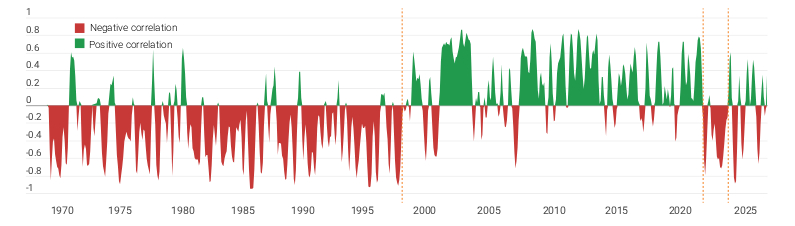 Source: Bloomberg, S&P 500 Index (US equity) and US 10-year government bond yield, January 1970 to May 2026, 90-day rolling correlation (smoothed). Correlation measures the relationship between two variables. A negative correlation means that when the equity market falls, bond yields rise, a positive correlation means that when
the equity market falls, bond yields fall, and vice versa. A correlation of 1 means both variables move strongly in the same direction, -1 means they move in opposite directions and zero suggests a weak or non-existent relationship. Past performance does not predict future returns.
When investors worry about economic growth, bonds tend to perform well. Slowing activity, rising unemployment or recession fears generally encourage central banks to cut interest rates or keep policy loose. Falling interest rates push bond yields lower and bond prices higher, helping offset losses elsewhere in a portfolio. In these environments, bonds act as a valuable shock absorber. This was a common feature of markets from the late 1990s through to 2021, when low and stable inflation allowed
investors to focus largely on the outlook for growth.
Inflation scares create a different outcome. When inflation becomes the dominant concern, rising government bond yields are no longer viewed as a sign of stronger economic activity. Instead, they reflect expectations of tighter monetary policy and higher borrowing costs. This can pressure both bond prices and equity valuations at the same time. Periods such as the 1970s and, more recently, the 2022-23 environment demonstrate how inflation concerns can weaken the traditional diversification benefits of bonds. Since 2024, the environment has become more mixed.
In simple terms, bonds generally like growth scares but dislike inflation scares. Weak growth typically supports lower yields and higher bond prices, while persistent inflation tends to push yields higher and bond prices lower.
For investors, this distinction matters. The role of bonds within a portfolio depends not only on their yield, but also on the economic regime. If inflation continues to moderate, bonds may once again provide valuable diversification against growth risks. However, if inflation remains volatile, investors should expect bond markets to remain sensitive to developments such as tariffs, government spending and labour markets.
Understanding whether markets are reacting to growth concerns or inflation concerns is therefore crucial when deciding how much interest rate sensitivity and government bond exposure to hold in a diversified portfolio.
Monetary policy: The policies of a central bank aimed at influencing the level of inflation and growth in an economy. Policy tools include setting interest rates and controlling the supply of money.
These are the views of the author at the time of publication and may differ from the views of other individuals/teams at Janus Henderson Investors. References made to individual securities do not constitute a recommendation to buy, sell or hold any security, investment strategy or market sector, and should not be assumed to be profitable. Janus Henderson Investors, its affiliated advisor, or its employees, may have a position in the securities mentioned.
Past performance does not predict future returns. The value of an investment and the income from it can fall as well as rise and you may not get back the amount originally invested.
The information in this article does not qualify as an investment recommendation.
There is no guarantee that past trends will continue, or forecasts will be realised.
Marketing Communication.