Chart to Watch: When markets are on edge, it pays to be prepared
Portfolio Manager Luke Newman makes the case for why market uncertainty can open the door for more flexible investment approaches.
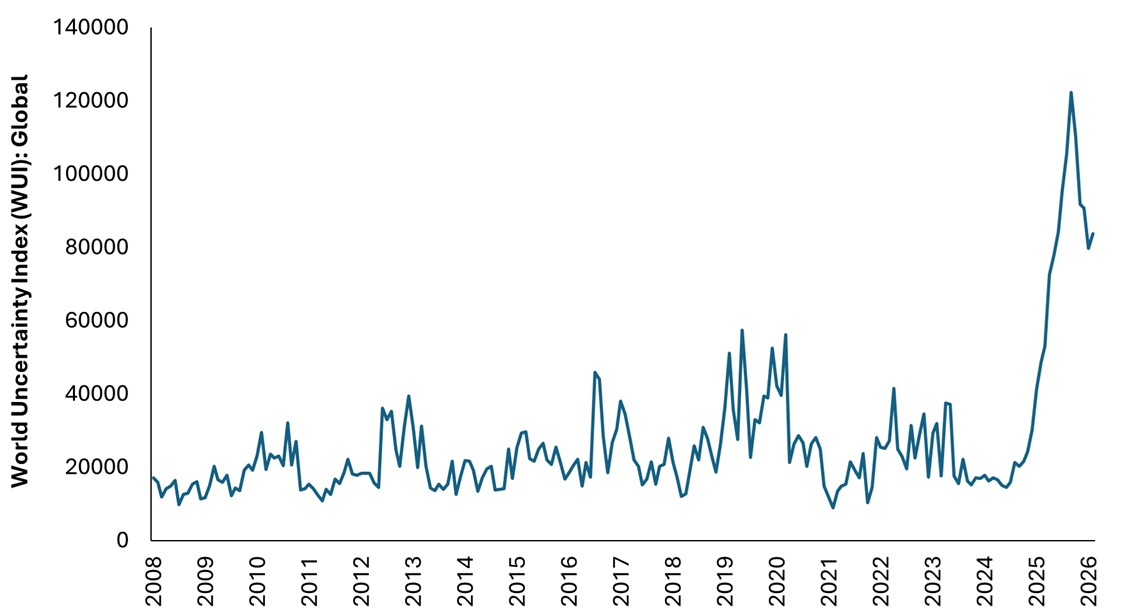
Source: World Uncertainty Index, GDP-weighted average, 1 January 2008 to 31 March 2026. Note: The WUI is computed by counting the percent of word “uncertain” (or its variants) in the Economist Intelligence Unit country reports, spanning 143 countries, before multiplying by 1,000,000. A higher number indicates higher uncertainty and vice versa. For example, an index of 200 corresponds to the word uncertainty accounting for 0.02 percent of all words.
Unlike past episodes driven by singular shocks, uncertainty today is more diffuse. – Luke Newman
Key Takeaways
- The World Uncertainty Index highlights rising global uncertainty, often linked to major market stress and volatility.
- Today’s uncertainty is broad and persistent, driven by trade shifts, policy change, and technological disruption.
- For absolute return strategies built around fundamental stock analysis, higher uncertainty can widen dispersion, improving stock selection opportunities across both long and short positions.
The World Uncertainty Index tracks the frequency of the word “uncertainty” across country reports compiled by the Economist Intelligence Unit, offering an insight into how policymakers and economists globally perceive the prevailing outlook.
Elevated readings have historically coincided with major stress events, from financial crises to geopolitical shocks. Tracking these shifts can help investors manage their exposure to risk.
What makes the current backdrop notable is not just the level of uncertainty, but its source. Unlike past episodes driven by singular shocks, uncertainty today is more diffuse. Trade relationships are shifting, supply chains are being reconfigured, and industrial policy is becoming more interventionist and confrontational, while technological disruption is bringing both opportunity and dislocation.
For long-only investors, these market conditions can be an obstacle, introducing the risk of higher share price volatility and weaker conviction. For absolute return investors employing long/short strategies, this dispersion can be a source of opportunity.
Companies with strong balance sheets, pricing power, or structural growth drivers may continue to perform, while more vulnerable businesses can see amplified downside risks. For long/short investors, this creates a richer opportunity set on both sides of the book. Assessing the level of market uncertainty can also help to frame risk management, serving as an early warning signal that encourages investors to reassess exposures, recalibrate position sizing, and ensure portfolios remain sufficiently flexible.
Absolute return investing: A type of investment strategy that seeks to generate a positive return over time, regardless of market conditions or the direction of financial markets, typically with a low level of volatility.
Balance sheet: A financial statement that summarises a company’s assets, liabilities, and shareholders’ equity at a particular point in time. Each segment gives investors an idea as to what the company owns and owes, as well as the amount invested by shareholders. It is called a balance sheet because of the accounting equation: assets = liabilities + shareholders’ equity.
Downside risk: An estimation of how much a security or portfolio may lose if the market moves against it.
Long position: A security that is bought with the intention of holding over a long period in the expectation that it will rise in value.
Long/short strategies: A portfolio that can invest in both long and short positions. The intention is to profit from combining long positions in assets in the expectation that they will rise in value, with short positions in assets expected to fall in value. This type of investment strategy has the potential to generate returns regardless of moves in the wider market, although returns are not guaranteed.
Pricing power: A company has pricing power when it can raise prices regardless of the economic backdrop without losing to competitors, whether that is due to the unique nature of its product, or specific market demand.
Short investing: Fund managers use this technique to borrow then sell what they believe are overvalued assets, with the intention of buying them back for less when the price falls. The position profits if the security falls in value.
Volatility: The rate and extent at which the price of a portfolio, security, or index, moves up and down. If the price swings up and down with large movements, it has high volatility. If the price moves more slowly and to a lesser extent, it has lower volatility. The higher the volatility, the higher the risk of the investment.
World Uncertainty Index (WUI): A measure that tracks uncertainty across the globe. The WUI is computed by counting the percent of word “uncertain” (or its variant) in the Economist Intelligence Unit country reports, across 143 countries. The WUI is then rescaled by multiplying by 1,000,000. A higher number means higher uncertainty and vice versa.
These are the views of the author at the time of publication and may differ from the views of other individuals/teams at Janus Henderson Investors. References made to individual securities do not constitute a recommendation to buy, sell or hold any security, investment strategy or market sector, and should not be assumed to be profitable. Janus Henderson Investors, its affiliated advisor, or its employees, may have a position in the securities mentioned.
Past performance does not predict future returns. The value of an investment and the income from it can fall as well as rise and you may not get back the amount originally invested.
The information in this article does not qualify as an investment recommendation.
There is no guarantee that past trends will continue, or forecasts will be realised.
Marketing Communication.
Important information
Please read the following important information regarding funds related to this article.
- Shares can lose value rapidly, and typically involve higher risks than bonds or money market instruments. The value of your investment may fall as a result.
- High exposure to a particular country or geographical region carries a higher level of risk than a more broadly diversified portfolio.
- If the Fund holds assets in currencies other than the base currency of the Fund, or you invest in a share/unit class of a different currency to the Fund (unless hedged, i.e. seeks to mitigate exchange rate movements between the share/unit class currency and the base currency of the Fund), the value of your investment may be impacted by changes in exchange rates.
- Derivatives may be used to help achieve the investment objective. This can result in leverage (higher levels of debt), which can magnify an investment outcome. Gains or losses may therefore be greater than the cost of the derivative. Derivatives also introduce other risks, in particular, that a derivative counterparty may not meet its contractual obligations.
- When the Fund, or a share/unit class, seeks to mitigate exchange rate movements of a currency relative to the base currency (hedge), the hedging strategy itself may positively or negatively impact the value of the Fund due to differences in short-term interest rates between the currencies.
- Securities could become hard to value or to sell at a desired time and price, especially in extreme market conditions when asset prices may be falling, increasing the risk of investment losses.
- Losses could be incurred if a counterparty became unwilling or unable to meet its obligations, or as a result of failure or delay in operational processes or the failure of a third party provider.
Specific risks
- Shares can lose value rapidly, and typically involve higher risks than bonds or money market instruments. The value of your investment may fall as a result.
- High exposure to a particular country or geographical region carries a higher level of risk than a more broadly diversified portfolio.
- If the Fund holds assets in currencies other than the base currency of the Fund, or you invest in a share/unit class of a different currency to the Fund (unless hedged, i.e. seeks to mitigate exchange rate movements between the share/unit class currency and the base currency of the Fund), the value of your investment may be impacted by changes in exchange rates.
- Derivatives may be used to help achieve the investment objective. This can result in leverage (higher levels of debt), which can magnify an investment outcome. Gains or losses may therefore be greater than the cost of the derivative. Derivatives also introduce other risks, in particular, that a derivative counterparty may not meet its contractual obligations.
- Securities could become hard to value or to sell at a desired time and price, especially in extreme market conditions when asset prices may be falling, increasing the risk of investment losses.
- Losses could be incurred if a counterparty became unwilling or unable to meet its obligations, or as a result of failure or delay in operational processes or the failure of a third party provider.