
Key takeaways:
- Technology is a driver of global economic change, transforming our daily lives. This creates opportunities for investors to identify the businesses best positioned to benefit from disruptive innovation.
- Successful technology investing requires balancing long-term growth opportunities with valuation discipline, helping investors navigate market hype while focusing on earnings, cash flows and fundamentals.
- As AI, geopolitics and policy shifts drive greater stock dispersion, active managers can add value through stock selection while managing downside risk.
Q: You run a global technology fund with one of the longest track records in Europe. What does this achievement mean to the team?
A: In the last three decades we have witnessed some significant technological shifts in modern history, driving some of the most profound changes in the global economy. A period that encompassed the full impact of the internet, and the early innings of the artificial intelligence (AI) era created the backdrop for a very strong period for stock market returns. These decades of innovation and disruption have created a stock market that is today dominated by the technology sector and by some of the key winners of these technology waves, notably the FAANG stocks (Facebook, Apple, Amazon, Netflix, Google) and more recently, NVIDIA.
We have successfully navigated such a dynamic over three decades and consistently identified major technological inflection points, along with some of the key winners within each wave. We consider that a testament to the strength of our investment philosophy, our focus on innovation and the trust investors have placed in us over multiple market cycles.
Our investment philosophy has remained consistent over the past quarter of a century: identifying underappreciated earnings power. The technology sector is the perfect hunting ground for such a philosophy given the repeated ability of new technologies to unlock much larger, new addressable markets. An industry that is ‘winner takes most’ also tends to concentrate the profits of these new technology waves into the hands of a relatively select group of winners. These tendencies favour an active approach, with a foundation of fundamental research to identify when these new technologies are ready to truly inflect, and which companies have the right to win.
We believe what further differentiates us from many peers is the team’s focus on valuation discipline. Investors tend to fall into one of two camps: value investors that are valuation-conscious; or ‘growth at any price’ investors that pay only lip service to valuation. We address the valuation challenges of investing in innovative sectors like technology in a different way. We seek to identify companies that have the potential to earn significantly more profits and cash flow than the market currently expects, which in turn often makes the stocks a lot cheaper than the market currently thinks. It is our belief that in the technology sector, price to earnings (P/Es) are opinions not fact. By this we mean the ‘E’ – earnings power – is prone to significant variation versus market consensus forecasts, creating opportunities for alpha generation.
Q: How has the technology sector evolved in the last three decades, what has surprised you?
A: In the mid-1990s, tech was a relatively small part of the global economy. The personal computing era was just taking off, and the internet was in its infancy. Many companies that dominate today’s markets either didn’t exist or were just starting out. We’ve seen a progression from personal computing to the internet, smartphones, cloud computing, digital payments, and now AI. What has surprised us most is the speed at which technology has become embedded in every sector of the economy, transforming not just how businesses operate but how people live and work. The consequence of those profound shifts have been new markets that grow exponentially through each technological wave as technology continues to disrupt and take share of the global economy.
As a result, looking at technology through a traditional sector or purely thematic lens is no longer appropriate given its scale and wide-ranging impact. Understanding the power of the internet to transform our lives, identifying the FAANGs and avoiding disrupted areas like high street retail and traditional media was a key driver of returns and alpha over the first two decades. More recently, with the dawn of generative and now agentic AI, that disruption is spreading further, impacting many more industries. The breadth of the technology industry today relative to 30 years ago has changed dramatically. We would argue that understanding these new technology waves and their impact is not just essential to being a technology investor but is the key to unlocking global stock market alpha, much more so than traditional frameworks based on geography, sector or size. The role of a technology specialist has never been more important.
Q: In your view, what makes a successful technology fund and fund manager?
A: Technology investing requires a combination of specialist knowledge, curiosity and discipline. Successful fund managers need to be able to identify, understand and quantify new, large addressable markets, emerging product cycles and the competitive advantages that enable companies to sustain growth over many years.
When assessing new technologies, it is important to navigate the hype cycle by focusing on realistic expectations of profit growth, not just revenue growth and the timing of those profits. We believe the trajectory of earnings estimates is the primary driver of stock returns. Avoiding hype cycles requires deep experience and strong valuation discipline. Our objective has always been to provide investors with exposure to technology’s compounding growth potential by aiming to identify the key inflections and true winners within each wave while using our focus on profits, cash flow and rational valuations to avoid some of the more significant drawdowns that the sector can experience.
Q: As the lead managers in the Global Technology Leaders Team, collectively you have more than 80 years of investment experience. What key lessons have you learned from managing a technology strategy through multiple tech waves?
A: One of the most important lessons is that markets frequently underestimate the scale of new technology wave markets and the power of compounding growth. Investors often dismiss innovative companies because they appear expensive, only to find that earnings growth far exceeds expectations over time.
At the same time, not every promising company delivers on its potential. The key is to stay focused on fundamentals; profits, earnings, cash flows and sustainable competitive moats rather than short-term market sentiment. Patience is critical, but it must be supported by rigorous analysis and a willingness to challenge assumptions when new information emerges. This is a patience and discipline we have learnt over decades, when the technology sector was not so in vogue. That experience required us to play by the same rules as other sectors rather than falling for the fallacy that because we focus on a highly innovative sector, the rules in some way do not apply. We think our discipline focused on profits, cash flows and rational valuations has stood the test of time, navigating through multiple technological, market and economic cycles.
Q: What is the most memorable stock you’ve owned, and what did it teach you?
A: Almost four years since the launch of ChatGPT, we see parallels to Apple post the launch of the iPhone. Back at the end of 2010, the iPhone was well established, and the market was looking for the next big thing. This de-rating caused Apple to trade below the market multiple on the expectation that growth would slow, and Apple would ultimately be the next Nokia or Motorola as smartphone competition picked up. The market had focused only on the product Apple sold, the fact that Apple had created a valuable ecosystem was missed. The App Store enabled the emergence of the mobile internet and the FANG (Facebook, Amazon, Netflix, Google), creating an addressable market far greater in scale and durability than the market appreciated at the time. Apple has returned more than 25% p.a. from the end of 2010, becoming the first listed US company to reach US$3 trillion market capitalisation.1
In a similar vein, NVIDIA in the past few years has dominated in an AI compute market that has grown exponentially larger than the prior public cloud data centre market before it. This has driven earnings power and ultimately stock market returns far in excess of market expectations. Both companies now sit with market capitalisations of more than US$5 trillion.2 Being able to identify these generational opportunities is what we believe defines a successful technology investor.
Q: What are the biggest mistakes investors can make when investing in technology stocks?
A: Not understanding that P/Es are opinions and not a fact. By not doing your own homework and relying on consensus forecasts that often just extrapolate the past, you can miss outsized returns from key technology wave winners. The shift to passive investing also ignores the dynamic nature of the technology sector, which means the winners of the past will not necessarily be those of the future. If you invested in the ten largest technology stocks at the end of 2010 you would have held six underperformers including two stocks that underperformed broader global equities.3 The benchmark only tells you who was successful in the past, not who is going to be a winner in the future.
Looking back over the last 20 years, technology has provided investors with positive returns over 80% of the time,4 but you want to be able to try and mitigate the downside risk and the volatility. The key to that is to be able to navigate the hype cycles that tend to come with technology. Opportunities for innovation and disruption tend to get overhyped in the short term and underestimated in the long term. This tends to be reflected in valuations and ignoring valuation can result in exposure to the biggest drawdowns. We saw this in the dot.com crash as well as in 2021-22 when unprofitable and the highest valuation technology stocks were hit the hardest.
Navigating the hype cycle
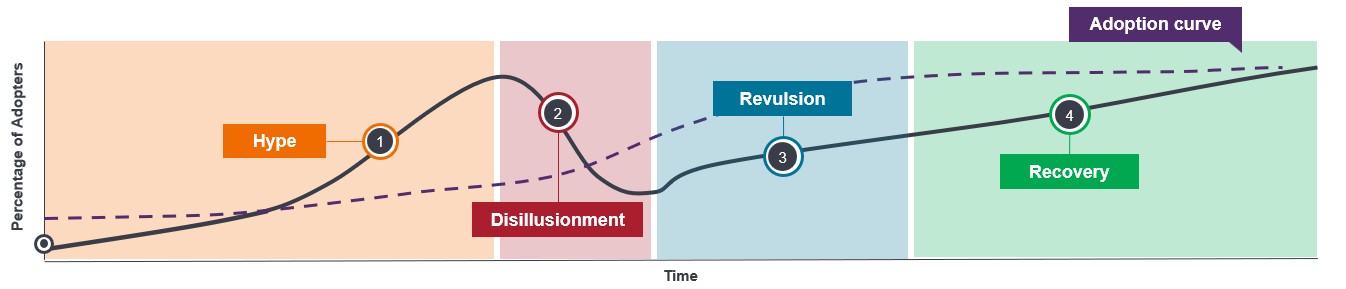
Source: Janus Henderson Investors. For illustrative purposes only.
Q: Tech stocks currently dominate global indices. How can an active manager add value?
A: Technology’s growing weight in global indices can give the impression that investors already have sufficient exposure through broad market funds. Inherently, the sector is highly dynamic and fast evolving. True technological waves like PC/internet, mobile/cloud and now AI take decades to mature. As each wave develops leaders emerge with dominant business models. But the winners of today may become tomorrow’s losers, with both emerging and established businesses facing constant competitive pressure. The AI wave is still in its early stages and is likely to dwarf previous tech waves in its impact on the global economy, capital markets and our everyday lives. Identifying where to invest and which stocks can outperform in each stage of the tech wave’s development is where the best active managers can add the most value.
Active managers can also add value by adjusting position sizes given even the most attractive structural winners’ valuations can run ahead of their fundamentals, and identify opportunities across the wider tech ecosystem. Active managers also navigate the macro environment: the return of the cost of capital, heightened geopolitical uncertainty, and more policy and regulation-driven markets are resulting in higher stock dispersion, which favours disciplined active managers. While the market likes to think through the lens of stock acronyms, ignoring the fact that the Magnificent 7 or the FAANGs before that very rarely uniformly outperformed with significant stock dispersion in any given year within those groupings,5 provides opportunity for alpha generation by differentiated portfolio positioning (stock selection and weighting).
Q: How do you think investing in the tech sector will change in the next five years?
A: Artificial intelligence and automation are likely to be among the most significant drivers of change over the coming decade. Their impact will extend far beyond the technology sector, influencing productivity, business models and competitive dynamics across the global economy. This makes the addressable market for AI exponentially larger than prior technology waves. AI markets are unlikely to be constrained by IT budgets, but by the value of knowledge work.
Innovation is increasingly disrupting parts of the market that were once viewed as stable and predictable. As technology becomes an even more important component of global equity markets, we expect specialist research and active management to remain essential in identifying the companies best positioned to benefit from the next wave of transformation.
IMPORTANT INFORMATION
There is no guarantee that past trends will continue, or forecasts will be realised.
References made to individual securities do not constitute a recommendation to buy, sell or hold any security, investment strategy or market sector, and should not be assumed to be profitable. Janus Henderson Investors, its affiliated advisor, or its employees, may have a position in the securities mentioned.
1 Bloomberg, AAPL total return 31 December 2010 to 15 October 2026. CNBC; ‘Apple becomes first U.S. company to reach $3 trillion market cap’; 3 January 2022. 2 Yahoo! Finance, NVDA US$5.13 trn; AAPL US$5.05 trn as at 22 October 2026. 3 Bloomberg, 10 largest stocks by market cap as at end December 2010, total returns end December 2010 to 30 September 2026. Comparison versus MSCI ACWI IT Index (tech) and MSCI ACWI Index (broader equities) total returns over the same period. 4 Janus Henderson Investors, Bloomberg as at 31 December 2025. Technology return referenced to MSCI ACWI Information Technology Index (net returns). Calculated using three year holding period returns, on a monthly rolling basis. Period of measurement January 2006 through September 2025. 5 Bloomberg; AAPL, MSFT, GOOGL, AMZN, META, NVDA, TSLA, NFLX annual returns 2017- 2025. Past performance does not predict future returns. Active investing: An investment management approach where a fund manager actively aims to outperform or beat a specific index or benchmark through research, analysis, and the investment choices they make. The opposite of passive investing. Alpha: The difference between a portfolio’s return and its benchmark index after adjusting for the level of risk taken. This measure is used to help determine whether an actively-managed portfolio has added value relative to a benchmark index. Cash flow: The net balance of cash that moves in and out of a company. Positive cash flow shows more money is moving in than out, while negative cash flow means more money is moving out than into the company. Cloud computing: The provision of IT services remotely by specialised service providers over the internet. De-rating: The downward adjustment of a company’s valuation e.g. via financial ratios like price-to-earnings (P/E), in response to business or market uncertainty, lower expectations for future earnings, etc. Dot.com era: Refers to the internet boom of the 1990s, driven by the groundbreaking shift to digital commerce. While some companies thrived and are today’s technology leaders, investor overenthusiasm drove many stocks to very high valuations despite questions about the sustainability of their business models, leading to the dotcom bubble bursting in 2000. Downside risk: An estimation of how much a security or portfolio may lose if the market moves against it. Drawdown: A measure of historic risk that looks at the difference between the highest and lowest price of a portfolio or security during a specific period. It is used to evaluate the possible risk and reward of an investment. FAANG: an acronym coined in 2013 for what were widely considered to be among the highest growth tech stocks namely Facebook (now Meta Platforms), Amazon, Apple, Netflix and Google (now Alphabet). Fundamental analysis: The analysis of information that contributes to the valuation of a security, such as a company’s earnings or the evaluation of its management team, as well as wider economic factors. Magnificent Seven: Refers to the seven major technology stocks: Apple, Microsoft, NVIDIA, Amazon, Tesla, Alphabet, and Meta, that have dominated markets in recent years. Navigating the hype cycle: The “hype cycle” represents the different stages in the development of a technology, from conception to widespread adoption, which includes investor sentiment towards that technology and related stocks during the cycle. Price-to-earnings ratio (P/E): A popular valuation metric that measures share price compared to earnings per share for a stock or stocks in a portfolio. Rational valuations: Valuations that appear reasonable and justifiable based on a company’s fundamentals and prospects, rather than prices driven mainly by excessive optimism or market hype. Stock dispersion: How much the returns of individual stocks in a benchmark differ from the average return of the benchmark. Valuation metrics: Metrics used to gauge a company’s performance, financial health and expectations for future earnings, for example the price-to-earnings ratio and return on equity. Volatility: The rate and extent at which the price of a portfolio, security or index moves up and down. Larger price movements indicate higher volatility and investment risk.
These are the views of the author at the time of publication and may differ from the views of other individuals/teams at Janus Henderson Investors. References made to individual securities do not constitute a recommendation to buy, sell or hold any security, investment strategy or market sector, and should not be assumed to be profitable. Janus Henderson Investors, its affiliated advisor, or its employees, may have a position in the securities mentioned.
Past performance does not predict future returns. The value of an investment and the income from it can fall as well as rise and you may not get back the amount originally invested.
The information in this article does not qualify as an investment recommendation.
There is no guarantee that past trends will continue, or forecasts will be realised.
Marketing Communication.