Key takeaways:
- At the conclusion of his second meeting as Fed Chair, Kevin Warsh delivered tough words on the primacy of price stability but fell short of providing a concrete plan on how the Fed’s 2.0% target can be achieved.
- According to Warsh, the rise in yields this summer intimates that the market is buying into the Fed’s new approach of letting price signals do the work rather than the central bank attempting to influence outcomes through forward guidance.
- We believe the volatility exhibited in longer-dated yields could persist until the Fed presents a less ambiguous framework around what will drive its policy decisions.
The July Federal Open Market Committee (FOMC) meeting will likely be remembered less for the decision itself and more for the market’s reaction to Chairman Kevin Warsh’s explanation of it.
On paper, the outcome was straightforwardly hawkish: The Fed left rates unchanged at 3.50%-3.75%, retained language describing growth as solid and inflation as elevated, and delivered a notable 9-3 vote, with Beth Hammack, Neel Kashkari, and Lorie Logan dissenting in favor of an immediate 25 basis point (bp) hike. That alone represented the strongest hawkish signal embedded in a split vote in a decade.
Yet markets ultimately looked through the hawkish optics and focused on something else: the lack of clarity around how, when, and under what conditions the Fed intends to return inflation to its 2.0% target.
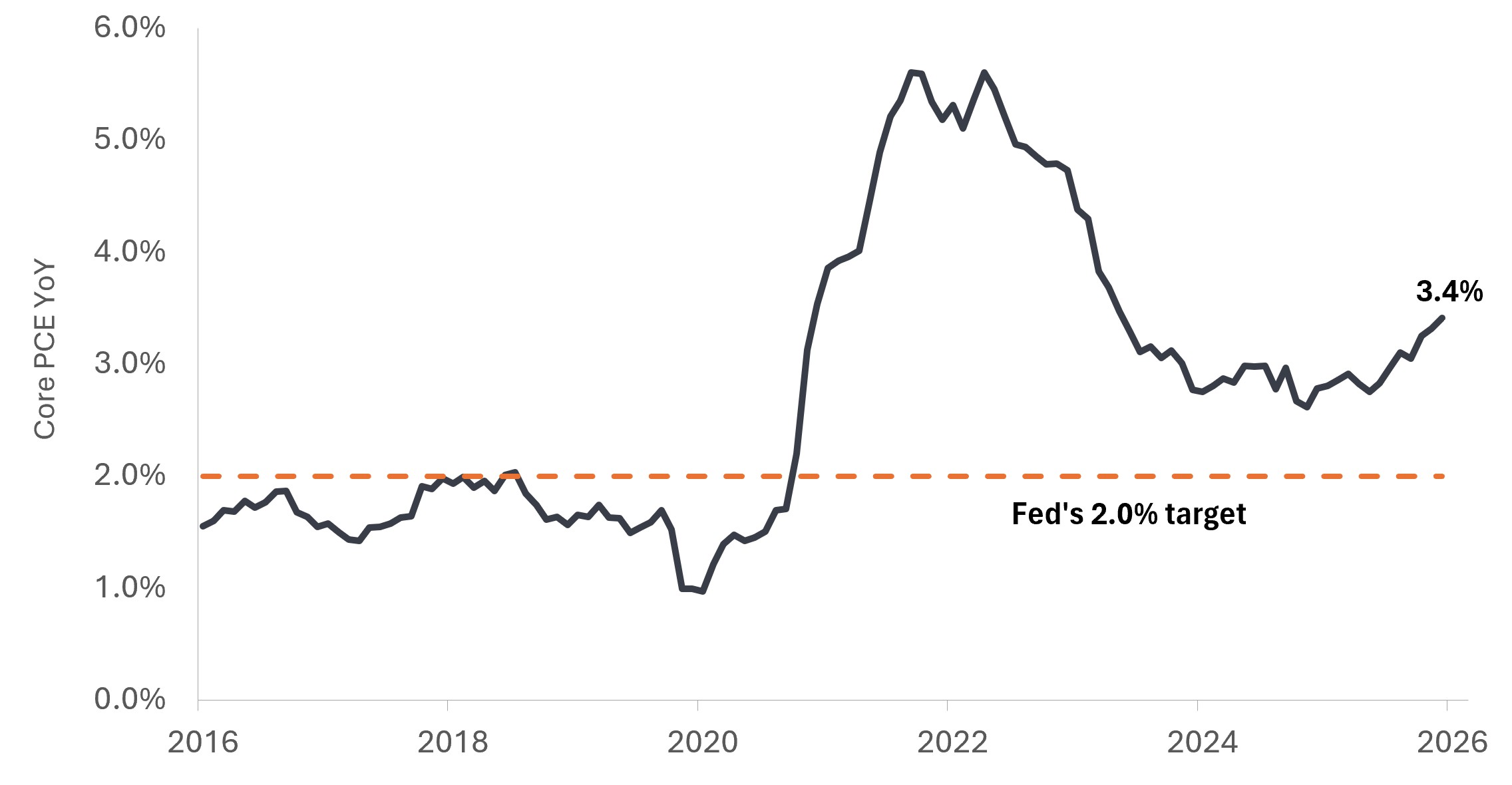
Exhibit 1: The elusive 2.0% goal
Chairman Warsh was forthright in his assessment that years of above-target inflation have posed challenges for consumers and businesses and dented the Fed’s credibility.
Source: Bloomberg, as of 29 July 2026.
Throughout the press conference, Warsh repeatedly emphasized that inflation has remained above target for more than five years and reiterated his commitment to a hard 2.0% inflation objective. He stressed that there is “no soft inflation target” and repeatedly argued that the Fed would deliver price stability.
The problem was that investors were left asking the same question by the end of the press conference that they were asking at the beginning:
“If inflation remains too high, why didn’t the Fed hike today?”
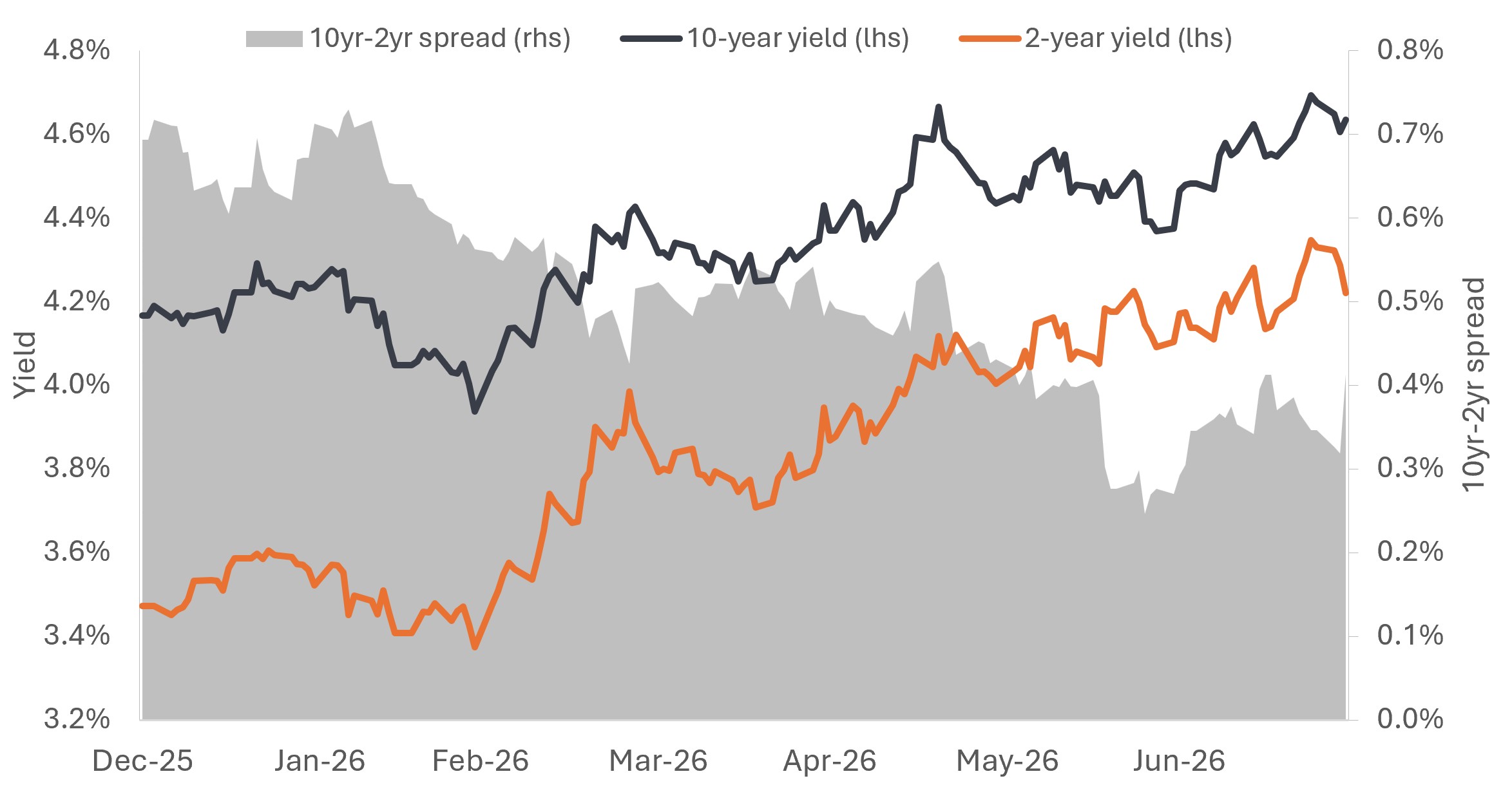
Warsh’s answer centered on the significant tightening that had already occurred through market rates. Real and nominal Treasury yields have risen materially since June, and his argument was effectively that financial conditions had tightened even without an increase in the policy rate.
Exhibit 2: Year-to-date 10-year and 2-year U.S. Treasury yields
While higher yields along the front end of the curve suggest the market is willing to take the Fed at its word on maintaining price stability, the absence of a formalized plan has sent longer-dated yields up, potentially intimating a “show me” mentality.
Source: Bloomberg, as of 29 July 2026.
Intellectually, that is a defensible position: Markets often do some of the Fed’s work. But communication matters. Rather than providing a clear framework for future policy decisions, Warsh repeatedly circled back to themes such as market signals, uncertainty, task forces, and the need to answer the “big questions” facing the economy. What he did not provide was a convincing explanation of what additional evidence is required before the committee acts.
As a result, markets appeared to conclude that although the Fed remains committed to its destination, its roadmap has become less clear. That stance was reflected in the market’s price action during and after the press conference: The front end of the U.S. Treasuries curve rallied as investors removed the residual probability of a July hike and substantially reduced September tightening expectations.
At the same time, the long end sold off sharply, producing a material steepening in the curve. The difference between 10-year and 2-year yields steepened by around 11 bps, while the 30-year/2-year curve widened roughly 17 bps. Additionally, breakeven inflation rates derived from Treasuries moved higher across the curve. Particularly notable was the roughly 6 bps increase in 5-year inflation expectations – essentially a gauge of expected inflation between 2031 and 2036 and one of the market’s most closely watched measures of the Fed’s long-run inflation credibility.
Mixed messages
The discord between Warsh’s hawkish rhetoric and the Fed’s dovish interpretation is difficult to ignore. Markets are effectively saying two things simultaneously:
1. The Fed is less likely to tighten in the near term than previously thought.
2. The path back to 2% inflation is less certain than it appeared before the press conference.
We would stop short of saying Chairman Warsh has already lost inflation credibility. It’s only his second meeting as Chair, and he perhaps deserves a mulligan. Furthermore, his repeated commitment to returning inflation to target was arguably the strongest part of the entire event. However, he may have dented the Fed’s policy credibility.
While markets appear willing to believe his destination, they seem to be less certain about his plan for getting there. In that sense, this meeting evolved from a hawkish hold into something more complicated: A Fed that remains deeply concerned about inflation but one that is increasingly asking markets to trust its commitment, without yet providing a sufficiently detailed framework for future action.
The key question heading into September is no longer whether the Fed wants 2% inflation – it clearly does. The question is whether policymakers are relying too heavily on tighter market rates doing the work for them and hoping that yet-to-be-determined task-force conclusions will assuage investors’ concerns when inflation remains above target today.
For now, the market’s verdict is clear: strong commitment, unclear roadmap. While there are many variables, we can expect volatility on longer-dated Treasuries until the market gets more confident that the Fed indeed has a framework that can lead to long-term price stability.
IMPORTANT INFORMATION
Fixed income securities are subject to interest rate, inflation, credit and default risk. The bond market is volatile. As interest rates rise, bond prices usually fall, and vice versa. The return of principal is not guaranteed, and prices may decline if an issuer fails to make timely payments or its credit strength weakens.
10-Year Treasury Yield is the interest rate on U.S. Treasury bonds that will mature 10 years from the date of purchase.
Basis point: One basis point (bp) equals 1/100 of a percentage point, 1bp = 0.01%.
Duration: Duration measures the sensitivity of a bond’s or fixed income portfolio’s price to changes in interest rates. The longer a bond’s duration, the higher its sensitivity to changes in interest rates and vice versa.
The Federal Open Market Committee (FOMC) is the body of the Federal Reserve System that sets national monetary policy.
Monetary policy: The policies of a central bank, aimed at influencing the level of inflation and growth in an economy. Monetary policy tools include setting interest rates and controlling the supply of money.
Volatility measures risk using the dispersion of returns for a given investment.
Yield: The level of income on a security over a set period, typically expressed as a percentage rate.
Yield curve: A yield curve plots the yields (interest rate) of bonds with equal credit quality but differing maturity dates.
These are the views of the author at the time of publication and may differ from the views of other individuals/teams at Janus Henderson Investors. References made to individual securities do not constitute a recommendation to buy, sell or hold any security, investment strategy or market sector, and should not be assumed to be profitable. Janus Henderson Investors, its affiliated advisor, or its employees, may have a position in the securities mentioned.
Past performance does not predict future returns. The value of an investment and the income from it can fall as well as rise and you may not get back the amount originally invested.
The information in this article does not qualify as an investment recommendation.
There is no guarantee that past trends will continue, or forecasts will be realised.
Marketing Communication.