Key takeaways:
- International market performance has been driven by broad sector participation, particularly technology, financials and energy, highlighting how exposure to AI-related demand, resilient banking fundamentals and supportive commodity prices has created multiple sources of return rather than reliance on a single theme.
- While AI investment remains a powerful tailwind, the focus is increasingly shifting towards companies that can convert AI into productivity gains across sectors such as financial services, manufacturing and healthcare, creating potential new avenues for earnings growth beyond the initial infrastructure build-out.
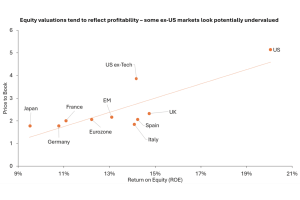
- International markets continue to offer what we see as attractive diversification benefits through higher income, lower valuations and corporate change initiatives, but investors should remain mindful of risks tied to concentrated AI spending and geopolitical conflicts, reinforcing the importance of balance-sheet strength and diversification.
Footnotes and definitions
Footnotes and definitions:
1 Portfolio performance …refers to share class, currency, reporting period, source and date. State 2 benchmark names. Portfolio positions as at XXX (referring to the sector weightings throughout. ) Past performance…
2 Janus Henderson Global Dividend and Buyback Index, Q1 2026.
Balance sheet strength: A company’s financial position.
Barriers to entry: Factors that can prevent or hinder new competitors from entering into an industry or business area, such as high start-up costs, patents, technical knowledge, brand loyalty, etc.
Benchmark: A standard (usually an index) that an investment portfolio’s performance can be measured against.
Capital expenditure (CapEx): Money invested to acquire or upgrade fixed assets such as buildings, machinery, equipment, or vehicles in order to maintain or improve operations and foster future growth.
Diversification: A way of spreading risk by mixing different types of assets or asset classes in a portfolio on the assumption that these assets will behave differently in any given scenario. Assets with low correlation should provide the most diversification.
Dividend: A variable discretionary payment made by a company to its shareholders.
Dividend payout ratio: The percentage of earnings (after tax) that are distributed to shareholders in the form of dividends in a year.
Earnings per share (EPS): EPS is the bottom-line measure of a company’s profitability, defined as net income (profit after tax) divided by the number of outstanding shares.
Exposure: The amount invested in an asset or market, and could potentially lose, should an investment fail. It is another way of describing financial risk.
Forward earnings: An estimate of the future earnings of a business, usually covering the present financial year or the next one.
Inflation: The rate at which the prices of goods and services are rising in an economy. The consumer price index (CPI) and retail price index (RPI) are two common measures.
Interest rates: The amount charged for borrowing money, shown as a percentage of the amount owed. Base interest rates are generally set by central banks and influence the interest rates that lenders charge.
Leverage: The use of borrowing to increase exposure to an asset or market. This can be done by borrowing cash and using it to buy an asset, or by using financial instruments such as derivatives to simulate the effect of borrowing for further investment in assets.
Outperform: To deliver a return greater than that of a portfolio’s assigned benchmark, also often called excess return.
Price-to-earnings (P/E) ratio: A popular ratio used to value a company’s shares compared to other stocks or a benchmark index. It is calculated by dividing the current share price by its earnings per share.
Pricing power: A company has pricing power when it can raise prices regardless of the economic backdrop without losing to competitors, whether that is due to the unique nature of its product, or specific market demand.
Total return: A performance measure that reflects the actual rate of return of an investment or a pool of investments over a given evaluation period.
Yield: The level of income on a security expressed as a percentage rate.
Yield to worst: A measure of the lowest possible yield that can be received on a bond that fully operates within the terms of its contract without defaulting.
View transcript
Where are you finding opportunities?
Ben Lofthouse: We haven’t really changed very much recently, to be honest. The tailwinds of higher rates continue to help the banking sector. The AI CapEx wave has showed no sign of abating. New areas are appearing, though defensive sectors that have been considered sensitive to bond yields have got very cheap. And we’ve had a low exposure to these sectors. So, we are looking there. And the beneficiaries of AI productivity companies are starting to harness the benefits of AI in areas like financial services, transport, manufacturing and healthcare, which could help them improve their profitability in the future. So that’s an area we’re looking at closely.
Why do you believe it’s an attractive time to invest in international markets?
Lofthouse: There is a low exposure to the areas that people worry about, both from the disruption of AI, such as software and online services, where other indices around the world just don’t have as much exposure to those sectors, and also to artificial intelligence spending if things slow down. The international markets tend to have exposure to areas like commodities, energy, where in recent years there hasn’t been as much investment, and so, there’s much more diversification.
In terms of income, the yields and dividends around the world are higher for international markets and are continuing to grow strongly. And finally, I’d say there’s a good total return and growth opportunity. There’s a lot of corporate change in many markets. Places like Japan are changing culturally in terms of corporate culture. And generally, the valuations are lower than they are in the US. So, these are themes we’ve spoken about for a number of years, and they continue to kind of help international outperformance versus the US.
What are the key risks and opportunities?
Lofthouse: I’d say the key opportunity is obviously a resolution to two conflicts, the two very large conflicts that are going on this world. A lot of pain in markets is priced in in terms of the higher inflation and the higher energy prices that both of these conflicts are causing. And so, you know, if we if we saw any kind of resolution to those, I think you’d see a big relief, and some of the sectors that have underperformed the most, like the consumer sectors, for example, could see much better performance.
The other thing on the risk side I’d flag is just the AI CapEx is a very, very large figure and it is helping a lot of sectors. It’s a very large amount of investment in a time when many other sectors aren’t investing very much, and also, there is quite a large concentration in some equity markets, such as the US and some parts of the emerging markets. So, I think remaining diversified remains important for investors.
What is the outlook for dividends and income generation?
Lofthouse: Global dividends have continued to grow this year. Our last dividend report2, which came out for Q2, reported 7% growth in dividends in US dollar year on year. Financial sector dividends grew faster than that at around 11%. But the fastest growth came from technology, which grew 20% year on year. These are both big sectors for the world, and so they’re very much helping offset some of the inflation impact for investors who are getting those dividends.
Earnings growth across markets remain strong. And that is the best predictor that we’ve found about future dividend growth. So, in our view the opinion the outlook looks good.