
Key takeaways:
- Our survey found that most investors view AI as a durable, long-term structural force rather than a fleeting trend. However, enthusiasm is tempered by concerns around hype and valuations, especially in the near term.
- Surprisingly, many investors believe their current AI exposure is modest or nonexistent, presenting an opportunity for advisors to educate clients on what they own and position AI holdings as part of a risk-managed, long-term growth strategy.
- Understanding investors’ concerns can help advisors frame client conversations around the importance of patience and discipline as the AI investment landscape evolves.
Artificial intelligence (AI) is the most talked-about technological, economic, and societal force today. Nearly every day, we read about how AI is poised to transform industries, businesses, and our day-to-day lives.
As the excitement around AI continues to build, due to the complexity of the technology and its implications, it’s not surprising that many investors feel uncertain about how to best approach it as an investment theme. With our 2026 Investor Survey, we sought to gain insight into investors’ biggest concerns, as well as how they expect AI to impact market returns in both the near term, and over the next five years.
Hype risk is a top investor concern
As with any theme of this magnitude, investors are understandably questioning whether AI will be able to live up to fulfill its promise. Indeed, “AI not living up to the hype” was the most frequently cited concern in our survey, followed closely by valuation risk, ethical issues, and fears that returns will accrue disproportionately to a small number of dominant firms.
These concerns stem from real risks that are inherent to the “winner-takes-all” environment surrounding AI, in which companies that enable or successfully deploy the technology will emerge as winners while those that fail to adapt will be left behind.
Acknowledging investors’ apprehension can help advisors frame client conversations and manage expectations. This includes highlighting the importance of patience and discipline and avoiding the implicit assumption that AI adoption automatically translates into equity upside – concepts that should resonate with investors who are approaching AI investment with caution.
Disparity in short- and long-term outlook
Given that the risk of overestimating AI is a top concern, it’s not surprising that roughly two-thirds (67%) of respondents said they are very or somewhat concerned about an AI bubble or AI-driven market correction in the next 12 months.
Those concerns are evident in investors’ confidence in AI’s return potential: Only about half of those surveyed believe AI-focused companies will deliver superior long-term returns, and nearly three-quarters don’t expect to change their AI exposure in the next 12 months.
However, a key finding is that those fears and lack of confidence appear mostly limited to the near term. When asked what impact they believe AI will have on overall market returns over the next five years, 61% expect it to have a modest or major positive impact. This suggests that most investors view AI as a durable, long-term structural force rather than a fleeting trend.
These conflicting views on AI’s short- and long-term potential create an opportunity for advisors to be proactive in framing AI as a multi-cycle transformational secular theme, not a short-term thematic allocation. If investors are hesitant to change their AI exposure out of fears of a possible bubble, advisors can explain how they are prioritizing firms that are creating competitive advantages through their use of AI while avoiding those that are already falling behind.
Confidence that AI-focused companies will deliver superior long-term returns
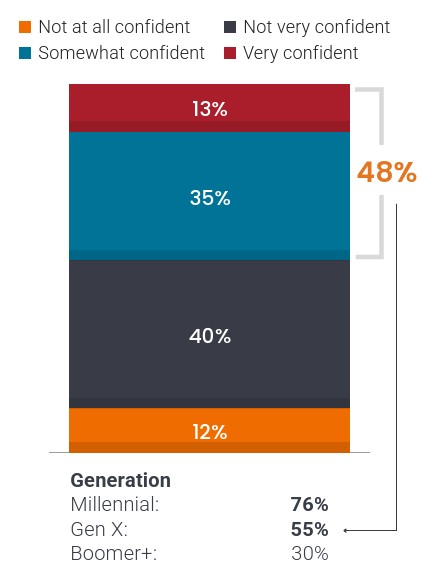
It’s worth noting that the responses were not uniform across all respondents: We saw a pronounced generational and wealth divide, with younger investors – and those with higher net worth – reporting significantly higher confidence in AI-focused companies’ potential to outperform over the long term. Advisors should be aware of these differences and approach conversations with clients accordingly.
Investors underestimate – and likely misunderstand – their AI exposure
Most investors access AI through broad market indexes or technology‑focused ETFs and mutual funds. Direct ownership of AI-related equities or private investments is less common, indicating that in many portfolios, AI exposure is incidental rather than intentional.
How investors are gaining exposure to AI
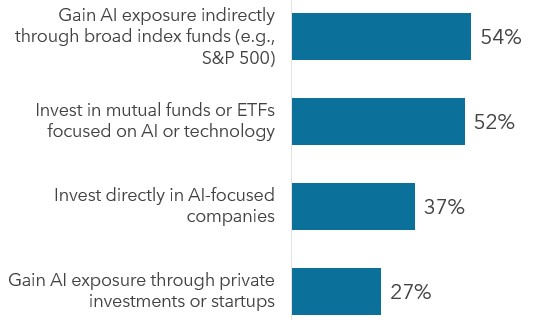
The most notable finding regarding investor AI exposure is not reflected in the above chart, which excludes investors who are not currently and not planning to invest in AI in any form – a group which accounted for a whopping 46% of respondents overall. Furthermore, comfort with AI allocations above 10% remains limited, particularly among older cohorts, who control the majority of investable assets.
The fact that many investors believe their current AI exposure is modest or nonexistent represents a significant opportunity for advisors to educate clients on what they own – especially considering AI is already embedded across core market and technology holdings. Advisors can initiate these conversations by making implicit AI exposure explicit within existing holdings, then positioning AI holdings as part of risk‑managed growth strategies – not speculative satellites.
A multi-layered opportunity
Our 2026 Investor Survey provided valuable insight into how investors are thinking about AI and helped reinforce our views on the complexity of AI as an investment theme. As a firm, we view AI as not a single investment opportunity, but rather three distinct opportunities with different levels of maturity and risk.
The first is the enablers: the infrastructure layer of semiconductors, networking, power, and hyperscale compute that is building the foundation for everything else. This is the most mature opportunity today, with visible revenue, established leaders, and earnings already flowing through to shareholders.
The second is the enhancers: the software and platform companies creating AI – whether large language models or AI built for a specific use case – and embedding AI into existing products to drive productivity, pricing power, and new revenue streams. The economics here are still developing, and the winners are only beginning to separate from the pack.
The third, and earliest, is the beneficiaries: the broad set of companies across healthcare, financials, industrials, and consumer sectors that will use AI to lower costs, reshape business models, and unlock entirely new markets.
Each layer carries a different risk profile, a different time horizon, and a different role in a portfolio, which is why we believe investing in AI requires a deliberate framework rather than a single thematic bet.
This complexity may help explain some of the hesitancy, uncertainty, and misunderstandings investors are experiencing around AI investing, as revealed in our survey. For advisors, acknowledging investors’ concerns is the first step to having productive conversations about AI. By educating clients on the distinct opportunities and risks and stressing the importance of a deliberate, selective approach, advisors can manage expectations and help clients feel confident about how they are positioned within this evolving theme.

Artificial intelligence (“AI”) focused companies, including those that develop or utilize AI technologies, may face rapid product obsolescence, intense competition, and increased regulatory scrutiny. These companies often rely heavily on intellectual property, invest significantly in research and development, and depend on maintaining and growing consumer demand. Their securities may be more volatile than those of companies offering more established technologies and may be affected by risks tied to the use of AI in business operations, including legal liability or reputational harm.