

Key takeaways:
- Global equities delivered solid returns in December, led by developed Europe and Asia Pacific ex‑Japan. U.S. markets were mixed, with broader participation beyond mega-cap tech as momentum behind the AI trade faded into year end.
- Global sovereign bonds posted mixed performance as yields on longer-dated bonds rose. Global corporate bonds fared better, delivering largely positive returns as spreads narrowed.
- Policy divergence and shifting growth signals defined December: The U.S. Federal Reserve (Fed) and Bank of England (BoE) delivered rate cuts while the European Central Bank (ECB), Canada, and Australia held steady and the Bank of Japan hiked. Long-dated yields climbed on fiscal and inflation pressures, even as global equities hit record highs amid sector rotation and optimism for 2026.
Market overview
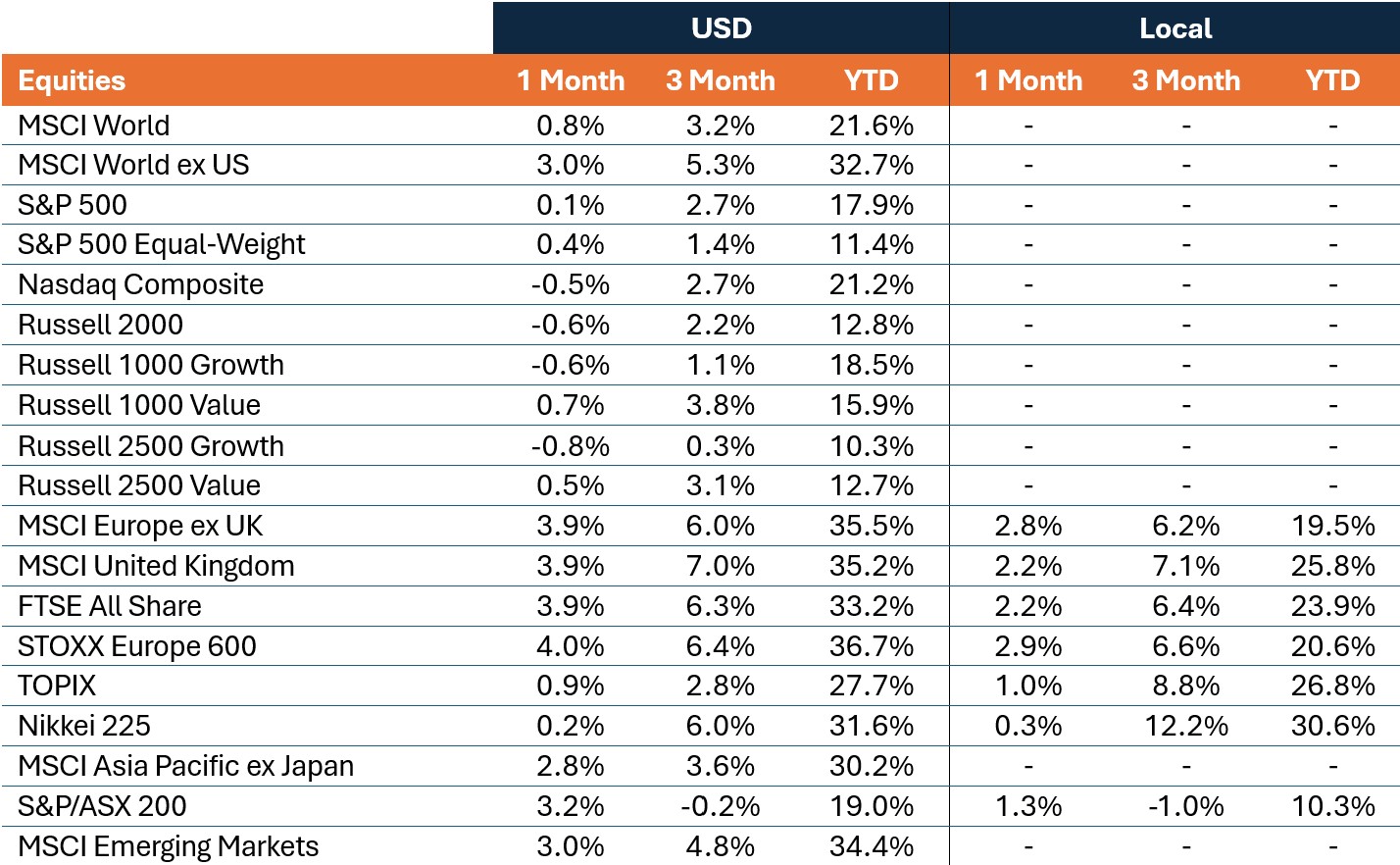
Global equities advanced in December, with broadening participation outside of U.S. mega-caps and stronger gains across developed Europe and Asia Pacific ex‑Japan. The MSCI World Index rose 0.8% in U.S. dollar terms, while the MSCI World ex US Index gained 3.0%. Cyclical and value exposure outperformed in several regions. Global government bonds delivered modestly negative returns for the month as yields on long-dated bonds rose. Global corporate bonds fared better, delivering largely positive returns as spreads narrowed.
Oil prices declined again, with WTI and Brent both lower for a fifth straight month. WTI ended 2025 down nearly 20% on the year. Gold rose 1.9%, capping a nearly 65% one-year gain to deliver its best year since 1979. The U.S. Dollar Index declined 1.1%, finishing down more than 9% on the year.
International equities deliver strongest returns in over a decade
The MSCI World ex USA Index outpaced the S&P 500® Index in 2025 after years of underperformance, boosted by a resilient global economy and weaker U.S. dollar.
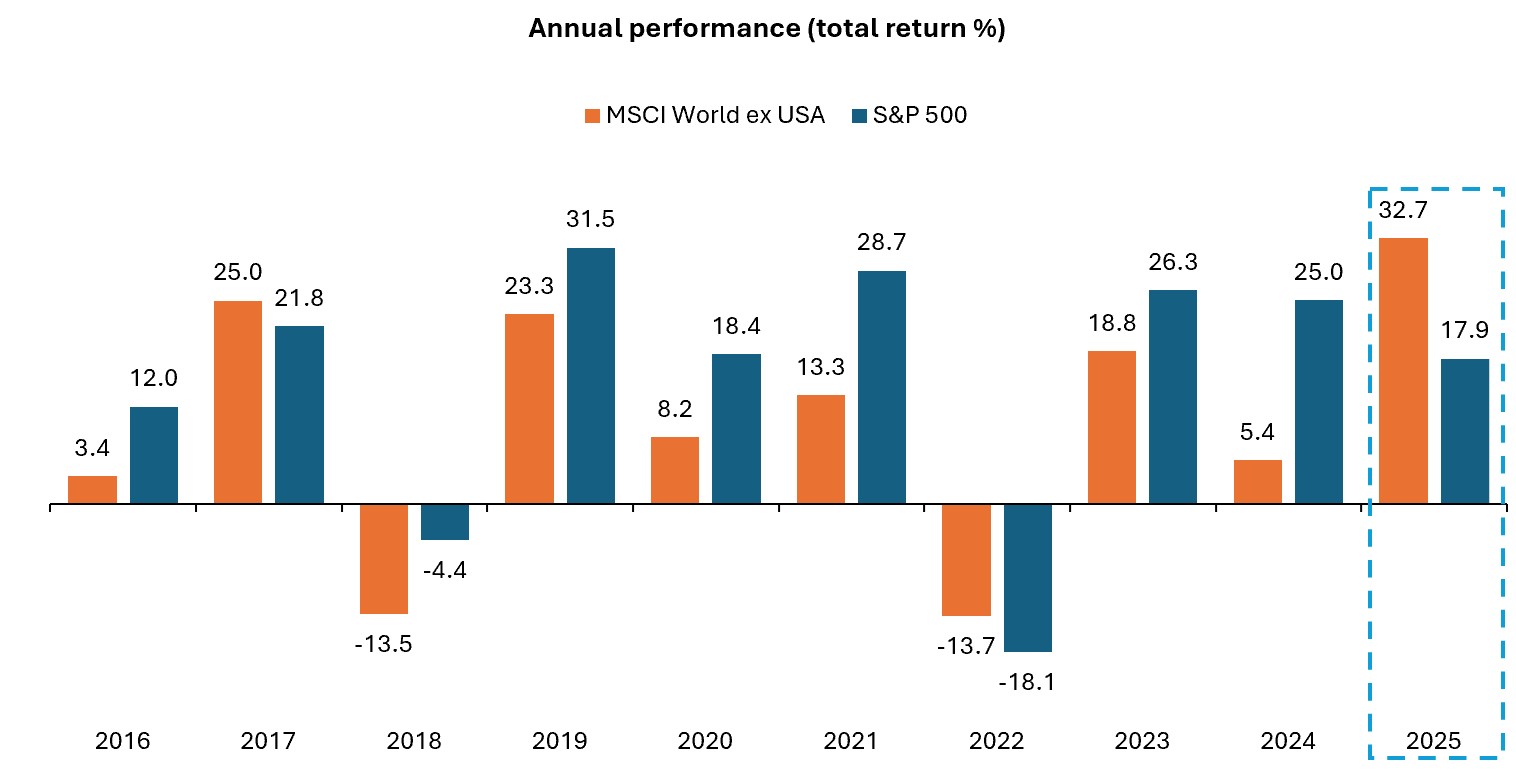
Source: Bloomberg, as of 31 December 2025. The MSCI World ex USA Index captures large- and mid-cap representation across 22 of 23 developed markets countries, excluding the United States.
Key themes that mattered for markets
- The Fed’s “hawkish cut” and divided committee underscore a higher bar for further easing: The Federal Open Market Committee (FOMC) delivered a 25 basis-point (bps) cut, as widely expected, but paired it with cautious guidance, emphasizing the tension between inflation risks and a softening labor market. The unusually split vote (9-3) underscored internal division, while the Summary of Economic Projections maintained just one further cut each in 2026 and 2027.
- Policy divergence sharpens as several major central banks appear done with easing: The Fed and BoE, having lagged G7 peers in the pace of their rate‑cut cycles, delivered December cuts and signaled scope for further reductions in 2026. In contrast, the ECB, Bank of Canada, and Australia held rates steady, with markets increasingly pricing in the possibility of rate hikes by the end of 2026. The Bank of Japan (BoJ) remained an outlier, hiking by 25 bps in December as it continued its gradual policy normalization.
- U.S. “data catch‑up” delivered mixed signals and stirred doubts about data quality: Delayed releases first showed weaker employment and much softer-than-expected inflation data, reinforcing the case for additional rate cuts in 2026. Then, a surprisingly strong Q3 GDP print (+4.3%) raised concerns that letting the economy run hot could spark inflation. Economists flagged flaws in the delayed inflation and payrolls reports, casting doubt on their reliability.
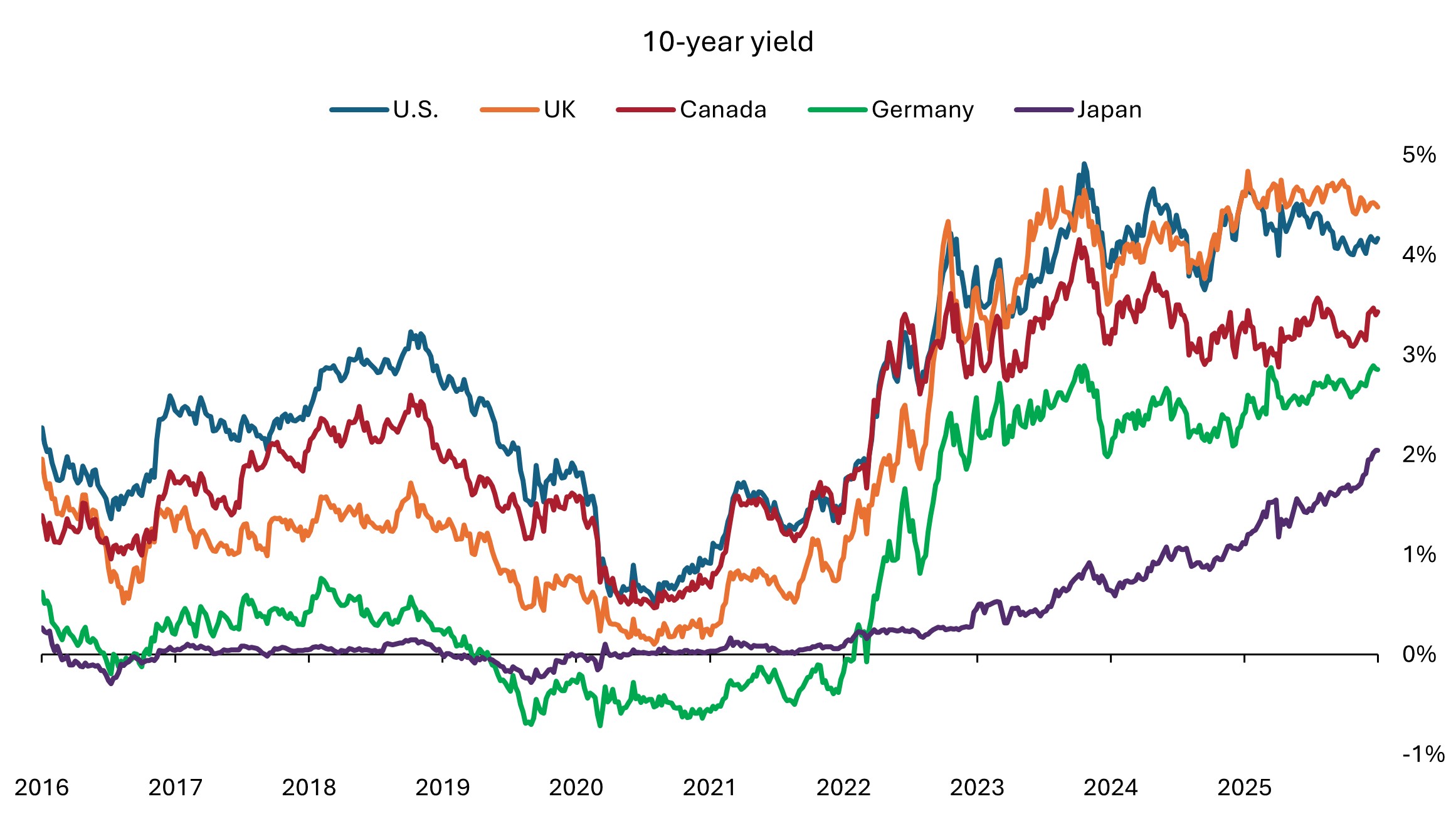
- Long‑dated sovereign yields climbed in December: German 10‑year Bund yields approached multi‑year highs, while Japan’s 10‑year breached 2% for the first time since 1999 as the BoJ advanced normalization. The rise underscores structural pressures from heavy fiscal issuance and persistent inflation, reinforcing a “higher for longer” backdrop for global bonds despite two years of policy easing by major central banks.
- Global equity markets ended the year near record highs, powered by sector rotation beneath the surface: In the U.S., leadership continued to broaden beyond mega-cap tech into year end as investors shifted toward cyclicals amid firmer growth expectations and optimism for further Fed easing. The pro-cyclical bent extended to Europe, which maintained its value bias as banks, mining, and energy continued to lead gains, supported by resilient growth signals and positioning for 2026.
United States
U.S. equities were mixed in December, with muted performance across benchmarks but notable shifts below the surface. Mega-cap tech took a backseat as a rotation into cyclicals gained momentum coming out of November, reflecting a shift toward more balanced market leadership and increasingly selective positioning in AI‑related names.
Sector rotation: Cyclicals outperformed defensives into year end
Since the recent November 20 market bottom, cyclicals notably outperformed traditionally defensive stocks amid optimism for economic growth and further Fed rate cuts in 2026.
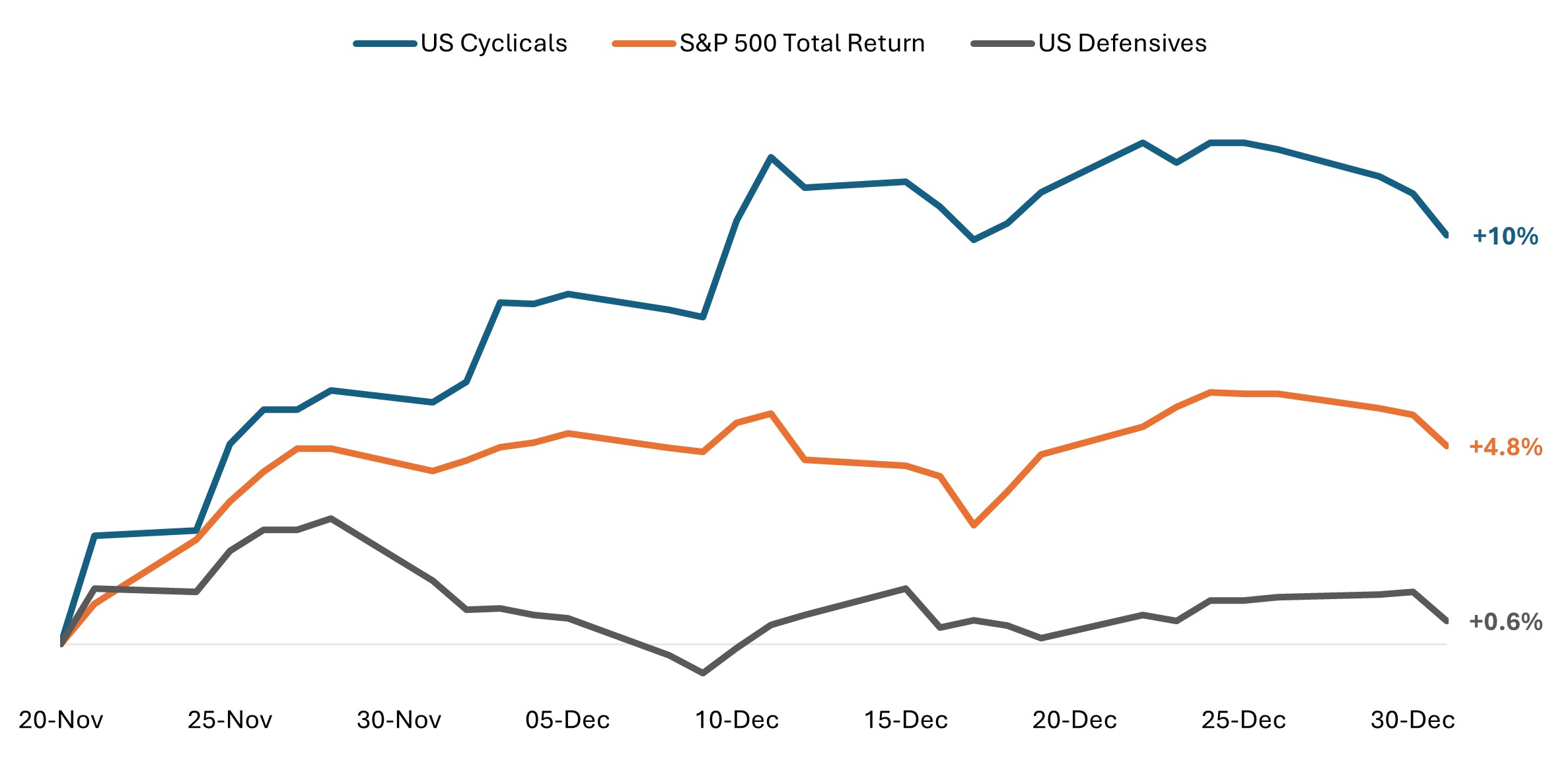 Source: Bloomberg, as of 31 December 2025. Cyclicals = Goldman Sachs US Cyclicals Index; heavily weighted toward Financials, Industrials and Consumer Discretionary. Defensives = Goldman Sachs US Defensives; heavily weighted toward Healthcare, Utilities, Staples and Real Estate.
- The S&P 500 edged up 0.1%, posting a nearly 18% gain for 2025 on a total return basis, its third straight year of double-digit gains.
- The Nasdaq Composite declined 0.5%, lower for a second straight month, but still ended 2025 with a more than 20% annual gain.
- The small-cap Russell 2000 fell 0.6% after outperforming in the prior month.
- Growth and mega-cap technology stocks lagged, while value and traditionally cyclical sectors outperformed. The Russell 1000 Growth Index declined 0.6%, whereas its value counterpart rose 0.7%.
S&P 500 sector performance (December & year to date)
Sector performance highlighted continued rotation, broadening beyond big tech.
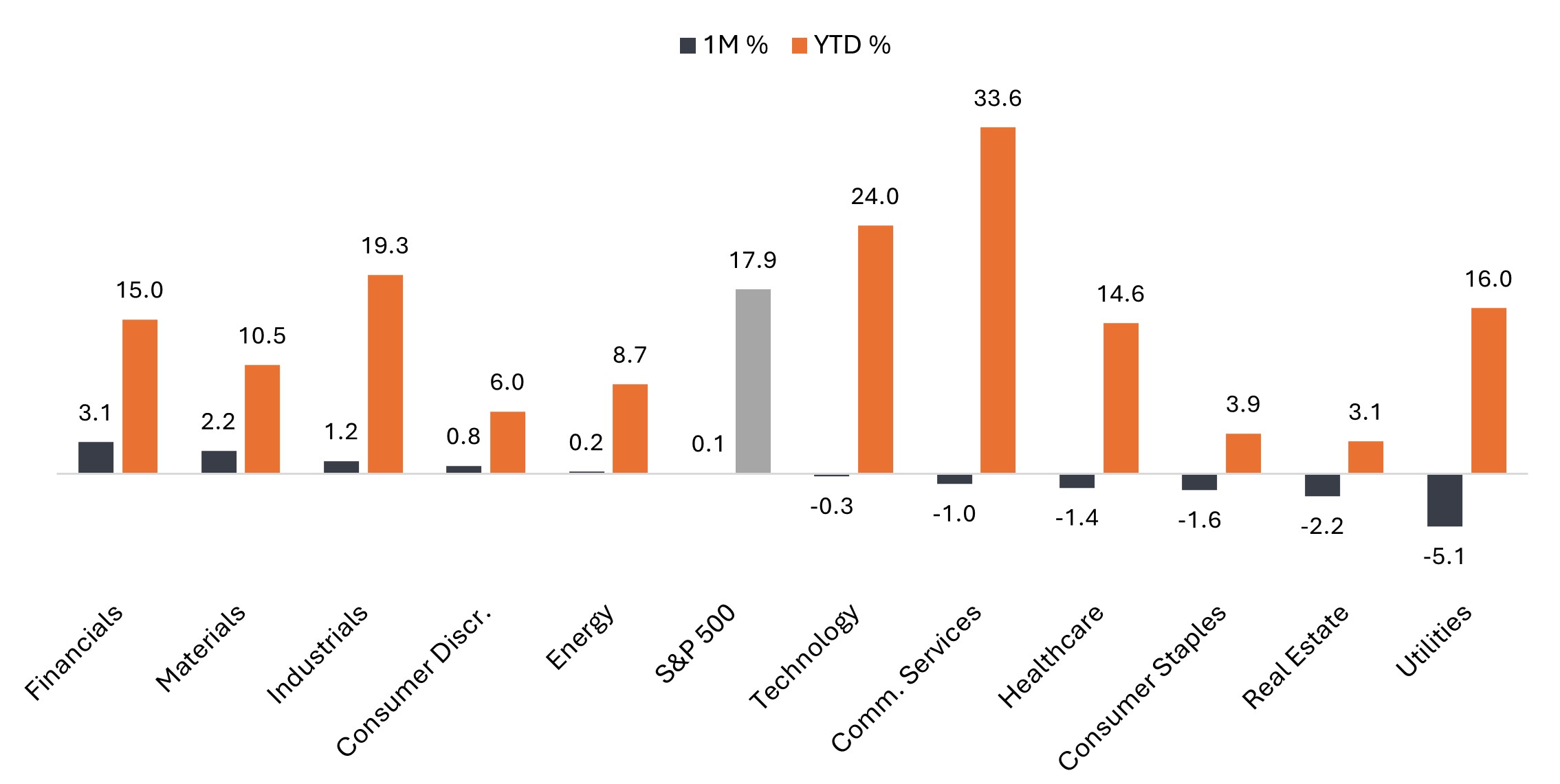
Source: Bloomberg. As of 31 December 2025.
Fed policy and previously delayed economic data grabbed the spotlight:
- The Fed cut rates by 25 bps, as widely expected, while the 9-3 split on the vote garnered much of the attention. Minutes from the December 10 FOMC meeting revealed most Committee members expect further rate cuts in 2026.
- The delayed first look at Q3 GDP showed the U.S. economy grew 4.3%, well ahead of consensus expectations and the strongest growth in two years.
- November inflation data came in cooler than expected. The Consumer Price Index (CPI) eased to 2.7% year over year while core CPI (ex food and energy) fell to 2.6%, its lowest level since March 2021.
- Nonfarm payrolls fell by 105,000 in October and rose by 64,000 in November, while the unemployment rate rose to 4.6%, reflecting further softening in the labor market.
U.S. employment: Nonfarm payrolls
U.S. jobs growth has stagnated since April, with job losses in three of the last six months.
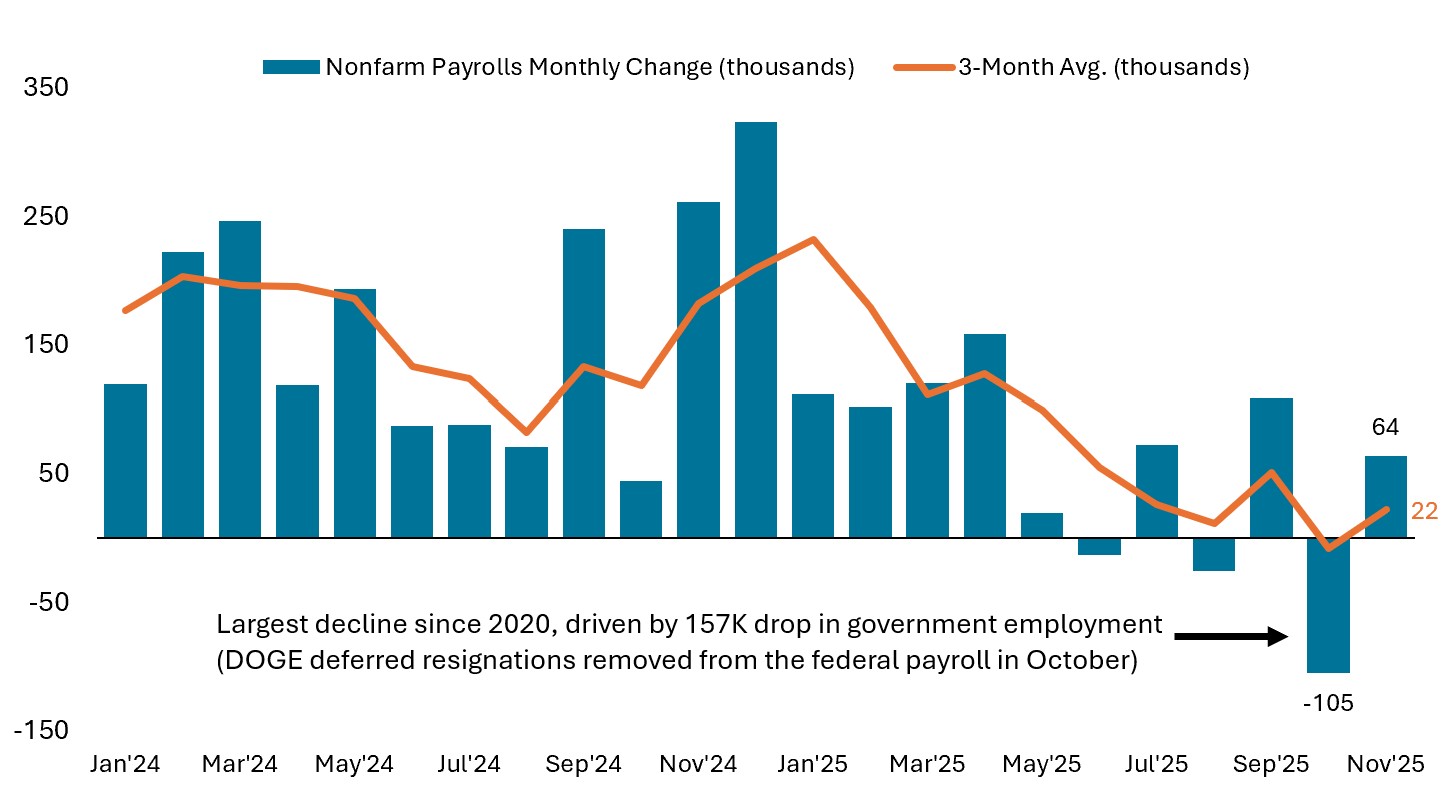
Source: Bureau of Labor Statistics, Bloomberg.
Europe
Eurozone equities ended the year on a strong footing, supported by growing confidence in the region’s economic outlook and prospects for broader earnings growth in 2026. The MSCI Europe ex UK Index rose 4.0% in U.S. dollar terms and 2.8% in euro. Major benchmarks across the regions closed out 2025 near record highs.
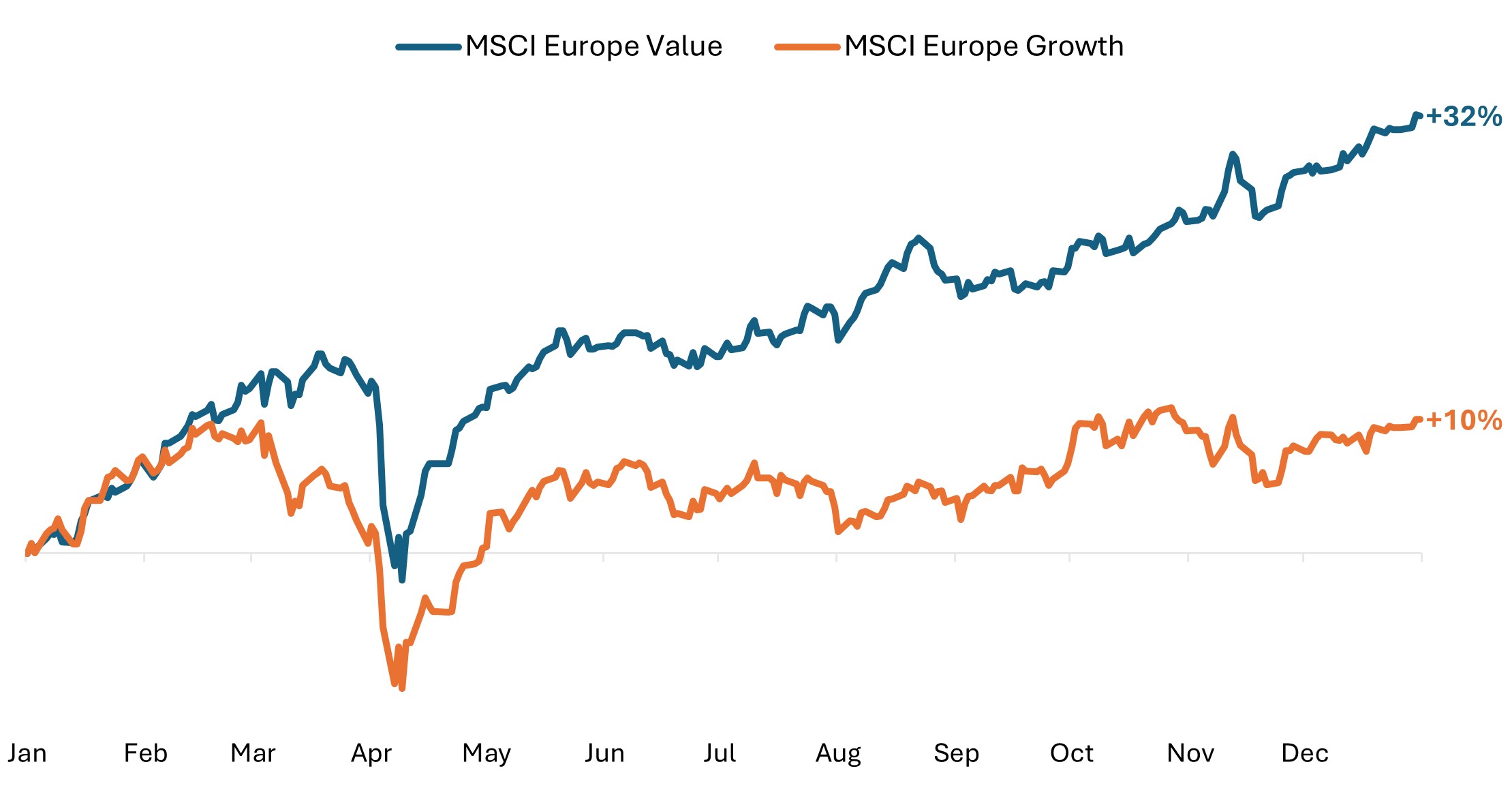
- The pro-cyclical dynamic was evident in Europe, with value extending its sizeable year-to-date lead over growth in December.
- The ECB left interest rates on hold, as expected, though the Governing Council modestly increased both its growth and inflation forecasts for 2026. That said, policymakers signaled no urgency to cut or hike rates and largely endorsed market expectations for an extended pause well into 2026.
- European business activity remained in expansion, though softened month on month. The preliminary reading for Eurozone composite purchasing managers’ index (PMI) moderated to 51.9 in December, down from 52.8 in November (a reading above 50.0 indicates expansion).
- Political uncertainty persisted in France as the government failed to approve a state budget but passed a stopgap bill to avert a shutdown.
European value stocks notably outperformed growth in 2025
In contrast to the technology- and growth-heavy U.S. equity market, value significantly outperformed growth in Europe over the past year.
Source: Bloomberg, as of 31 December 2025. Value = MSCI Europe Value Net Total Return Local Index. Growth = MSCI Europe Growth Net Total Return Local Index.
UK equities delivered solid gains in December, supported by cooler-than-expected inflation and monetary policy easing. The MSCI United Kingdom Index rose 3.9% in U.S. dollar terms and 2.2% in sterling, figures which were also matched by the FTSE All Share Index.
- UK CPI eased to 3.2% in November from 3.6% in October, below the 3.5% forecast and marking the lowest level since March, confirming views that inflation has likely peaked in the near term.
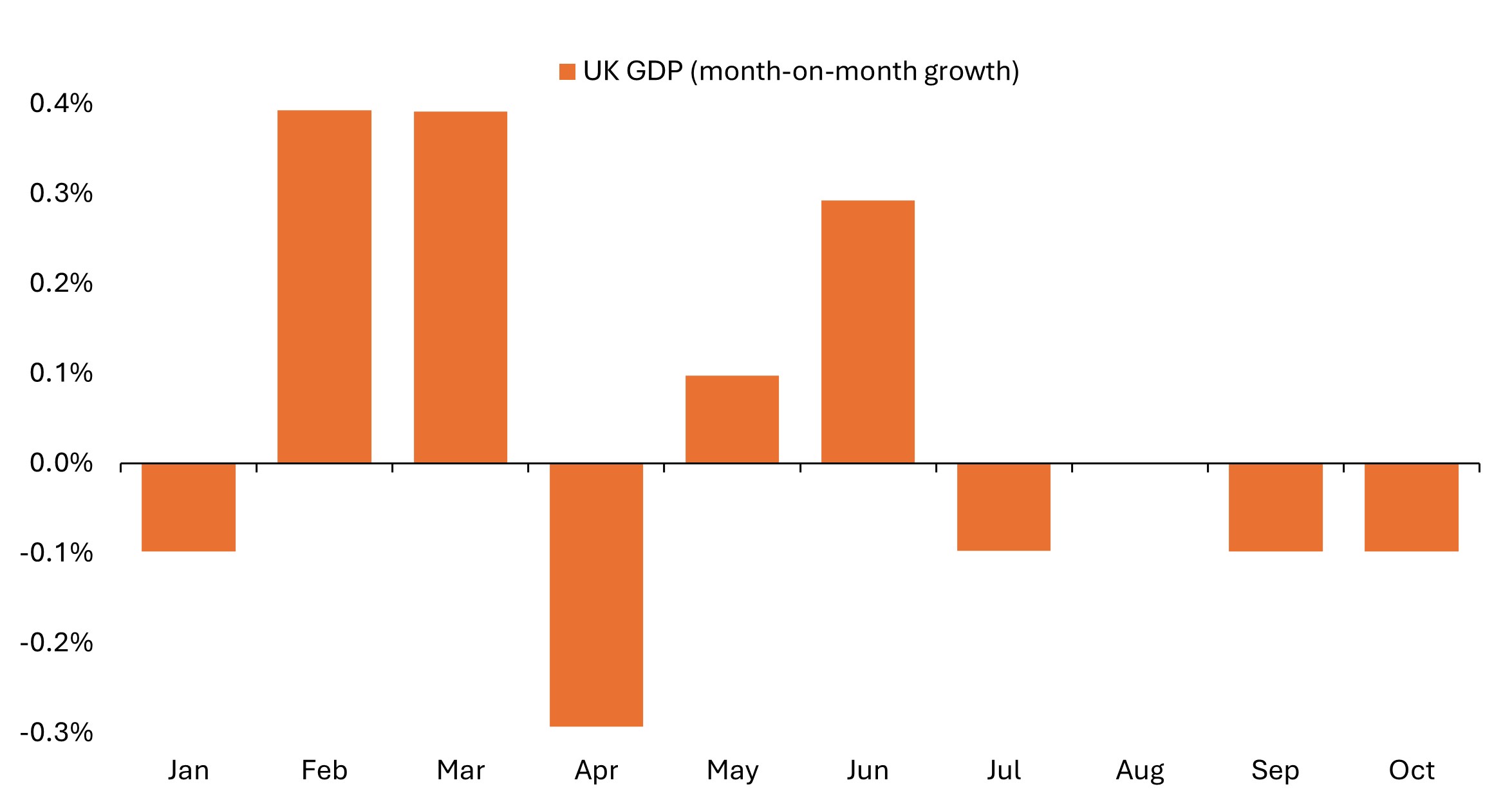
- UK GDP contracted 0.1% in October, marking a second straight monthly decline and reinforcing expectations for policy easing.
- The Bank of England (BoE) lowered its policy rate by 25 bps in a split 5-4 vote, with policymakers citing subdued growth and easing inflation pressures.
- There were signs of a pickup in business activity after the November Budget as the flash reading for UK composite PMI improved to 52.1 for December, up from 51.2 in November.
UK economy unexpectedly contracted in October
GDP has not grown since June and has been either flat or falling in the past four monthly releases.
Source: Office for National Statistics (ONS).
Across the STOXX 600 – comprising companies from 17 countries across developed Europe including the UK – sector dispersion widened, reflecting rotation toward cyclicals.
- Basic Resources (+10.3% in euro terms) led amid a rally in precious metals and copper, while Banks (+7.9%) added to strong year-to-date gains supported by lower interest rates.
- Retail (+7.5%) and Travel & Leisure (+3.8%) also posted strong gains, supported by robust holiday sales and resilient travel demand. Industrials rose 3.2% amid ongoing defense spending, though optimism was tempered at times by headlines on Ukraine peace talks.
- Conversely, Food & Beverage (-1.2%) led decliners amid the rotation away from defensive sectors, while Chemicals (-1.1%) extended the sector’s year-to-date underperformance amid ongoing concerns around weak end-market demand visibility.
Asia Pacific
Japanese equities saw modest gains in December, with headlines centered on the Bank of Japan’s policy stance and messaging, firm wage dynamics, and yield moves that kept the yen volatile and investors attentive to the cadence of any future rate hikes. The TOPIX rose 1.0% in yen terms and 0.9% in U.S. dollars, while the Nikkei 225 increased 0.3% in local terms.
- The BoJ raised its policy rate by 25 bps to 0.75%, the highest level in 30 years, while signaling openness to further hikes. Messaging disappointed markets as economists criticized the lack of clarity on the pace of tightening.
- The 10-year Japanese government bond (JGB) yield climbed above 2.0% following the BoJ decision, reaching its highest level since 1999.
Asia Pacific ex Japan rallied broadly. Financial press coverage highlighted AI demand tailwinds and an evolving policy backdrop across the region. The MSCI AC Asia Pacific ex Japan Index rose 2.8% in U.S. dollar terms. Strength was notable in Korea and Taiwan, up 12.7% and 5.9%, respectively, in U.S. dollar terms. Australia’s ASX 200 gained 3.2% in U.S. dollar terms (+1.3% in AUD), with miners bolstered by higher metal prices while healthcare and IT stocks fell. China lagged, with the MSCI China Index down 1.2% in U.S. dollar terms as investors weighed stimulus signaling against uneven economic activity data.
Emerging Markets
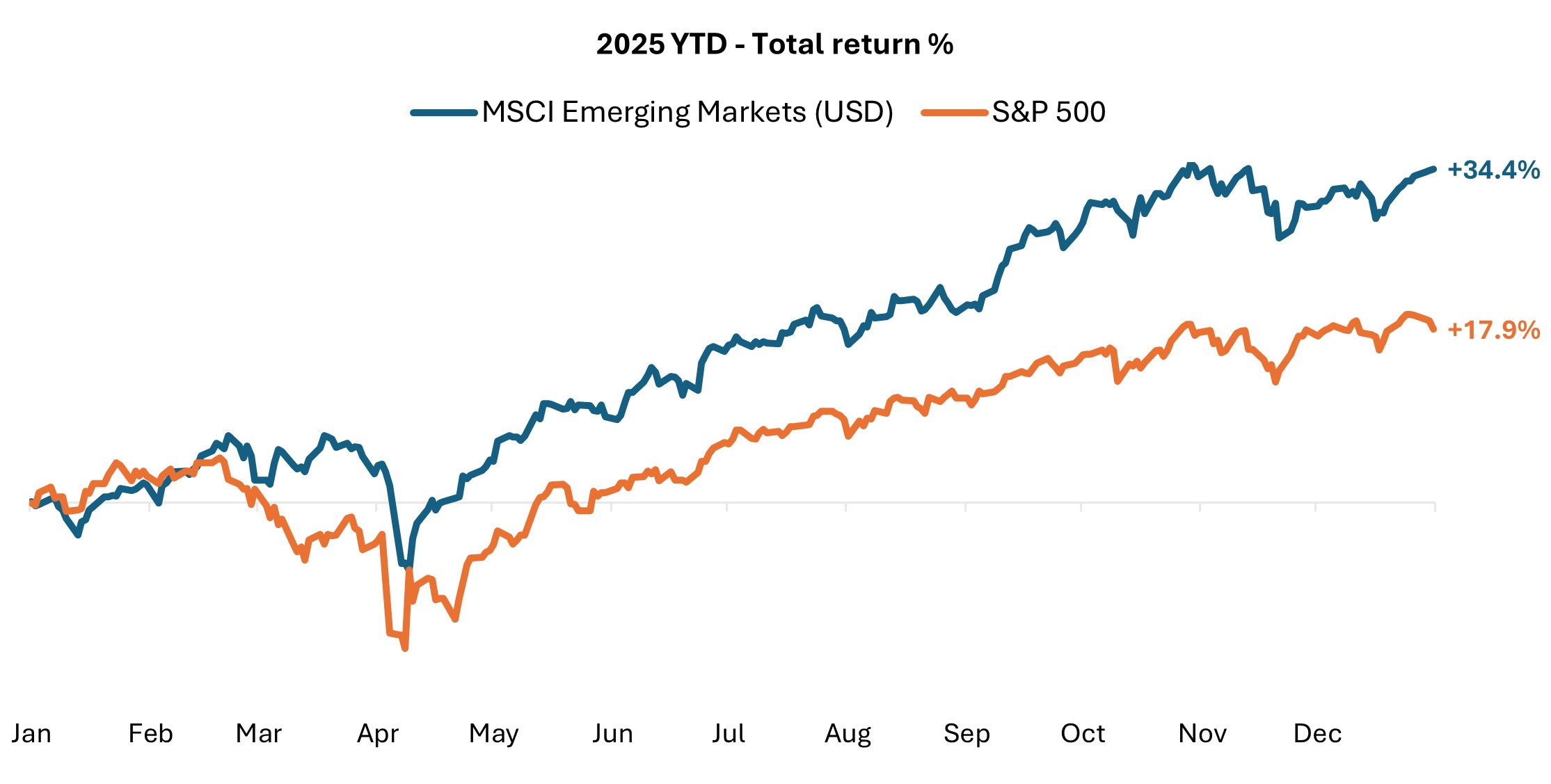
Emerging market equities rose in December, with leadership concentrated in Asia tech-exposed markets and selected commodity-linked regions. The MSCI Emerging Markets Index rose 3.0% in U.S. dollar terms, ending 2025 up nearly 35% on the year for its best annual performance since 2017.
- Korea (+12.7%) and Taiwan (+5.7%) led emerging market countries in Asia, recovering from a pullback in November. Other standouts included South Africa gaining 9.1%, Chile up 7.6%, and Mexico up 3.4%, while Brazil slipped 1.2%.
- Cross currents included currency moves, commodity price dynamics, and evolving central bank stances, with India easing policy and several Asia markets watching the U.S. policy path and China stimulus narrative.
Emerging market equities outperformed U.S. stocks by a wide margin in 2025
The MSCI Emerging Markets Index delivered its best annual performance since 2017.
Source: Bloomberg, as of 31 December 2025. The MSCI Emerging Markets Index captures large- and mid-cap representation across 24 emerging markets countries.
Fixed Income
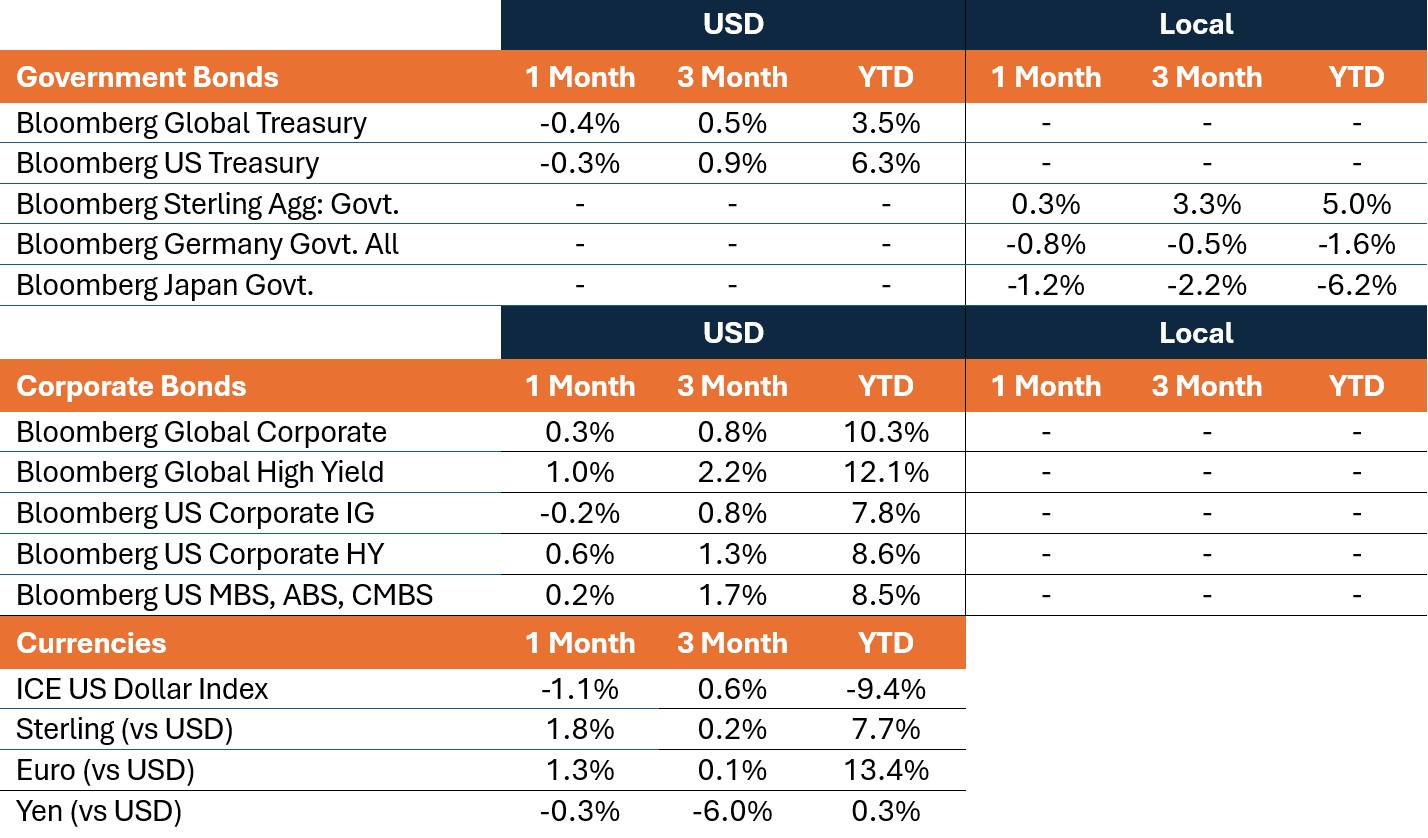
Global government bonds delivered modestly negative returns in December as yields rose across the long end of curve in most regions. Spread sectors fared better amid light volume and largely positive risk sentiment into year end.
- The Bloomberg Global Treasury Index fell 0.4% in U.S. dollar terms.
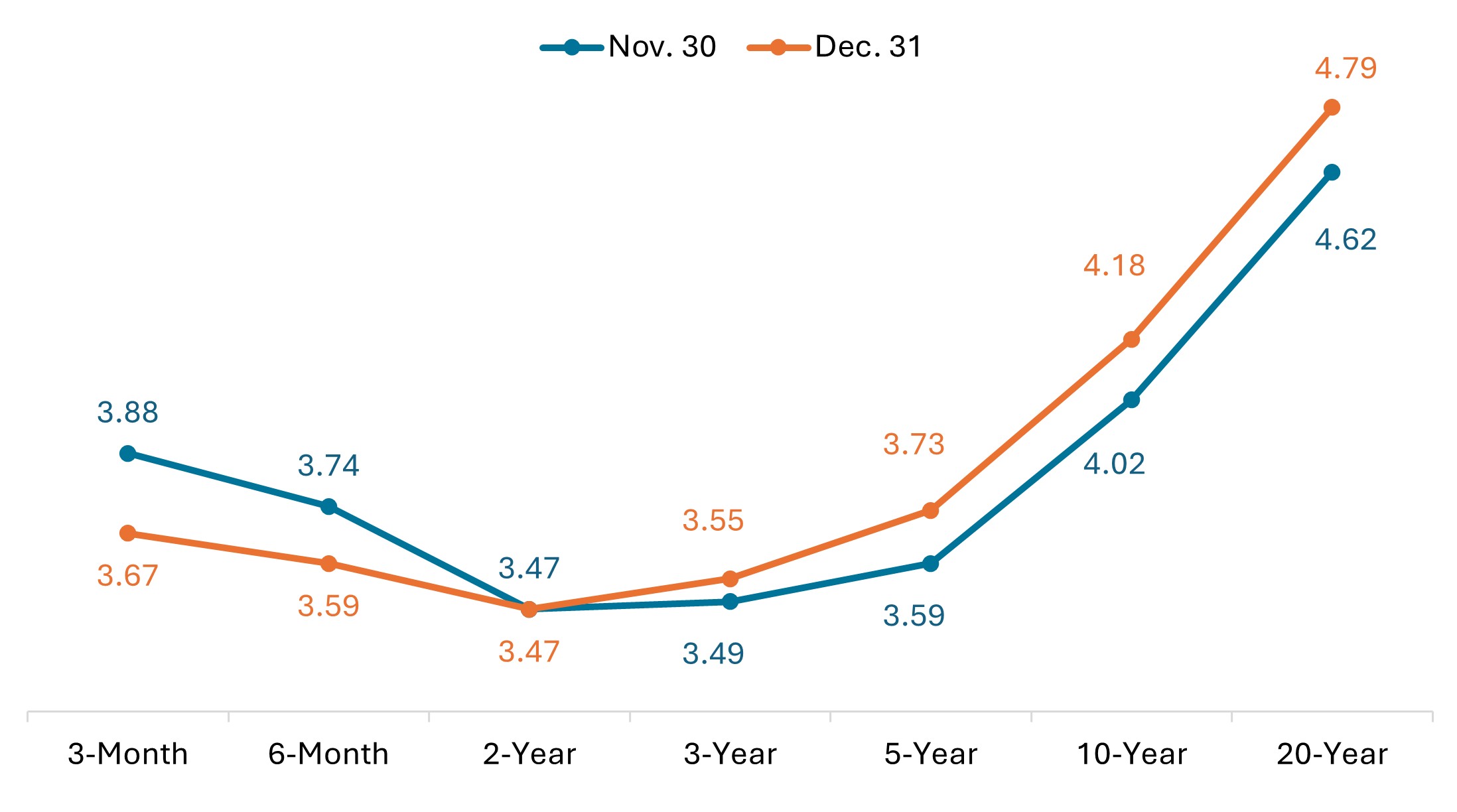
- The U.S. Treasury curve bull-steepened, with front-end rates falling in the wake of the Fed’s December 10 rate cut, while longer-dated yields rose. 10-year Treasury yields rose 16 bps but remain within the narrow range seen since August.
U.S. Treasury yield curve (month-on-month change)
Source: Bloomberg, U.S. Treasury.
- In Europe, German government bonds underperformed, with 10-year Bund yields rising 17 bps to their highest level in two years.
- In the UK, 10-year Gilt yields rose a more modest 4 bps, with focus shifting to the Bank of England’s 2026 policy path after it delivered a December rate cut but noted future decisions will be a closer call.
- Yields continued to march higher in Japan after the BoJ hiked interest rates in a continuation of monetary policy normalization. The yield on the 10-year JGB rose 23 bps, reaching its highest level since 1999.
Global long-dated bond yields stay higher for longer
G7 long-dated bond yields continued to rise in 2025 despite central bank rate cuts; German Bund yields were the highest since 2023, while the Japanese 10-year topped 2% for first time since 1999.
Source: Bloomberg, as of 31 December 2025.
Spread sectors delivered largely positive total returns in December as option-adjusted spreads (OAS) narrowed across investment-grade and high-yield benchmarks, as well as for asset-backed and mortgage-backed securities.
- The Bloomberg Global Aggregate Corporate Index rose by 0.3% in U.S. dollar terms, while the Bloomberg Global High Yield Index gained 1.0%.
- Global investment-grade spreads narrowed by approximately 3 bps, while high-yield spreads narrowed by roughly 7 bps.
- In securitized markets, asset-backed securities (ABS) and mortgage-backed securities (MBS) spreads narrowed by approximately 7 bps.
Central Bank Watch
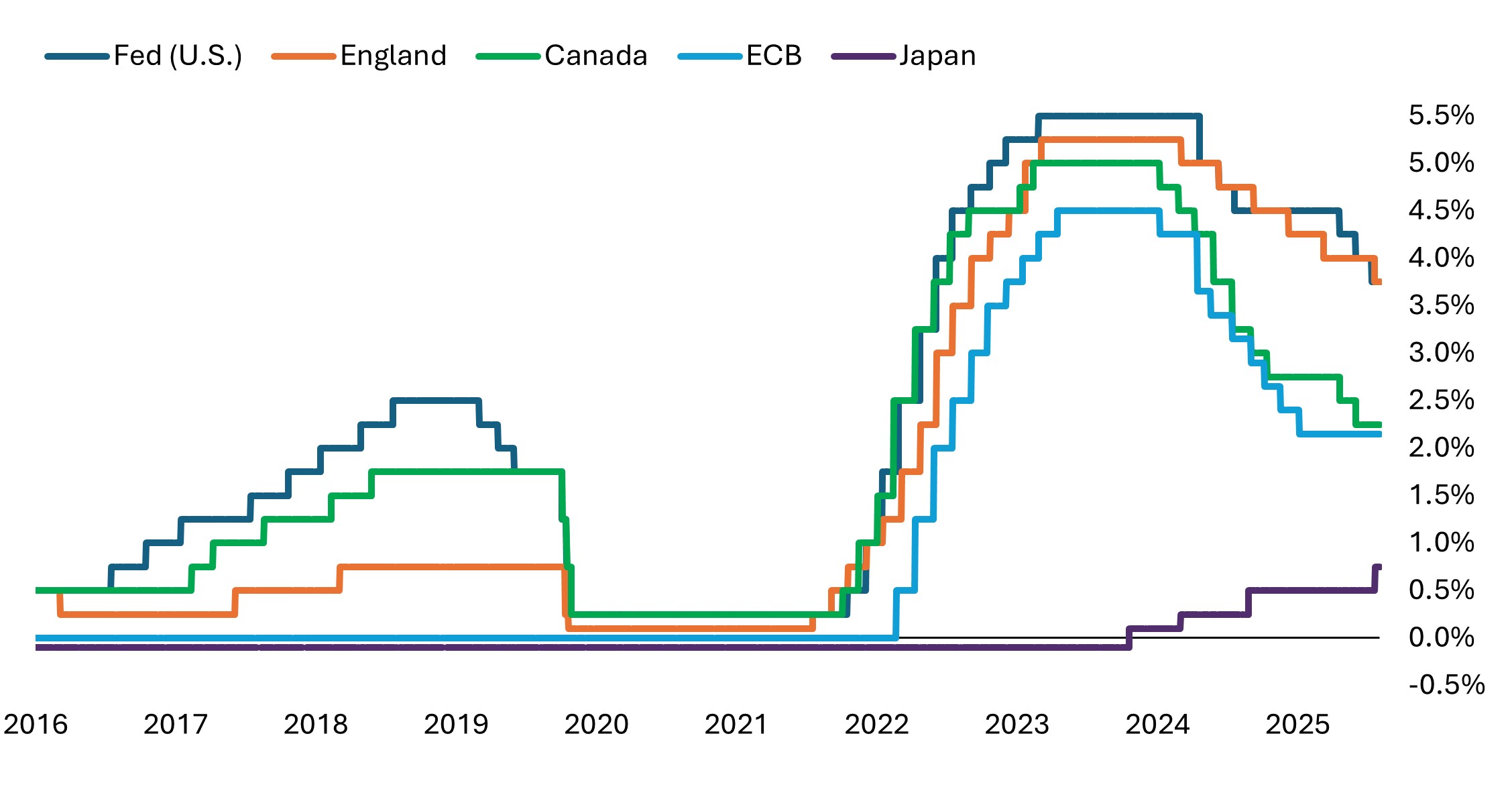
December was an extremely busy month on the monetary policy front, with a flurry of rate decisions from major central banks. Policy divergence gained traction as a prominent theme: The U.S. and UK continued on an easing path, while Europe, Canada, and Australia left rates unchanged and appear increasingly likely to remain on hold (or even hike rates) in 2026.
G7 central bank target rates
Fed and BoE keep easing on the table while ECB and Canada are likely done with rate cuts; Japan remains an outlier in hiking mode.
 Source: Bloomberg.
- Reserve Bank of Australia (Dec. 9): Kept its cash rate at 3.60% as policymakers monitored persistent inflation; Governor Bullock suggested the next move could be a hike not a cut, while the minutes showed the board discussed what would be need for a rate increase.
- Fed (Dec. 10): Cut rates by 25 bps to 3.50%–3.75%; division among Committee members rose to the fore with an unusually split 9-3 vote. After second consecutive “hawkish cut”, futures markets are largely pricing in no change in rates at the January 28 meeting.
- Bank of Canada (Dec. 10): Held overnight rate at 2.25%, citing mixed growth and inflation near target. The BoC remains data-dependent, with no clear bias toward the next move.
- Riksbank – Sweden (Dec. 17): Left rate unchanged at 1.75%; signaled likelihood for an extended pause.
- Norges Bank – Norway (Dec. 17): Maintained key rate at 4.00%; reiterated that a restrictive policy stance would likely be needed through 2026.
- BoE (Dec. 18): Trimmed its Bank Rate by 25 bps to 3.75% in a narrow 5-4 vote. Governor Bailey said further cuts will be “closer calls.”
- ECB (Dec. 18): Held deposit rate at 2.0%, reaffirming a data-dependent stance and signaling no urgency for near-term policy changes with inflation near its 2% target.
- BoJ (Dec. 19): Raised its policy rate by 25 bps to 0.75%, its highest in 30 years. While the BoJ signaled it will likely move forward with additional rate increases in 2026, economists noted some disappointment in the lack of explicit guidance on their timing.
- Emerging Markets: The People’s Bank of China held its one-year and five-year Loan Prime Rates steady at 3.00% and 3.50%, respectively, marking the seventh consecutive month of unchanged policy. The Reserve Bank of India cut the repo rate by 25 bps to 5.25%, maintaining a neutral stance. In Latin America, Brazil held rates at 15%, while Mexico cut by 25 bps to 7.0%.
Key events on tap in January
- Jan 9 – U.S. Employment (Nonfarm Payrolls, Unemployment Rate)
- Jan 13 – U.S. Consumer Price Index (December)
- Jan 19 to 23 – Annual World Economic Forum (WEF) meeting in Davos
- Jan 19 – Eurozone Consumer Price Index (December)
- Jan 20 – People’s Bank of China Rate Decision
- Jan 20 – UK Unemployment Rate (August to November)
- Jan 21 – UK Consumer Price Index (December)
- Jan 23 – Bank of Japan Rate Decision
- Jan 28 – Bank of Canada Rate Decision
- Jan 28 – FOMC (Fed) Rate Decision
- Note, President Trump is also expected to name his new Fed Chair sometime in January.
Market performance
Total returns (%), periods ended December 31, 2025
Bloomberg Asian-Pacific Japan Government-Related Index is a fixed-rate, investment grade, JPY-denominated benchmark that includes debt from government-related issuers.
Bloomberg Germany Government All Bonds Index measures the performance of German government bonds (Bunds) issued by the German government.
Bloomberg Global Aggregate – Corporate Index is a flagship measure of global investment grade, fixed-rate corporate debt. This multi-currency benchmark includes bonds from developed and emerging markets issuers.
Bloomberg Global High Yield Index is a multi-currency flagship measure of the global high yield debt market. The index represents the union of the US High Yield, the Pan-European High Yield, and Emerging Markets (EM) Hard Currency High Yield Indices.
Bloomberg Global Treasury Index tracks fixed-rate, local currency government debt of investment grade countries, including both developed and emerging markets.
Bloomberg Sterling Aggregate: Government Index measures the performance of UK government bonds (Gilts) within the broader Bloomberg Sterling Aggregate Index, which covers the investment-grade, fixed-rate, sterling-denominated bond market.
Bloomberg US Corporate Bond Index measures the investment grade, fixed-rate, taxable corporate bond market. It includes USD-denominated securities from US and non-US issuers.
Bloomberg US Corporate High Yield Bond Index measures the USD-denominated, high yield, fixed-rate corporate bond market. Bonds from issuers with an emerging markets country of risk, based on Bloomberg EM country definition, are excluded.
Bloomberg US Securitized: MBS, ABS, and CMBS Index tracks all USD-denominated, investment grade, securitized issues within the Bloomberg US Aggregate Index.
Bloomberg US Treasury Index measures U.S. dollar-denominated, fixed-rate, nominal debt issued by the U.S. Treasury.
FTSE All-Share Index reflects the equity market performance of the United Kingdom. The index includes nearly all eligible companies on the London Stock Exchange, covering large, mid, and small-cap stocks.
ICE U.S. Dollar Index is a benchmark measuring the U.S. dollar’s value against a basket of six major world currencies (Euro, Yen, Pound Sterling, Canadian Dollar, Swedish Krona, Swiss Franc).
MSCI AC Asia Pacific ex Japan Index reflects the equity market performance of the Asia Pacific region, excluding Japan, covering both developed and emerging markets.
The MSCI ACWI ex USA Index captures large- and mid-cap representation across 22 of 23 developed markets (excluding the US) and 24 emerging markets countries.
MSCI Emerging Markets Index reflects the equity market performance of emerging markets.
MSCI Europe Index reflects the equity market performance of large and mid-sized companies listed in developed markets in Europe.
MSCI Europe ex UK Index reflects the equity market performance of large and mid-sized companies listed in developed markets in Europe excluding the United Kingdom.
MSCI United Kingdom Index reflects the equity market performance of large and mid-sized companies listed in the UK market.
MSCI World Index captures large- and mid-cap representation across 22 of 23 developed markets countries, excluding the United States.
MSCI World ex USA Index reflects the equity market performance of global developed markets excluding the United States.
NASDAQ Composite Stock Index: National Association of Securities Dealers Automated Quotation System (NASDAQ) is a nationwide computerized quotation system for over 5,500 over-the-counter stocks. The index is compiled of more than 4,800 stocks that are traded via this system.
Nifty 50: An Indian stock market index that represents the float-weighted average of 50 of the largest Indian companies listed on the National Stock Exchange.
Nikkei 225 Index (also known as Nikkei Stock Average): A measure of Japanese equity market performance. The index includes 225 of the largest companies listed on the Tokyo Stock Exchange.
Russell 1000® Growth Index reflects the performance of U.S. large-cap equities with higher price-to-book ratios and higher forecasted growth values.
Russell 1000® Value Index reflects the performance of U.S. large-cap equities with lower price-to-book ratios and lower forecasted growth values.
Russell 2000® Index reflects the performance of U.S. small-cap equities.
Russell 2500™ Growth Index reflects the performance of U.S. small to mid-cap equities with higher price-to-book ratios and higher forecasted growth values.
Russell 2500™ Value Index reflects the performance of U.S. small to mid-cap equities with lower price-to-book ratios and lower forecasted growth values.
S&P 500® Index reflects U.S. large-cap equity performance and represents broad U.S. equity market performance.
S&P 500® Equal Weight Index (EWI) is the equal-weight version of the S&P 500. The index includes the same constituents as the capitalization weighted index, but each company is allocated a fixed weight – or 0.2% of the index total at each quarterly rebalance.
S&P/ASX 200 Index reflects the performance of the 200 largest, most liquid companies listed on the Australian Securities Exchange (ASX).
STOXX Europe 600 Index: An index of the 600 largest listed stocks in the European equity market, comprising 17 countries and 11 industries
TOPIX: A capitalization-weighted index of all the companies listed on the First Section of the Tokyo Stock Exchange and is widely regarded as a broad benchmark for Japanese stock prices.
10-year bond: A bond that is set to mature (repay the principal value) in 10 years.
Agency Mortgage-backed Securities (Agency MBS): A type of asset-backed security that is specifically secured by a collection of mortgages.
Asset-backed Securities (ABS): These are financial instruments that are backed by a pool of assets—typically those that generate a cash flow from debt, such as loans, leases, credit card balances, or receivables.
Basis point: One basis point (bp) equals 1/100 of a percentage point, 1bp = 0.01%.
Bund yield: Bund yields are viewed as benchmark yield indicators for European government bonds; those with a 10-year maturity are considered to be the German equivalent of U.S. Treasury bonds.
Commercial Mortgage-backed Securities (CMBS): A type of mortgage-backed security that is secured by the loan on commercial real estate properties rather than residential real estate.
Consumer Price Index (CPI): A measure that examines the price change of a basket of consumer goods and services over time. It is used to estimate inflation.
Credit spread: The difference in yield between securities with similar maturity but different credit quality. Widening spreads generally indicate deteriorating creditworthiness of corporate borrowers, and narrowing indicate improving.
Curve/Yield curve: A yield curve plots the yields (interest rate) of bonds with equal credit quality but differing maturity dates. Typically bonds with longer maturities have higher yields.
The Federal Open Market Committee (FOMC) is the body of the Federal Reserve System that sets national monetary policy.
Fiscal policy: Describes government policy relating to setting tax rates and spending levels. Fiscal policy is separate from monetary policy, which is typically set by a central bank.
Gilt yield: Gilt yields are viewed as benchmark yield indicators for United Kingdom government bonds; those with a 10-year maturity are considered to be the UK equivalent of U.S. Treasury bonds.
High yield bond: Also known as a sub-investment grade bond, or ‘junk’ bond. These bonds usually carry a higher risk of the issuer defaulting on their payments, so they are typically issued with a higher interest rate (coupon) to compensate for the additional risk.
Inflation: The rate at which the prices of goods and services are rising in an economy. The Consumer Price Index (CPI) and Retail Price Index (RPI) are two common measures.
Investment grade bond: A bond typically issued by governments or companies perceived to have a relatively low risk of defaulting on their payments, reflected in the higher rating given to them by credit ratings agencies.
JGB yield: JGB yields are viewed as benchmark yield indicators for Japanese government bonds; those with a 10-year maturity are considered to be the Japanese equivalent of U.S. Treasury bonds.
Monetary policy: The policies of a central bank, aimed at influencing the level of inflation and growth in an economy. Monetary policy tools include setting interest rates and controlling the supply of money. Dovish policy aims to stimulate economic growth by lowering interest rates and increasing the money supply. Hawkish policy aims to curb inflation and slow down growth in the economy by raising interest rates and reducing the supply of money.
Securitization: The process in which certain types of assets are pooled so that they can be repackaged into interest-bearing securities. The interest and principal payments from the assets are passed through to the purchasers of the securities.
U.S. Treasury securities are direct debt obligations issued by the U.S. Government. Treasury Bills and U.S. Government Bonds are guaranteed by the full faith and credit of the U.S. government, are generally considered to be free of credit risk.
Yield: The level of income on a security over a set period, typically expressed as a percentage rate. For equities, a common measure is the dividend yield, which divides recent dividend payments for each share by the share price. For a bond, this is calculated as the coupon payment divided by the current bond price.