
Key takeaways:
- ESG considerations are reshaping how people think about investing, with a growing recognition of the meaningful financial impact they have on company performance.
- A lack of clearly defined industry-wide terms for ESG investment styles has led to confusion. We see five categories and favour an ‘integration’ based approach.
- We believe ESG integration should be thoughtful, practical, research-driven, and forward-looking. Approached in this way it can have a meaningful positive impact on long-term investment returns.
Our ESG integration approach: Thoughtful, practical, research-driven and forward-looking
ESG stands for environmental, social and governance. These three categories are reshaping how people think about investing around the world. This is based on a growing recognition of the financial impact ESG can have on company cash flows, valuations, cost of capital, and ultimately investment returns.
At a glance:
- Environmental criteria examine how a company manages risks and opportunities relating to environmental challenges. Considerations include carbon emissions, waste, impacts and dependencies on deforestation and biodiversity loss.
- Social criteria focus on how a company treats its key stakeholders, particularly its employees. Considerations include human capital management, diversity, equity and inclusion opportunities, health and productivity of workspaces, and rules around product mis-selling to customers.
- Governance criteria examine how a company is governed, who makes decisions, and who is accountable. Considerations include executive remuneration, tax practices and strategy, and board diversity and structure.
An ‘integrated’ approach to ESG is the consideration of E, S and G factors that can directly influence the long-term financial success of a company.
Are ESG factors ‘financially material’?
The term ‘materiality’ is used to describe the importance that is attributed to specific environmental or social factors. An ESG issue is material if it affects (or could affect) the future value of a company. Which ESG issues are financially material can vary significant between companies and industries. For example, a material ESG metric that may influence the future value of an industrial company is how it deals with environmentally toxic waste. If the company does not dispose waste in an environmentally sustainable manner, it may be exposed to litigation, fines, loss of reputation and loss of customers. However, this issue will be largely immaterial for a software company where social issues, such as how it manages cybersecurity concerns, might be more critical to its future success.
At the heart of ESG investing is the simple idea that evaluating and understanding a company from both traditional financial analysis and ESG financial materiality analysis allows for a complete perspective of a company’s future performance than either alone.
While the focus is often on the risks of ESG, there are also many opportunities presented. Companies that are improving on critical ESG measures or are exposed to ESG-driven growth trends could represent attractive investment opportunities. For instance, a company that is at the forefront of developing a lower-carbon version of its products may be better positioned to gain market share.
Importantly, ESG analysis is not just about what a company is doing today. Consideration of future trends is critical and should include how a company manages issues such as climate change or technological progress.
How can ESG investment views be expressed?
ESG investing includes a range of approaches, which are often used in combination as part of an overall portfolio approach. To make things harder, there are differences in how people use certain terms across the industry with no agreed upon standardised definitions.
At Janus Henderson, we see five main approaches and, in general, favour an ESG integrated approach.
Figure 1: ESG investment styles
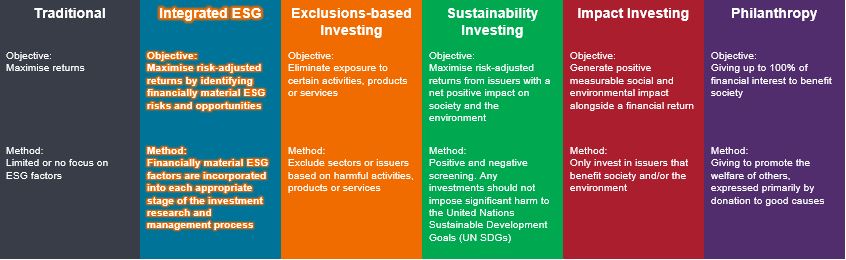
For actively-managed portfolios, ESG integration can helps investors maximise risk-adjusted returns. Some asset owners want to invest for a purpose beyond just financial outcomes; for these clients asset managers offer a range of ESG-focused strategies – an ESG-objectives alongside a financial objective.
Why is ESG so important?
At Janus Henderson, we believe consideration of financially material considerations is vital to long-term sustainable risk-adjusted returns and is consistent with our fiduciary duty to clients. We believe ESG integration is all the more important given the scale and extent of disruptive megatrends, such as climate change or the rise of artificial intelligence. Such challenges can represent substantial long-term financial risks and opportunities to investor portfolios.
Our approach to ESG integration has been crafted to be thoughtful, practical, research-focused, and forward-looking. When evaluating a company, we consider its products and services, its behaviour, conduct, supply chain management, and other considerations in running a business. Our ESG analysis considers not only a company’s current ESG practices, but also its strategy and future commitments.
Figure 2: ESG integration within the investment process
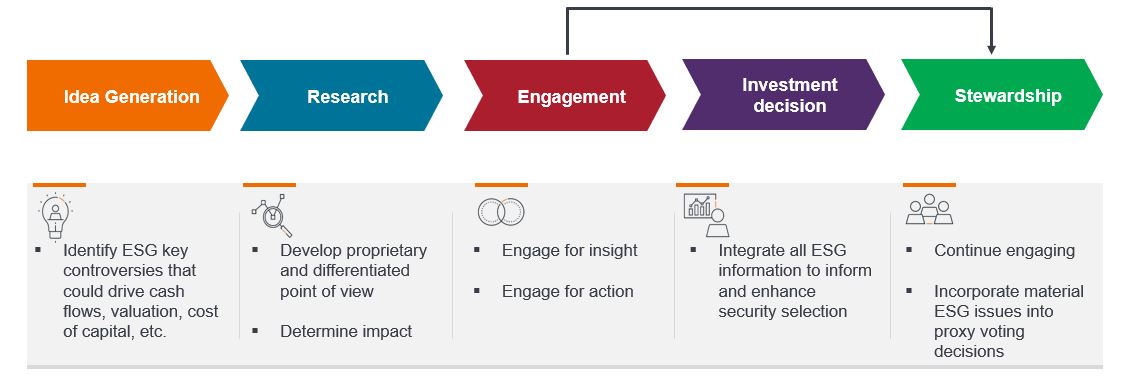
At Janus Henderson, we leverage our differentiated research to drive optimal outcomes for our clients. Research on financially material ESG themes from our central Responsibility Team and investment teams is integral to the generation of actionable investment insights. As part of our Knowledge Shared approach, we share the research and views of our investment teams as articles, videos, and white papers on our website.
Through our engagements, we leverage our access to portfolio companies to conduct research for insight, but also for action to help these companies create long-term value by encouraging companies to manage financially material ESG risks and opportunities. Such research is integral to Janus Henderson’s DNA and helps us with our aim of generating sustainable long-term returns.
While we generally apply an ESG ‘integrated’ approach in our portfolios, we recognise that many clients want us to go further and implement specific ESG objectives. For those clients, we have built a suite of focused strategies that marry an emphasis on sustainable investment with financial considerations.
We care about ESG because we are passionate about fulfilling our fiduciary duty to our clients to help them meet their long-term financial goals and aspirations. We believe the integration of financially material ESG factors into our investment research and management process enables us to achieve this.
Footnote:
Sustainable Development Goals (SDGs): the United Nation’s 17 interlinked Sustainable Development Goals are a call for action by all countries to promote prosperity while protecting the planet. They address global challenges, including poverty, inequality, climate change, environmental degradation, and peace and justice, and are intended to be achieved by 2030.
IMPORTANT INFORMATION
Sustainable or Environmental, Social and Governance (ESG) investing considers factors beyond traditional financial analysis. This may limit available investments and cause performance and exposures to differ from, and potentially be more concentrated in certain areas than the broader market.