Chart to Watch: Japan’s rate reset creates opportunities in financials
Japan’s gradual shift away from ultra-low interest rates is reshaping the outlook for banks and insurers. Higher rates and rising bond yields are lifting net interest income and investment returns for financials, translating into higher earnings and profits beyond direct AI beneficiaries, according to portfolio managers Junichi Inoue and Julian McManus.
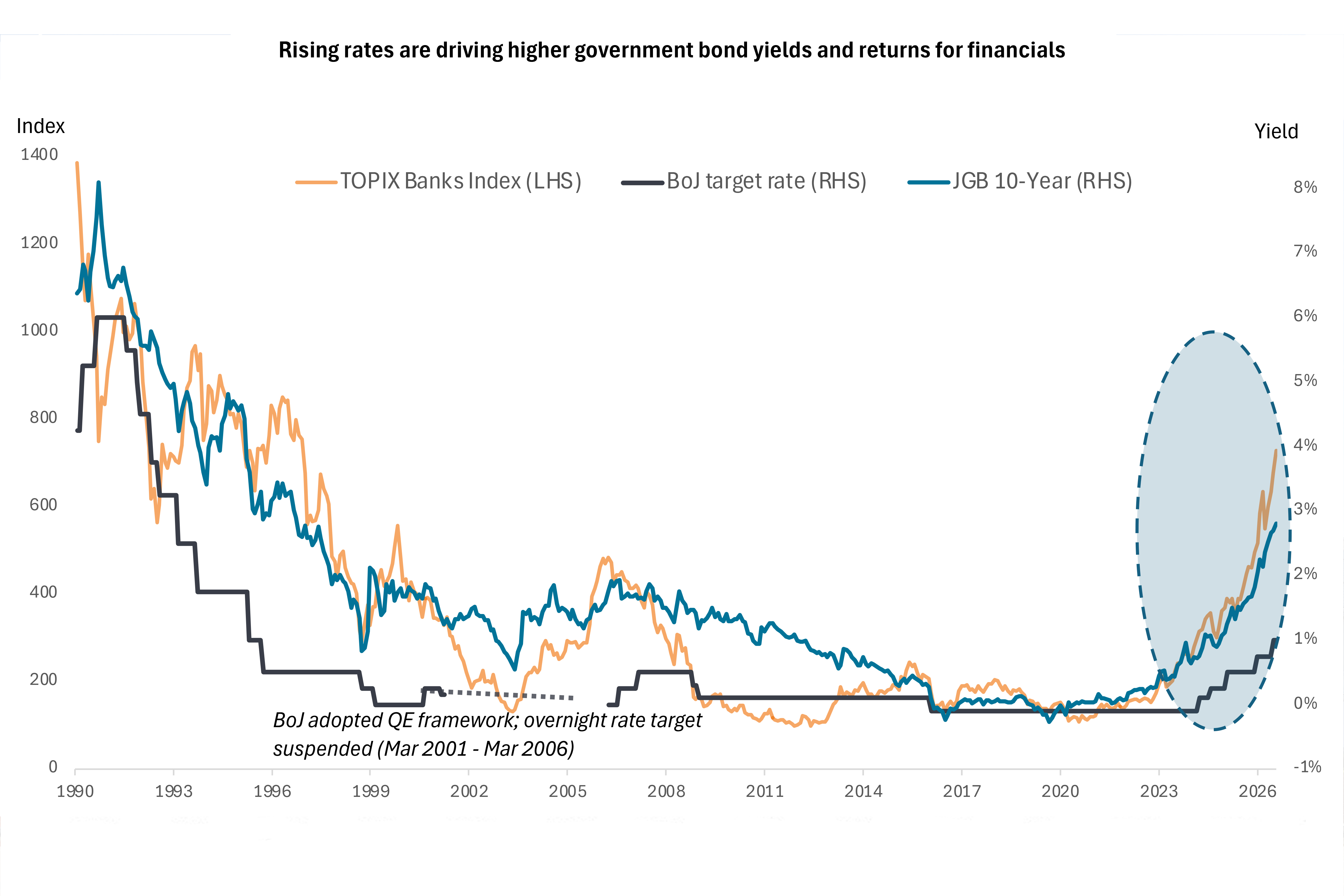
Source: Bloomberg, Janus Henderson Investors as at 31 July 2026. Between March 2001 and March 2006, the Bank of Japan suspended its overnight rate target and instead implemented quantitative easing, targeting the level of bank reserves held at the central bank to combat deflation and support economic activity. Yields may vary and are not guaranteed.
For banks and insurers, Japan’s rate normalisation marks a structural shift from a low-return environment to one that offers a clearer path to improved profitability. We saw this recently with Japanese companies delivering a strong set of earnings for the April-June quarter, and in particular, for banks.1 This shows profit growth is broadening out beyond semiconductors, to other sector like financials. With stronger market expectations for additional rate hikes this year, pressure on the BoJ to tighten policy to strengthen the yen, and a positive outlook for corporate earnings, we think the case for Japanese stocks remains very attractive. The initial phase of Japan's rate normalisation has helped lift a broad range of sectors and companies. As rates move higher, however, we expect greater differentiation between winners and losers, creating a more fertile environment for active stock selection.
Key takeaways
- Japan's rate normalisation is creating a more supportive environment for financials, with higher interest rates and bond yields benefiting bank profitability and insurer investment income.
- Earnings growth is broadening beyond AI-related sectors and exporters, with Japanese banks among the beneficiaries of a structural shift away from decades of ultra-low interest rates.
- Stronger market expectations for rate hikes this year, pressure on the BoJ to tighten policy to strengthen the yen, and a positive outlook for corporate earnings combine to make a compelling case for Japanese equities.
Japan is one of the few developed markets where rising interest rates can be viewed as a positive for equities, particularly within the financial sector. After decades of ultra-low rates, the Bank of Japan (BoJ) began normalising policy in March 2024, ending negative interest rates and abandoning yield curve control. Since then, Japanese government bond yields have risen, creating a more supportive earnings environment for banks and insurers.
For banks, higher rates equate to higher net interest margins, allowing them to charge more interest on floating-rate loans and new lending. For example, among the largest banks, Mitsubishi UFJ and Sumitomo Mitsui both estimate that a 25-basis-point increase in the policy rate may possibly add around ¥100 billion to their annual net interest income.2 Meanwhile, for insurers higher rates generate stronger investment income potential for the sector, shifting the main revenue driver from underwriting to investments.
IMPORTANT INFORMATION
Equity securities are subject to risks including market risk. Returns will fluctuate in response to issuer, political and economic developments.
1 JP Morgan, Japan Equity Strategy, 15 August 2026.
2 S&P Global.com, Japan banks to get a boost as central bank resumes monetary policy normalization, 19 December 2025.
Bond yield: The level of income on a security expressed as a percentage rate. For a bond, this is calculated as the coupon payment divided by the current bond price. There is an inverse relationship between bond yields and bond prices. Lower bond yields mean higher bond prices, and vice versa.
Deflation: A decrease in the price of goods and services across the economy, usually indicating that the economy is weakening. It differs from ‘disinflation’, which implies a decrease in the level of inflation. Deflation is the opposite of inflation.
Floating rate loan: A floating interest rate refers to a variable interest rate that changes over the duration of the debt, with the interest rate typically based on a reference, or benchmark, rate that is outside of any control by the parties involved.
Japanese government bond (JGB): A bond issued by the Japanese government to borrow money from investors.
Monetary policy tightening: Refers to central bank activity aimed at curbing inflation and slowing down growth in the economy by raising interest rates and reducing the supply of money.
Net interest margin: The difference between the interest a bank earns on loans and securities and the interest it pays on deposits and funding.
Policy normalisation: Phasing-out of central banks’ unconventional monetary policies for example zero- or low-interest rates and purchases of short-term government bonds to stimulate the economy.
Quantitative easing: An unconventional monetary policy used by central banks to stimulate the economy by boosting the amount of overall money in the banking system.
Yield curve control (YCC): A central bank policy targeting long-term interest rates as opposed to typical short-term rate setting. Aiming to stabilise long-term rates, encourage borrowing and investment to support economic growth, YCC targets specific bond yields, while QE influences general financial conditions.
These are the views of the author at the time of publication and may differ from the views of other individuals/teams at Janus Henderson Investors. References made to individual securities do not constitute a recommendation to buy, sell or hold any security, investment strategy or market sector, and should not be assumed to be profitable. Janus Henderson Investors, its affiliated advisor, or its employees, may have a position in the securities mentioned.
Past performance does not predict future returns. The value of an investment and the income from it can fall as well as rise and you may not get back the amount originally invested.
The information in this article does not qualify as an investment recommendation.
There is no guarantee that past trends will continue, or forecasts will be realised.
Marketing Communication.