Multi-asset credit
An active approach to capturing opportunities across global fixed income sectors.
Why Multi-Asset Credit matters now
The global fixed income universe is vast, spanning numerous sectors and industries, each with different credit and interest rate risks. A Multi-Asset Credit strategy aims to allow investors to maximise risk-adjusted returns and diversification by allocating flexibly to the most compelling opportunities.
How our Multi-Asset Credit strategy works
Capturing global opportunities
Actively positioning the portfolio to access a breadth of sectors and diversification.
Optimal risk blend
Balancing fixed income risk exposures with the aim of supporting smoother returns and delivering resilient outcomes across different market environments.
Aiming to deliver consistent income
Dynamically allocating to maximise yield per unit of volatility.
Delivered competitive risk-adjusted returns
The chart compares annualised return and volatility over three years, five years and since inception, illustrating the strategy’s aim to improve risk-adjusted outcome versus a core bond benchmark.
Multi-Asset Credit risk/return profile versus Global High Yield
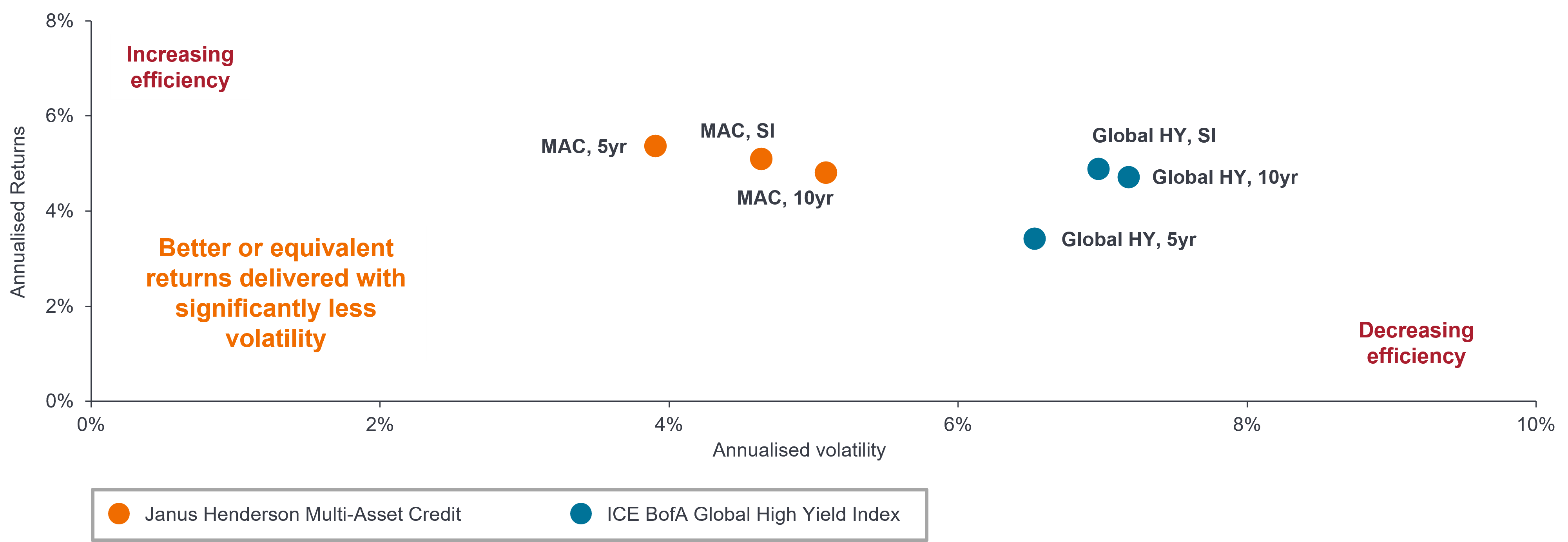
Source: Janus Henderson Investors, as at 30 April 2026.
Note: Janus Henderson Multi-Asset Credit: Representative account representative share class (Net GBP). Since inception (SI) date June 2012.
Global high yield comparator: ICE BofA Global High Yield Index. Periods over one year are annualised. Fees can have a material impact on the value of your investment. Past performance does not predict future returns.
Calendar year returns
| Performance (%) | 2025 | 2024 | 2023 | 2022 | 2021 | 2020 | 2019 | 2018 | 2017 | 2016 |
|---|---|---|---|---|---|---|---|---|---|---|
| Multi-Asset Credit Rep Account Rep Share Class (Net GBP) | 7.04 | 8.12 | 10.78 | -4.97 | 3.44 | 1.76 | 4.71 | 1.03 | 3.63 | 5.54 |
| SONIA | 4.37 | 5.27 | 4.78 | 1.43 | 0.07 | 0.39 | 0.82 | 0.67 | 0.34 | 0.52 |
Source: Janus Henderson Investors, as at 31 March 2026.
Note: Janus Henderson Multi-Asset Credit: Representative account representative share class (Net GBP). Since inception (SI) date June 2012.
Benchmark: SONIA (Sterling Overnight Index Average) having transitioned from 3m LIBOR on the 1st October 2021. The benchmark is used to compare performance. Periods greater than one year are annualised. Past performance does not predict future returns.
Our competitive edge
Global platform
Pioneers of multi-sector credit strategies since 2012, supported by a global investment team with deep sector expertise and comprehensive relative value insights.
Dynamic sector allocation
We adopt an agile, active approach, utilising sector outlooks and proprietary quantitative tools to inform relative value opportunities and adapt seamlessly to evolving market conditions.
Our best ideas
We seek the best part of the capital structure and use our knowledge of an issuer or sector from the loan market to the bond market and vice versa.
Why Janus Henderson for Fixed Income?
- Rigorous fundamental analysis, deep experience, and advanced quantitative tools combine to provide the perspective needed in seeking to generate high-conviction ideas and identify relative value.
- From pioneering securitised strategies to advancing active fixed income ETFs, innovation is core to our approach.
- All this is built on the foundation of more than 40 years of delivering fixed income solutions for our clients.

The role of U.S securitised assets in the Global Financial Crisis
John Kerschner, CFA, Global Head of Securitised Products and Portfolio Manager at Janus Henderson, explores how the securitised asset market has evolved since 2008. He examines the structural reforms that followed the financial crisis and why securitised assets may offer attractive opportunities for multi-sector fixed income investors.
U.S Securitised Assets: How 2008 Compares to Today
Download the report to hear from Head of U.S Securitised Products, John Kerschner, as he provides an overview of the securitisation process, and highlights the differences between securitised markets in 2008 vs Today.