
Key takeaways:
- Today’s advisors are tasked with helping clients address financial considerations posed by increased longevity.
- While assets and meeting expenses in retirement are still relevant and necessary objectives, many non-financial considerations are just as crucial to retirees’ long-term well-being.
- A focus on “retirement wellness” – which encompasses physical, mental, social, and financial health – allows advisors to go beyond financial planning and provide true life value for clients and their families.
As longer lifespans become a growing part of the retirement planning equation, several new issues arise that investors must consider as they prepare for what lies ahead. The prospect of increased longevity adds a layer of complexity to conversations about careers, saving, investing, healthcare, and wealth transfer and legacy goals, among others.
Money underlies many – if not all – of those issues. This puts advisors in a position to help clients navigate the financial challenges presented by a prolonged retirement. But many other non-financial considerations are just as crucial to clients’ future comfort and satisfaction. These include physical and mental health, time management, and social connection.
A client’s financial plan may be strong, but if their physical, mental, emotional, and spiritual beings aren’t equally strong, all that money and planning lose much of their value. In fact, money is essentially worthless if a client can’t use it in a way that is fulfilling.
Put simply, this isn’t just financial wellness; this is holistic wellness. And it’s a topic that demands more attention as clients prepare for potentially longer – and, ideally, more satisfying – retirements.
What is retirement wellness?
Retirement wellness is a state of overall well-being encompassing physical, mental, social, and financial health that supports a fulfilling and secure life after retirement.
Some of these areas are black and white and quantitative, such as money and time. Others, like mental and social health, are grayer and more qualitative. But while the psychological, emotional, and even spiritual aspects don’t fit neatly into a spreadsheet, they are of course no less important to one’s overall wellness in retirement.
What can make these areas especially thorny is that all of them can become clouded by comparison. When investors assess their own levels of health – whether financial, physical, or otherwise – they often view themselves as worse off than others.
This reminds me of the trope of the miserable rich person. So often we see people in movies and books – or even real life – that seemingly have everything they could want but are lonely, disengaged, and miserable (Ebeneezer Scrooge being the classic example). But while it’s something of a cliché, money truly does not always equate to happiness – which is why retirement wellness cannot be measured in monetary terms alone.
How can advisors help?
Today’s advisors must take a more active role in developing the retirement wellness of their clients. Just getting the portfolio to a certain number and then sitting back, believing that your job is done, is no longer enough.
Below are three ideas that are actionable, applicable to any client, and grounded in research.
Framing
As I mentioned above, comparison can be troublesome when considering retirement wellness. Many times, we look at someone and believe they have it better than we do, whether it’s more assets, less debt, nicer cars, a better family – or all of the above (at least in our eyes). But it’s important to remember that everyone looks normal from across the street.
Research has shown that how we frame the comparative tendencies of humans can make a difference. Simply asking someone, “Are you better off?” can help. In fact, a recent survey found that, when using “better off” framing, respondents believed they used money to create joy and happiness, had more positive feelings about their financial situation, and felt that they managed their money better.1
Holistic health
As we’ve already established, retirement wellness involves a lot more than just financial health. Sonya Lutter, who is director of Financial Health and Wellness in the School of Financial Planning at the Texas Tech University College of Human Sciences, has developed a framework advisors can use to help clients view their lives in retirement more holistically and think about where changes can and should be made to enhance wellness.
Through her Wellness Wheel framework, we can see how social, mental, financial, and physical health all impact overall wellness.
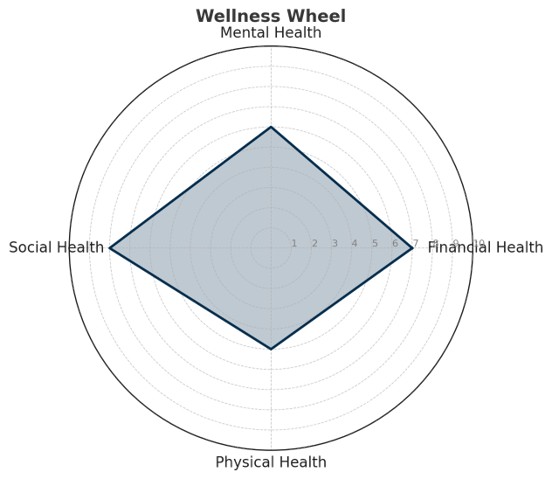
Lutter et al.’s research also shows how changes to time usage, assets, retirement, and other ideas can impact the social, mental, financial, and physical aspects of health differently.
For advisors, it’s important to recognize that trade-offs exist. For example, increasing assets clearly improves financial health, but an increase in wealth can have a negative impact on social and mental health. On the other hand, time efficiency has a positive impact on all areas of wellness. Presenting these ideas to clients might help them reevaluate their goals and reconsider using assets to outsource tasks that aren’t fulfilling.
These trade-offs and their impacts also create the opportunity to discuss a client’s goals in the short, medium, and long term. Advisors can help clients figure out which levers to pull, which then allows a client and advisor to create a plan that seeks to increase overall wellness.
Financial confidence
The “better-than” framing and the ideas within the Wellness Wheel bring us back to the basic, but important, ideas of setting goals and having a financial plan. Janus Henderson’s own research has shown that those who have clarity around their goals and have a written financial plan report lower negative stress levels.2 That financial clarity leads to financial confidence, and financial confidence can lead to improved well-being.
We all have anecdotal evidence of this from experiences with clients, but research has shown that those who are more financially confident experience less chronic stress,3 along with greater life satisfaction and better psychological functioning.4 These are all central attributes of retirement wellness.
A (longer) life worth living
In the end, advisors and clients must ask themselves: What is the goal of a financial plan? For most, it’s to increase assets, meet expenses in retirement, and achieve financial goals. And while those are still relevant and necessary objectives, I believe we may be entering an era where a financial plan should include wellness as a goal or even a primary aim.
Financial goals help create a life that we can get through. But what about a life worth living? The longer we expect to live, the more weight that question carries. A focus on retirement wellness allows advisors to go beyond financial planning guidance and provide true life value for clients and their families over the longer term.
1 Lutter, Sonya, et al. “The role of positive framing in the future of financial planning.” Financial Planning Research Journal. 2025.
2 Janus Henderson Investors. “High levels of stress impacting financial advisors and investors personally and professionally.” 2019.
3 Financial Health Network. (2023). Understanding the Mental-Financial Health Connection.
4 Hu, J., Quan, L., Wu, Y., Zhu, J., Deng, M., Tang, S., & Zhang, W. (2021). Financial Self-Efficacy and General Life Satisfaction. Frontiers in Psychology, 12.