
Key takeaways:
- For advisors who may be concerned that mentioning AI use could reduce perceived value, the data does not support that conclusion.
- Our survey findings suggest that investors may care less about whether AI is used and more about how AI is framed, governed, and connected to better advice delivery.
- Importantly, investors’ willingness to pay for advice is not simply a function of wealth. It is shaped by expectations, beliefs, comfort with technology, and how the advisor’s role is framed.
Most advisors assume fee sensitivity is primarily driven by wealth. The more assets a client has, the more willing they should be to pay for advice — or so the common assumption goes.
Our 2026 Investor Survey suggests something different.
When we gauged how investors viewed advisor services, including the use of artificial intelligence (AI), one finding stood out: The willingness to pay advisory fees appears to be driven less by wealth and more by beliefs, expectations, and how investors think about advice itself.
That has important implications for advisors. Fee resistance may not simply be a pricing problem; it may be a positioning problem.
How we tested willingness to pay
As part of our 2026 Investor Survey, we explored how investors view AI both as an investment theme and as a tool used by financial advisors in their practices. In previous posts, we examined investor views on advisor disclosure and specific AI-assisted tasks.
For this analysis, we focused on a different question:
Does an advisor’s use of AI impact how much investors are willing to pay for advice?
To test this, participants were assigned to one of four scenarios:
- Financial planner using AI
- Financial planner not using AI
- Investment advisor using AI
- Investment advisor not using AI
After reviewing their assigned scenario, participants selected the annual fee they would be willing to pay using a slider ranging from 0.25% to 2.00% of assets managed, or 25 to 200 basis points.
The headline result: AI use did not dramatically change clients’ fee tolerance.
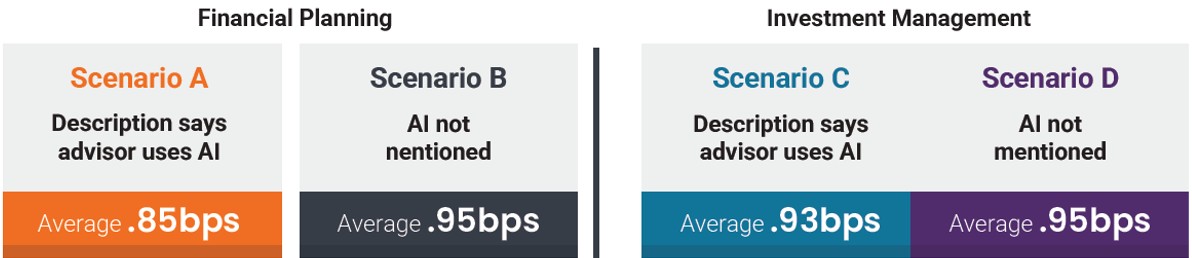
At the broadest level, the results were directionally encouraging. Investors did not appear to penalize advisors meaningfully for using AI. In both the financial planner and investment advisor scenarios, AI usage had only a modest impact on overall willingness to pay.
That matters.
For advisors who may be concerned that mentioning AI use could automatically reduce perceived value, the data does not support that conclusion. Our survey findings suggest that investors may care less about whether AI is used and more about how AI is framed, governed, and connected to better advice delivery.
But the more interesting story emerged beneath the headline results.
Key finding #1: Fee sensitivity is psychological, not just financial.
Many advisors assume wealthier clients are naturally less fee sensitive. But our data suggests that assets alone may not explain willingness to pay.
In fact, investable assets had almost no relationship to return expectations for the S&P 500 over the next 12 months or fee willingness, with correlations of roughly 0.02 to 0.03. By contrast, AI usage was positively correlated with both expected returns and willingness to pay.
The relationships were:
- AI use vs. expected returns: approximately +0.30
- AI use vs. fee willingness: approximately +0.27
- Assets vs. returns or fees: approximately +0.02 to +0.03
In practical terms, this means a pessimistic $3 million household may behave like a fee skeptic, while an optimistic $500,000 household may behave like a fee accepter.
That is a meaningful shift in how advisors should think about pricing conversations.
The question may not be, “How much does this client have?”
Instead, it may be, “How does this client think?”
Key finding #2: AI usage may signal lower fee sensitivity.
One of the most surprising findings was the relationship between personal AI usage and willingness to pay for advice.
A common assumption is that frequent AI users would be more self-directed, more comfortable doing things themselves, and therefore more resistant to advisory fees.
Our findings suggest the opposite.
Participants who used AI “rarely” or “never” had an average fee tolerance of approximately 85 basis points. Those who used AI “often” or “continually” had an average fee tolerance of approximately 113 basis points.
That does not necessarily mean that using AI makes investors willing to pay more. But it may indicate that frequent AI users are more comfortable with tech tools, more accepting of complexity, and more likely to see technology and human advice as complements rather than substitutes.
In other words, they may not be looking to replace advisors with AI; rather, they may be more likely to understand that tools are only as valuable as the judgment, context, and decision-making framework surrounding them.
Key finding #3: The advisor’s positioning matters.
Fee sensitivity is often misdiagnosed as a pricing issue. But in many cases, it may be a positioning issue.
When clients view an advisor primarily as an investment manager, the advisory fee becomes mentally linked to portfolio performance. In that frame, the fee is often evaluated against returns, benchmarks, passive strategies, and lower-cost digital alternatives.
That can create a fragile value proposition. When markets are strong, the fee may feel more acceptable. When expectations fall, fee tolerance can compress quickly.
By contrast, when clients view an advisor as a financial planner, the fee is tied to a broader set of outcomes: coordination, context, trade-off analysis, tax-aware decisions, estate planning, family dynamics, retirement income, risk management, and behavioral coaching.
That positioning can make the advisor’s value feel less dependent on short-term market performance.
The distinction is important. An advisor positioned as an investment manager is constantly defending fees against alternatives, while an advisor positioned as a planner is operating in a different category.
What this means for advisors
The practical takeaway is not that advisors should lead every conversation with AI. Rather, it is that advisors should pay closer attention to the beliefs and mental models that shape how clients evaluate value their services.
Here are three implications:
1. Stop segmenting only by balance sheet.
Net worth matters, but it may not tell the full story. Advisors should also consider softer but highly relevant indicators, such as:
- Comfort with technology
- Market expectations
- Openness to advice
- Willingness to delegate
- Appreciation for planning complexity
- Preference for integrated decision-making
These traits may provide better clues about fee sensitivity than assets alone.
2. Reframe AI as an enhancement to judgment, not a replacement for it.
Investors may be comfortable with AI when it is presented as a tool that helps advisors organize information, model scenarios, monitor risks, and improve preparation.
But it’s important to emphasize that AI does not replace the advisor. The advisor remains responsible for judgment, personalization, interpretation, and helping clients make better decisions.
This can be framed as follows:
“We use technology to improve analysis, organization, and efficiency so that our human conversations can focus more on judgment, priorities, and decisions.”
3. Lead with planning value, not performance value.
If an advisor’s value proposition is centered too heavily on investments, fees will naturally be compared to investment alternatives.
That is a difficult battle to win.
A more durable value proposition emphasizes the advisor’s role as a coordinator of complexity focused on the following:
- Helping clients clarify goals
- Connecting investment decisions to life priorities
- Anticipating risks and trade-offs
- Coordinating tax, estate, retirement, and family considerations
- Supporting better decisions during uncertainty
This shifts the conversation away from, “What does this portfolio cost?” toward “What decisions are we making better?”
The bottom line
Our research suggests that investors’ willingness to pay for advice is not simply a function of wealth. It is shaped by expectations, beliefs, comfort with technology, and how the advisor’s role is framed.
That should be encouraging for advisors.
Fee resistance is not always solved by lowering fees or adding more services. Often, it is solved by helping clients understand what kind of relationship they are actually buying. Are they paying for investment selection? Or are they paying for judgment, coordination, context, and better decision-making?
The answer to that question may determine how much value they see — and how much they are willing to pay.
In the end, fees are not determined only by what clients have. They are determined by how clients think.
