
Key takeaways:
- Our survey revealed that client acceptance of advisor AI use depends strongly on the task.
- While most clients feel good or neutral about AI supporting administrative activities, many are still uncomfortable with the idea of their advisor using AI for investment recommendations or personal communications.
- For advisors, it’s critical to be clear and specific about how AI is being implemented in their practices, while also adhering to the AI-era adage of “keeping a human in the loop.”
Our 2026 Investor Survey focused on how investors view AI within financial advisory practices and as an investment.
In my first article delving into the findings, I discussed the significant risk advisors face simply by not being transparent with clients about the use of AI in their practices. Aside from the most obvious route to transparency – talking to clients about AI – I encouraged advisors to create an inventory of the specific tasks for which they leverage AI so they can be prepared to address questions that come up in client conversations.
While this sort of exercise may seem daunting and/or unnecessary, our survey findings might convince you to take a closer look at how you’re using – and disclosing – AI in your practice.
As we did in our 2024 survey, this year we asked participants:
How would you feel if you learned that your advisor used AI (e.g., ChatGPT, Claude, Gemini) to:
- Create educational content to share with you
- Handle administrative tasks
- Provide investment recommendations
- Automatically responds to your texts or emails
Possible responses were:
- I would feel good
- I would feel neutral
- I would be upset
Comfort with advisors using AI for different tasks
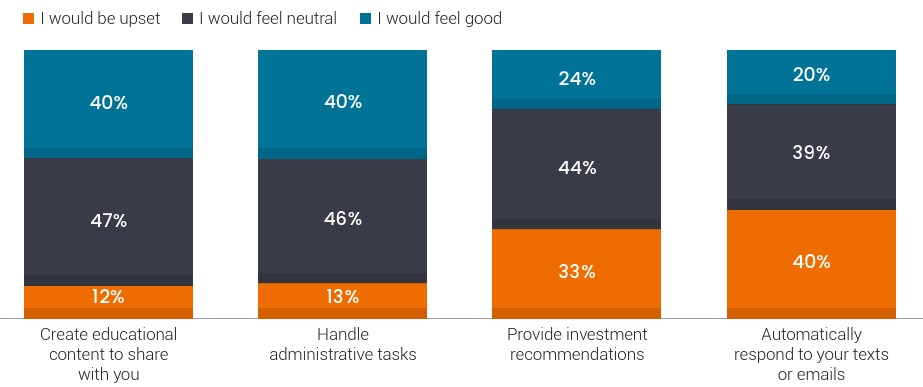
As you can see, clients’ comfort with their advisor using AI depends strongly on what it’s being used for, with most feeling good or neutral with AI supporting activities like administrative tasks and creating educational content.
On the other end of the spectrum, a significant portion of investors would be “upset” to learn their advisor used AI to provide investment recommendations or automatically respond to texts and emails.
Not automatic for the people
Through our Amplifying Human Intelligence program, I’ve had the opportunity to speak with advisors across the country about how they are using AI in their practices. I’ve heard cases where advisors have used AI to do one or more of the tasks referenced above, including draft emails or create communications after meetings. However, seeing that 40% (44% in 2024) would be “upset” to find their advisor was doing this should make all of us stop and think.
Referencing our survey findings, the use of the word “automatically” is important to note. We’ve all received automated replies to text messages and emails, whether for an appointment or a dinner reservation. Everyone knows an automated response when they see one based on how quickly it arrives (i.e., immediately) and what it says (usually a generic “canned” message). With AI and automated AI agents, advisors can now create processes through which a client email can be responded to quickly and easily. But as with a lot of things in life, just because you can do it, doesn’t mean you should.
In this case, it’s generally a good idea to adhere to the AI-era adage of “keeping a human in the loop.” It’s also important to consider why clients might be upset about this type of automatic, AI-generated response. When AI is leveraged to draft or send an email, the message can easily lose the personalization and human touch clients need and want in their relationships with advisors.
That doesn’t necessarily mean you shouldn’t use AI to help with idea generation, review, and editing. But regardless of the medium, the client conversation should retain some friction and personalization.
What would you say … you do here?
The other idea where we saw negative sentiment around AI is when it comes to providing investment recommendations. In this case, I would have loved to be able to ask respondents “why” they feel negative about this idea. But my guess is that it speaks to how investors view the value of financial advisors and the services they provide.
It’s not difficult to imagine clients asking, “If you’re using AI to make investment recommendations, then what would you say you do here, and what am I paying you for?”
Again, just as with client communications, I think the personalization aspect cannot be discounted. If advisors are using AI to come up with investment ideas, investors may feel as if their personal situation is not being considered. (In fact, research backs this up: As I discussed in a recent article, when it comes to portfolio recommendations, AI has been shown to fall short of human advice.)
They want the truth
In all the potential use cases of AI, the key is transparency. Our survey found that, among those investors working with or planning to work with an advisor, 85% expect their advisor to be responsible for AI-driven outputs and 79% would be upset if AI use was not disclosed.
Being clear and specific about how these processes work within your practice, how they help improve efficiency, and how they affect clients should be the main goal of this transparency. If you’re using AI to draft emails, be up front about it and explain exactly how it is being done. If you are using it for investment research and decisions, explain the process involved. Importantly, using AI for any task should always allow advisors to spend more time with clients – and clients should be made aware of how that benefits them.
Having spoken to advisors across the country, many of those who have discussed AI usage in their practices with clients have noted to me that the conversations have gone well if it is framed correctly. So yes, clients want the truth and they can handle it.
Having these conversations sooner rather than later is crucial. We are all getting caught up in the AI wave, and I fear that if we don’t discuss how the technology is being implemented by advisors, we will reach a point where clients may just view everything as AI.
That’s one of the primary reasons we developed our Amplifying Human Intelligence program: to help advisors think about ways to use AI that drive them back into human interaction. It is my belief that, in the age of AI, being able to use high-tech tools to support high-touch client relationships will be the primary way advisors differentiate themselves.

Artificial intelligence (“AI”) focused companies, including those that develop or utilize AI technologies, may face rapid product obsolescence, intense competition, and increased regulatory scrutiny. These companies often rely heavily on intellectual property, invest significantly in research and development, and depend on maintaining and growing consumer demand. Their securities may be more volatile than those of companies offering more established technologies and may be affected by risks tied to the use of AI in business operations, including legal liability or reputational harm.