
Key takeaways:
- An emotionally charged period like an election cycle can bring investors’ deep-seated cognitive biases to the surface and allow politics to get in the way of sound financial planning.
- Attachment bias, herding, confirmation bias, and overconfidence can cause investors to make irrational decisions based on their political beliefs.
- Understanding these biases can promote open dialogue with clients and help them stay focused on their long-term plan.
I’m not exactly sure how the upcoming midterm elections will shake out. What I am quite sure of is that emotions will run high.
For advisors, what becomes difficult is predicting how specific investors will react and then being able to help manage those emotions. And since emotional decision-making typically leads to worse investment outcomes when we look at historical long-term portfolio returns (see Exhibit 1), this behavioral management is a critical aspect of helping clients meet their financial goals.
To effectively address investor emotions, it’s helpful to understand how and why these feelings arise. To that end, following are three of the most common cognitive biases that impact investors during election season. Not only does understanding these biases allow advisors to educate investors on what to look out for, but it also creates a space to have a more open dialogue about how clients are feeling and the best ways to move forward.
Attachment bias (political identity bias)
An emotional predisposition that causes an individual to act irrationally toward people or objects to which they have an emotional attachment.
During elections, it doesn’t matter if you’re a registered Democrat, Independent, or Republican; we all have emotional attachments to the candidates from our chosen party.
During elections, political identity bias may manifest as a specific form of attachment bias. As a result, someone’s political affiliation can become a mental shortcut for assessing the policies of candidates, the results of an election, and the future economic consequences of those results.
This may change the lens through which an investor judges a certain idea. Instead of thinking “I prefer this policy,” a person may think “I am a Republican/Democrat” first. When this occurs, an investor’s identity may shift from “I’m a long-term investor” to “I’m a Republican/Democrat”
That change in perspective, and the red or blue lens that is then used to process information, can lead to significant changes in the thinking process one uses to consider an issue. It may look like the following:
Identity –> interpretation of information –> economic expectations –> investment decision
You can see how the starting point might impact all the next points along the decision process. How someone identifies themself then impacts the immediate positive or negative feeling associated with something, and that could lead to short-term emotional decisions when we use that identity as a mental shortcut to make decisions.
Taken to its extreme, if this attachment bias were to function as an investing strategy, investors would only invest during the administrations of their favored party. Showing investors exactly how this might play out is a great way to help them overcome this bias.
The chart below illustrates an investor would have fared from 1977 to June 30, 2024, if they only invested in the S&P 500® Index during the administration of their preferred political party. We compare this to a bipartisan investor who invests in the S&P 500 throughout the period indicated, regardless of who is in office.
Exhibit 1: Results of partisan investing (1977 – Sept. 30, 2026)
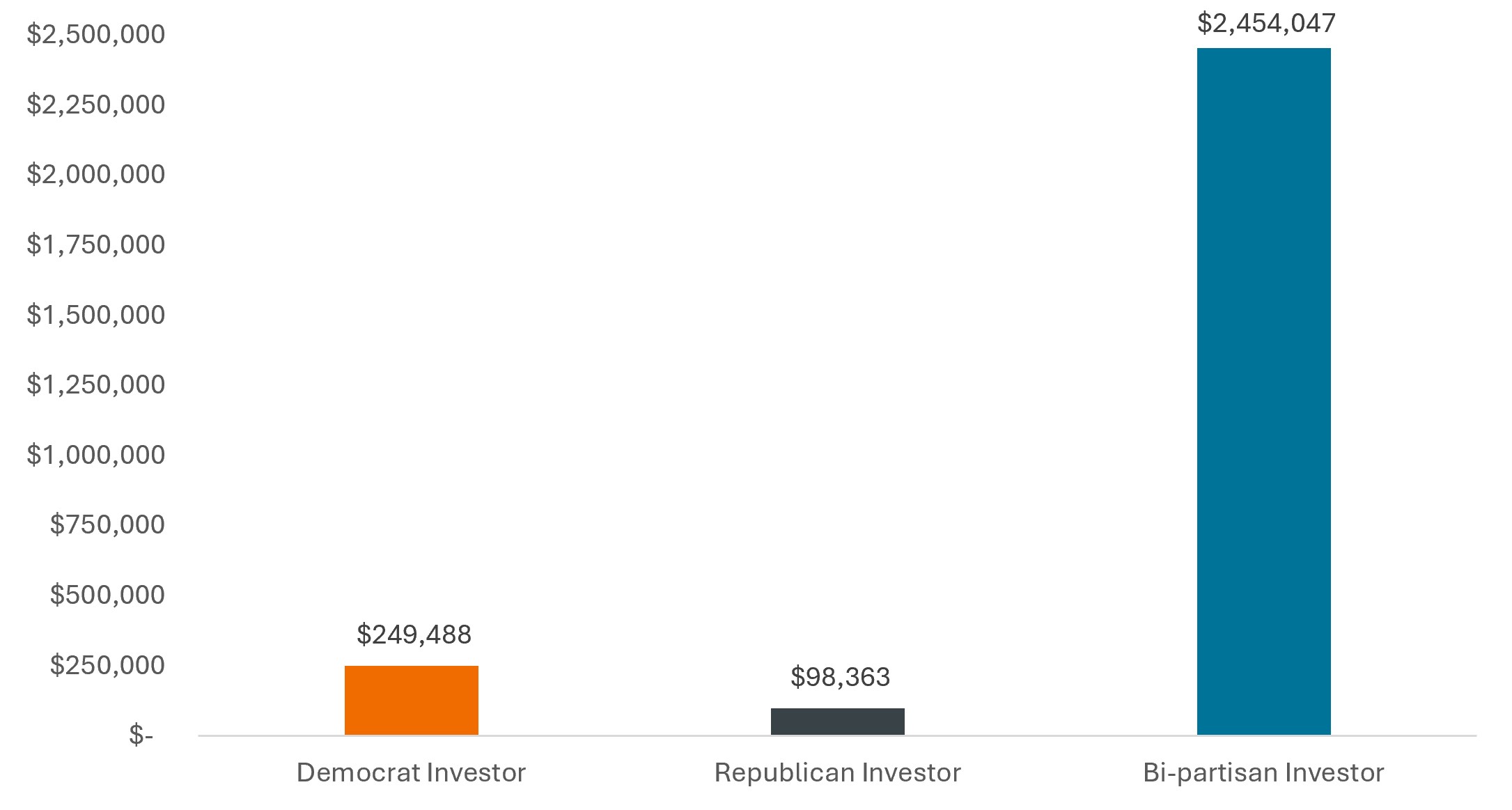
Assumes investors makes initial investment of $10,000 in S&P 500® Index only during Democrat/Republican administration and moves to cash (no return) during opposite party’s time in office. Past performance does not guarantee future results.
Here’s another question to ask clients to help create perspective:
“Do you disagree with or dislike [Candidate X’s policies]?”
Disagreement assumes some level of consideration; disliking assumes a more emotional response. We can see how the second part of the question (do you dislike) uses a person’s overall emotional evaluation of a candidate as a shortcut for evaluating a specific financial decision.
Confirmation bias
The tendency for individuals to seek out information that supports their preexisting beliefs and avoids information that could contradict their already held beliefs.
We all increasingly fall victim to this bias as more information is available to us, especially as that information is more frequently driven by algorithms on websites and social platforms that track our preferences and feed them back to us. The resulting echo chamber makes this bias very difficult to combat. I’m sure if someone believes that 2+2=5, there is a website out there that will confirm it.
For voters, those preexisting beliefs align with their party’s vision for the future. When asked to consider the positive attributes of the opposing candidate’s platform, they may immediately disregard those ideas. Then, to avoid feeling any cognitive dissonance, they might seek out a favored news site and social media feed for stories that support the party’s platform.
As Francis Bacon put it: “The human understanding when it has once adopted an opinion … draws all things else to support and agree with it.”1
Thus, an investor who supports a particular candidate may believe that Candidate X’s policies will be good for the economy and markets, whereas Candidate Y’s policies will be terrible for markets. This can be a problem, because the investor is starting from the conclusion and finding information to support it. They aren’t analyzing facts through a neutral lens.
That’s why it’s important for investors to view their advisor as a source of balanced, non-biased information that can help them make well-informed decisions. It’s also important for advisors to plant the seed early on in a client relationship that during periods like an election, when this bias can surface, they may bring up ideas that can spark debate but ultimately create greater perspective for the client.
Overconfidence
Cognitive bias characterized by an overestimation of one’s actual ability to perform a task successfully … or by excessive certainty in the accuracy of one’s beliefs[ii].
When investors consider an upcoming election, they may be making two forecasts associated with this one event, the first being the outcome of the election and the second how financial markets will respond to that outcome. There may also be a third, that being how long the market response will last.
An investor can be correct about the first prediction and still wrong about the second.
For example: “I know who will win” doesn’t imply “I know what stocks/investments will do well.”
And: “I know what stocks will do immediately afterward” doesn’t imply “I know what they will do six months later.”
The issue for investors may occur when they find out their predictions are wrong. For example, investors who show signs of overconfidence may respond with action bias, which makes them feel as if they need to do something. Many times, those responses are outsized and can lead to major deviations from preset asset allocations or a long-term financial plan.
In this case, using a Defaults frame from the MINDSPACE framework may be useful, as it helps us communicate with clients at an emotional level and leverages our proclivity for pre-set options. In this case, you might say:
“I understand the urge to sell, but remember that you will have to be right twice: once when you sell and again when to reenter after the election. For that reason, I recommend we stick with the plan and allow this market cycle to play out.”
Herding
The tendency of individuals to follow the behavior of others, often without independent analysis or decision-making. This behavior is driven by the belief that the collective actions of a group are more likely to be correct or beneficial, leading individuals to conform[iii].
Whether you’re part of the donkey or elephant herd, the group mentality can be particularly strong during an election. The regular news stream, which is already significant during an election, can unleash a flood of partisan sentiments during an election. Unfortunately, this leads investors to get carried away when “everyone” seems to be freaking out or ecstatic about the results of the election and their impact on the market.
During periods when herding and the emotional decisions that go along with it may be high, using the MINDSAPCE framework may again be helpful. In this case, the Norms frame, which leverages how we are influenced by what others do, may help a client gain perspective. In this case, you might say:
“While each situation is different, most of our clients (both Democrats and Republicans) are staying the course.” (Cite anonymous examples if appropriate.)
This framing helps put some space between the emotion that’s taken hold of a client and a decision. It allows them to get to a point where they are in a calmer, more future-oriented state of mind, which should allow you to revisit concerns in the context of their long-term goals with clearer eyes.
Emotions have no place in a long-term financial plan
These are just a few of the biases and mental shortcuts that many, if not all, of us will succumb to during the midterm election cycle. Others, like recency bias, availability bias, negativity bias, and narrative bias are also likely.
For advisors and clients, whatever the bias is, the important thing to remember is that recognizing these biases and maintaining perspective when they arise allows for clearer, more rational long-term thinking. And while politics is inherently emotional, those emotions should have nothing to do with your long-term financial plan.
2 American Psychology Association, APA Dictionary of Psychology.
3 “Expert insights on herd instinct.” UC Riverside School of Business. August 2024.