
Key takeaways:
- While the Huang story was shocking for many to see, it’s far from uncommon: History is full of companies and leaders who, like Icarus, flew too close to the sun and paid the price.
- The case is a prime example of how overconfidence bias – and its more extreme form, hubris – can lead investors to disregard tried-and-true principles like diversification.
- By understanding their investing boundaries and knowing the risks, investors can maintain a steady flight to their financial goals without getting burned by hubris.
First the midterms and now this … my jaw is bruised from hitting the floor so often over the past two weeks.
The Jensen Huang story has been shocking for all of us to watch. A man who seemed to have it all figured out, and who had been able to successfully navigate the tightrope of business and politics for more than three decades as head of Nvidia, one of the most richly valued companies in the world. And then it all came crashing down in a matter of days.
While Huang’s downfall may feel like an unprecedentedly spectacular saga, I think it’s extremely important to remind ourselves that this is not a new story. We have seen the story play out dozens if not hundreds of times in the past.
Just off the top of my head, we had Enron, Theranos, FTX, WeWork, Richard Nixon, Napolean, and Lance Armstong. Whether it was business, politics, war, or sports, each of these companies or leaders, like Icarus, flew too close to the sun and paid the price.
And guess what? We will see stories like this again in the future.
Don’t get burned by overconfidence and hubris
So, what are the lessons investors should take from this latest Icarian tale?
From a behavioral finance standpoint, the Jensen case is a prime example of overconfidence bias. This is the tendency to feel more confident in our own abilities, including our ability to make sound moral judgments. This could be telling ourselves we’re better drivers than most people, believing we’re better investors since we’ve had success in the past, or convincing ourselves we won’t get caught because we’ve done it before and nothing bad happened.
From there, overconfidence can lead to hubris. While overconfidence is believing too much in your ability, hubris occurs when that confidence becomes so great that you stop respecting limits.
For investors, these biases could play out like this:
Overconfidence: “My portfolio has done well because I’m a good investor.”
Hubris: “I’ve been right for so long that I don’t need to diversify.”
Unfortunately, as we know from the examples above, even the best things can’t last forever. The sun of our own success gets too hot, and we get burned when the market inevitably shows us how important diversification actually is.
So, how can we help ensure we don’t get overconfident when it comes to our portfolios and our financial plans? Here are a few ideas on how to stay humble and prudent.
“Never get bored with the basics.”
This famous quote from Kobe Bryant works for many parts of life. For investors, it highlights the value of diversification. Financial professionals always talk about diversification, and it has always been a fundamental tenet of investing because it simply works. And because of this, investors should periodically rebalance their portfolios to ensure they are appropriately diversified.
While diversification is and has always been a fundamental tenet of investing, it’s perhaps even more important nowadays, as the largest companies in the S&P 500® Index today make up a larger percentage of the total than they have in the past.
S&P 500 at historically high levels of concentration
10 largest companies at year-end 2025 by market cap
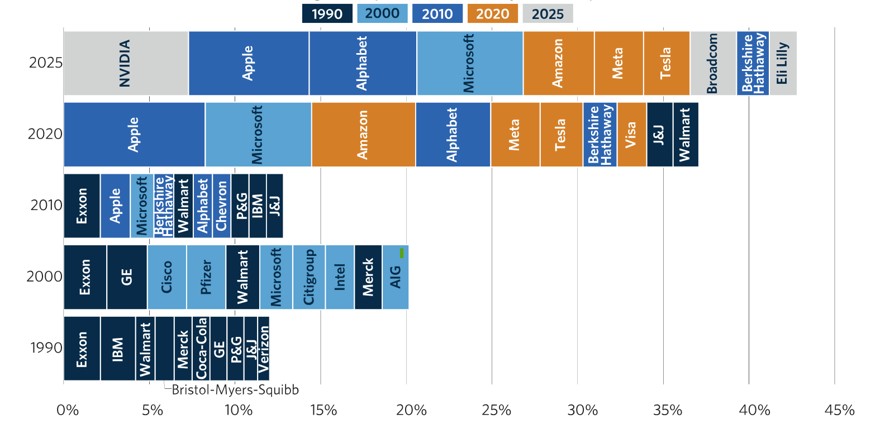
Source: Bloomberg, Yahoo Finance, EDGAR filings as of 31 December 2025.
Goals, not returns
Investors must remember that the return of a holding or their overall portfolio is not the goal. Rather, investors should be focused on how they are progressing toward their financial goals over the long term.
Imagine a couple needs a 5% long-term return in the assumptions underlying their financial plan, but their current portfolio exposes them to substantially greater risk in pursuit of potentially higher returns. In this case, they need to ask themselves: “What are we taking the additional risk for?” Even if the portfolio is providing returns well above the 5% needed, it should be reviewed periodically and possibly reallocated. This may feel illogical, but remember, Icarus just needed to escape the island of Crete; he didn’t need to fly close to the sun to do it.
Keep a level head with a predetermined exit strategy
Preset rules can also be used to ensure our psyches or portfolios don’t get too far afield. For example, our predetermined investment policy rules might dictate that we:
- Sell 10% of the position annually.
- Sell enough each year to keep the position below the agreed-upon concentration ceiling.
- Redirect dividends and new money away from the concentrated holding.
These types of rules can help us take the emotion out of investing and keep us focused on our goals instead of obsessing over every market swing.
This too shall pass
The lessons from the Huang saga could be summed up with a concept that originates from medieval Sufi poets in Persia. The phrase This too shall pass has stood the test of time, but it holds particular power today. We tend to treat today’s conditions as though they’ll persist indefinitely. They won’t.
The beauty of This too shall pass is that it’s a concept that applies both when things are going extremely well and when they’re going extremely poorly.
If things are going extremely well, we shouldn’t get overconfident. We should rebalance our portfolios, maintain a cash reserve, review how we are tracking toward our goals, and create rules for concentrated holdings.
And if things are going extremely poorly, we should maintain hope that things will get better. We should rebalance our portfolios, maintain a cash reserve, review how we are tracking toward our goals, and create rules for concentrated holdings.
And finally, I will leave you with these words from Charles de Gualle: “The graveyards are filled with indispensable men.” It’s meant as a reality check for our egos and a reminder that no one is truly indispensable. Whether it’s Jensen Huang, or Icarus, or you as an investor, we must all remember to take advice, understand our boundaries, and know the risks so we’re able to continue our flight toward our financial goals without getting burned by hubris.